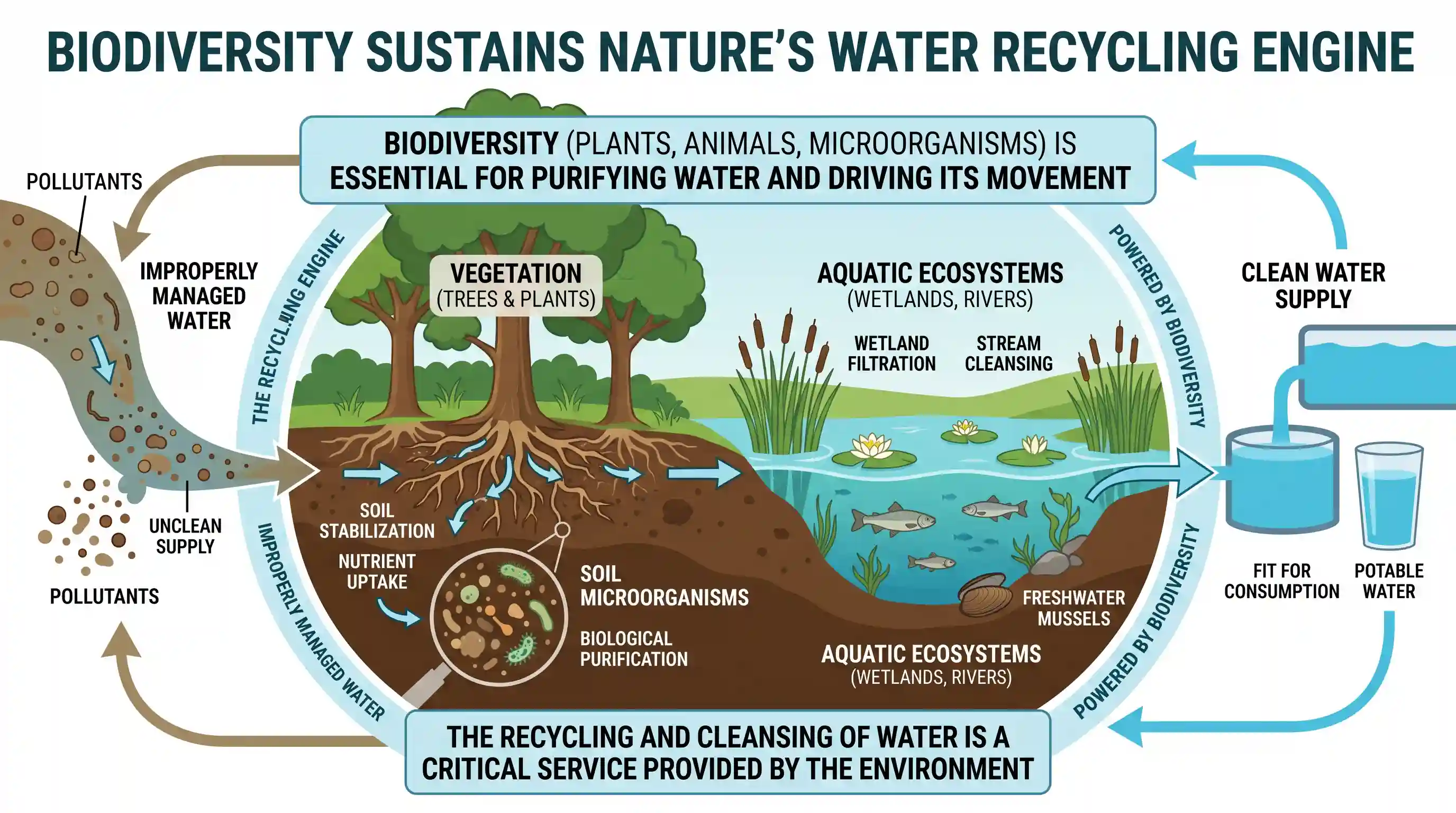
Passage-3 Understanding of the role of biodiversity in the hydrological cycle enables better policy-making. The term biodiversity refers to the variety of plants, animals, microorganisms, and the ecosystems in which they occur. Water and biodiversity are interdependent. In reality, the hydrological cycle decides how biodiversity functions. In turn, vegetation and soil drive the movement of water. Every glass of water we drink has, at least in part, passed through fish, trees, bacteria, soil and other organisms. Passing through these ecosystems, it is cleansed and made fit for consumption. The supply of water is a critical service that the environment provides. Which among the following is the most critical inference that can be made from the above passage?

- Abiodiversity sustains the ability of nature to recycle waterCorrect
- BWe cannot get potable water without the existence of living organisms
- CPlants, animals and microorganisms continuously interact among themselves
- DLiving organisms could not have come into existence without hydrological cycle
Explanation
The passage highlights the crucial role of biodiversity (plants, animals, microorganisms, and ecosystems) in the hydrological cycle. It states that "vegetation and soil drive the movement of water" and that water "Passing through these ecosystems, it is cleansed and made fit for consumption." This directly implies that biodiversity is essential for the natural processes of water movement, purification, and overall recycling. The "supply of water is a critical service that the environment provides," further emphasizing this role.
Let's analyze the options:
A) biodiversity sustains the ability of nature to recycle water This option accurately captures the essence of the passage. The passage explains how biodiversity (vegetation, soil, organisms) drives water movement and cleanses it, which are key aspects of nature's water recycling ability. This is a direct and critical inference.
B) We cannot get potable water without the existence of living organisms While the passage states that water "passed through fish, trees, bacteria, soil and other organisms" and "is cleansed and made fit for consumption," implying a vital role for organisms in natural purification, the statement "cannot get potable water" is an absolute. It doesn't account for artificial purification methods. More importantly, option A is broader and encompasses the entire recycling process, not just the final potable stage.
C) Plants, animals and microorganisms continuously interact among themselves This is a true statement about ecosystems, and interactions are implicit in the passage. However, the passage's main focus is not on these internal interactions but on the collective role of biodiversity in the hydrological cycle and providing water as a service. It's a supporting detail, not the most critical inference.
D) Living organisms could not have come into existence without hydrological cycle The passage states, "the hydrological cycle decides how biodiversity functions," indicating influence. However, it does not make a claim about the origin of living organisms or state that they could not have come into existence without the hydrological cycle. This goes beyond the scope and emphasis of the passage.
Therefore, option A is the most critical and comprehensive inference, as it directly reflects the passage's main argument about biodiversity's fundamental role in sustaining the natural water recycling process.
The final answer is A
Related questions
More UPSC Prelims practice from the same subject and topic.
- Prelims 2016CSATReading Comprehension
Accountability, or the lack of it, in governance generally, and civil services, in particular, is a major factor underlying the deficiencies in governance and public administration. Designing an effec…
- Prelims 2016CSATReading Comprehension
Accountability, or the lack of it, in governance generally, and civil services, in particular, is a major factor underlying the deficiencies in governance and public administration. Designing an effec…
- Prelims 2016CSATReading Comprehension
Accountability, or the lack of it, in governance generally, and civil services, in particular, is a major factor underlying the deficiencies in governance and public administration. Designing an effec…
- Prelims 2016CSATReading Comprehension
Accountability, or the lack of it, in governance generally, and civil services, in particular, is a major factor underlying the deficiencies in governance and public administration. Designing an effec…
- Prelims 2016CSATReading Comprehension
In general, religious traditions stress our duty to god, or to some universal ethical principle. Our duties to one another derive from these. The religious concept of rights is primarily derived from …
- Prelims 2016CSATReading Comprehension
In general, religious traditions stress our duty to god, or to some universal ethical principle. Our duties to one another derive from these. The religious concept of rights is primarily derived from …