Historically, the biggest Challenge to world agriculture has been to achieve a balance between demand for and supply of food. At the level of individual countries, the demand-supply balance can be a critical issue for a closed economy, especially if it is a populous economy and its domestic agriculture is not growing sufficiently enough to ensure food supplies, on an enduring basis; it is not so much and not always, of a constraint for an open, and growing economy, which has adequate exchange surpluses to buy food abroad. For the world as a whole, Supply-demand balance is always an inescapable prerequisite for warding off hunger and starvation. However, global availability of adequate supply does not necessarily mean that food would automatically move from countries of surplus to of deficit if the latter lack in purchasing power. The uneven distribution of Inoger, starvation, under or malnourishment, etc., at the world-level, thus owes itself to the presence of empty-pock hungry mouths, overwhelmingly confined to the underdeveloped economies. Inasmuch as 'a two-square meal' is of elemental significance to basic human existence, the issue of worldwide supply' of food has been gaining significance, in recent times, both because the quantum and the composition of demand has been undergoing big changes, and because, in recent years, the capabilities individual countries to generate uninterrupted chain of food supplies have come under strain. Food production, marketing and prices, especially price-affordability by the poor in the developing world, have become global issues that need global thinking and global solutions. According to the above passage, which of the following helps/help in reducing hunger and starvation in the developing economies? 1. Balancing demand and supply of food 2. Increasing imports of food 3. creasing purchasing power of the poor 4. Changing the food consumption patterns and practices Select the correct answer using the code given below:

- A1 only
- B2, 3 and 4 only
- C1 and 3 onlyCorrect
- D1, 2, 3 and 4
Explanation
The passage highlights two main challenges and solutions related to hunger and starvation, especially in developing economies:
-
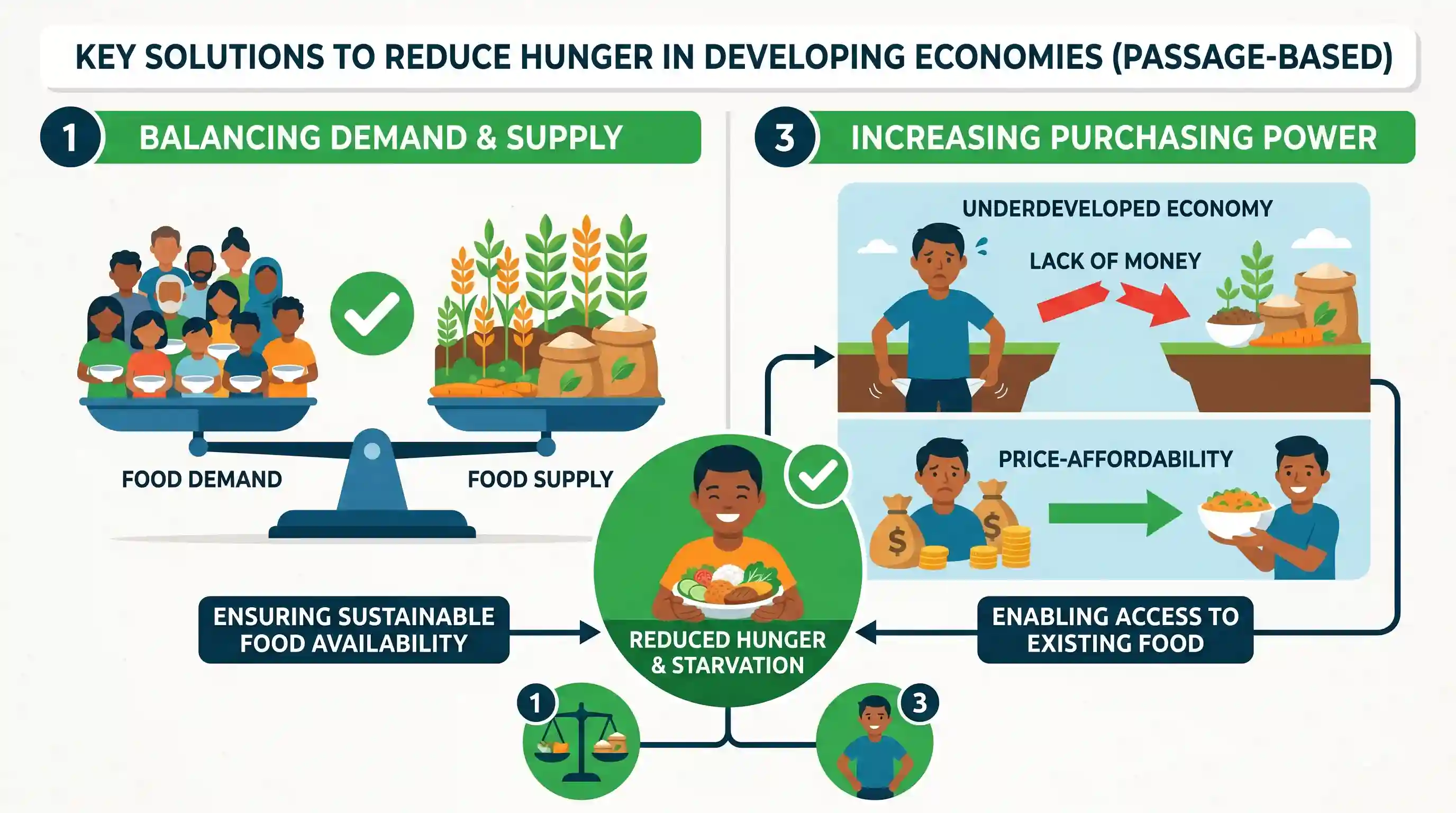
Balancing demand and supply of food: The passage states, "For the world as a whole, Supply-demand balance is always an inescapable prerequisite for warding off hunger and starvation." This directly supports statement 1.
-
Increasing purchasing power of the poor: The passage explicitly links hunger and starvation to "empty-pock hungry mouths, overwhelmingly confined to the underdeveloped economies" and states that food won't move from surplus to deficit countries "if the latter lack in purchasing power." This strongly implies that increasing the purchasing power of the poor is essential to reduce hunger. This supports statement 3.
-
Increasing imports of food: While an open economy with "adequate exchange surpluses to buy food abroad" can manage, the passage immediately qualifies this by stating that global supply doesn't help if deficit countries "lack in purchasing power." For developing economies, characterized by "empty-pock hungry mouths," simply increasing imports without addressing purchasing power isn't presented as a primary solution.
-
Changing the food consumption patterns and practices: The passage mentions that "the quantum and the composition of demand has been undergoing big changes," contributing to the challenge. However, it does not suggest that changing these patterns is a solution to reduce hunger and starvation in developing economies.
Therefore, only statements 1 and 3 are supported by the passage as ways to reduce hunger and starvation in developing economies.
The final answer is C
Related questions
More UPSC Prelims practice from the same subject and topic.
- Prelims 2016CSATReading Comprehension
Accountability, or the lack of it, in governance generally, and civil services, in particular, is a major factor underlying the deficiencies in governance and public administration. Designing an effec…
- Prelims 2016CSATReading Comprehension
Accountability, or the lack of it, in governance generally, and civil services, in particular, is a major factor underlying the deficiencies in governance and public administration. Designing an effec…
- Prelims 2016CSATReading Comprehension
Accountability, or the lack of it, in governance generally, and civil services, in particular, is a major factor underlying the deficiencies in governance and public administration. Designing an effec…
- Prelims 2016CSATReading Comprehension
Accountability, or the lack of it, in governance generally, and civil services, in particular, is a major factor underlying the deficiencies in governance and public administration. Designing an effec…
- Prelims 2016CSATReading Comprehension
In general, religious traditions stress our duty to god, or to some universal ethical principle. Our duties to one another derive from these. The religious concept of rights is primarily derived from …
- Prelims 2016CSATReading Comprehension
In general, religious traditions stress our duty to god, or to some universal ethical principle. Our duties to one another derive from these. The religious concept of rights is primarily derived from …