Which of the following practices can help in water conservation in agriculture? 1. Reduced or zero tillage of the land 2. Applying gypsum before irrigating the field 3. Allowing crop residue to remain in the field Select the correct answer using the code given below:

- A1 and 2 only
- B3 only
- C1 and 3 onlyCorrect
- D1, 2 and 3
Explanation
Let's evaluate each practice for water conservation in agriculture:
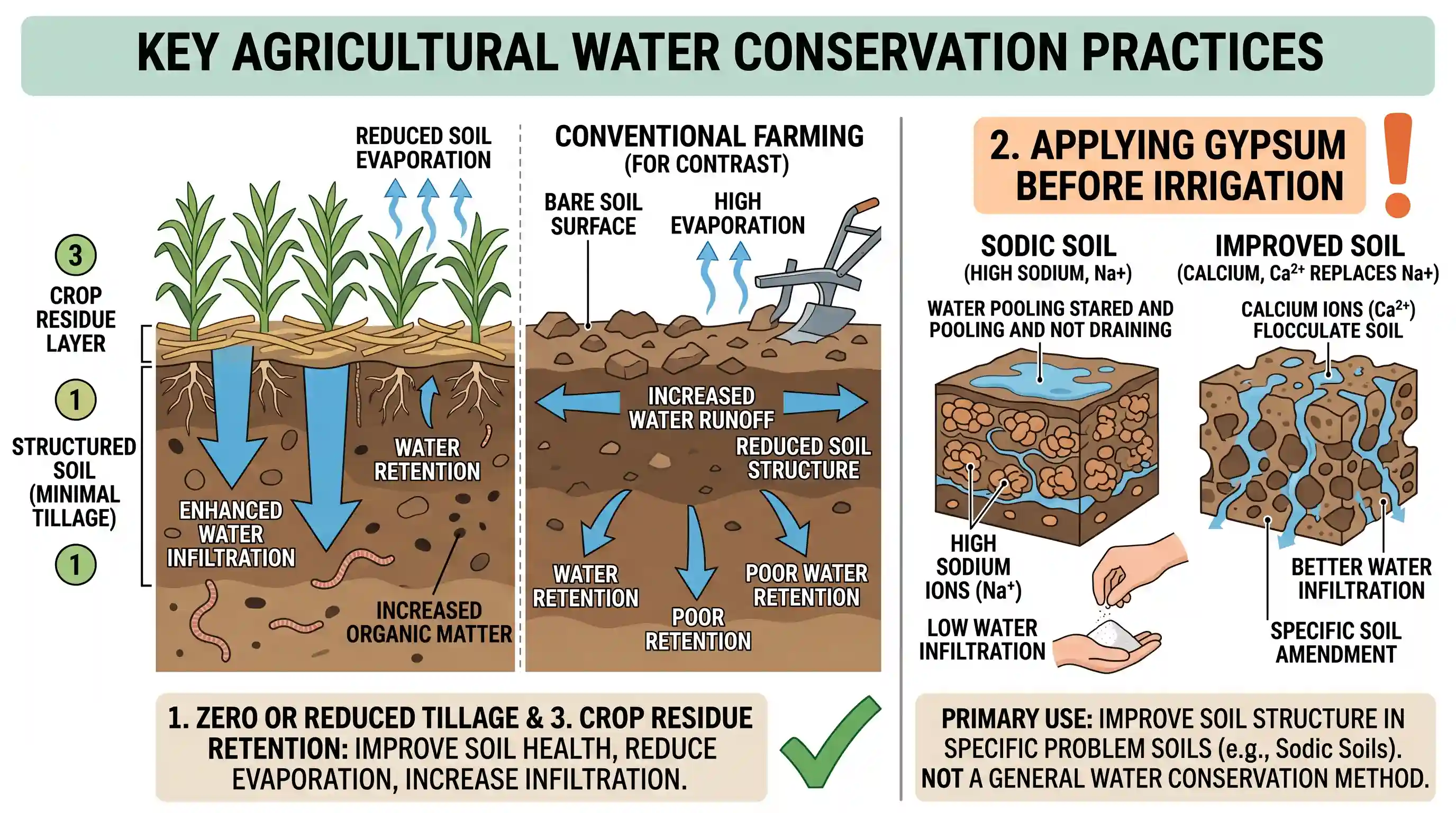
- Reduced or zero tillage of the land: This practice significantly helps in water conservation. By minimizing soil disturbance, it preserves soil structure, increases organic matter, and enhances water infiltration and retention, while reducing evaporation and runoff from the soil surface.
- Applying gypsum before irrigating the field: Applying gypsum (calcium sulfate) is primarily used to improve soil structure, especially in sodic (high sodium) and saline soils, by replacing sodium ions with calcium. While improved soil structure in such specific problematic soils can lead to better water infiltration, it's not a general water conservation practice applicable or beneficial for all types of fields or a primary method compared to other practices.
- Allowing crop residue to remain in the field: This practice, often called mulching or residue retention, is an excellent water conservation method. The residue acts as a protective cover over the soil surface, reducing direct evaporation, moderating soil temperature, suppressing weed growth (which compete for water), and improving soil organic matter, all of which contribute to better water retention and reduced irrigation needs. Therefore, practices 1 and 3 are effective for water conservation in agriculture.
Related questions
More UPSC Prelims practice from the same subject and topic.
- Prelims 2017GS1geography
From the ecological point of view, which one of the following assumes importance in being a good link between the Eastern Ghats and the Western Ghats?
- Prelims 2017GS1geography
In the context of solving pollution problems, what is/are the advantage/advantages of bioremediation technique? 1. It is a technique for cleaning up pollution by enhancing the same biodegradation proc…
- Prelims 2017GS1geography
Due to some reasons, if there is a huge fall in the population of species of butterflies, what could be its likely consequence/consequences? 1. Pollination of some plants could be adversely affected. …
- Prelims 2017GS1geography
In the context of mitigating the impending global warming due to anthropogenic emissions of carbon dioxide, which of the following can be the potential sites for carbon sequestration? 1. Abandoned and…
- Prelims 2017GS1geography
With reference to 'Global Climate Change Alliance', which of the following statements is/are correct? 1. It is an initiative of the European Union. 2. It provides technical and financial support to ta…
- Prelims 2017GS1geography
Biological Oxygen Demand (BOD) is a standard criterion for