Which of the following are not necessarily the consequences of the proclamation of the President's rule in a State? 1. Dissolution of the State Legislative Assembly 2. Removal of the Council of Ministers in the State 3. Dissolution of the local bodies Select the correct answer using the code given below:

- A1 and 2 only
- B1 and 3 onlyCorrect
- C2 and 3 only
- D1, 2 and 3
Explanation
When President's Rule is proclaimed in a State under Article 356 of the Indian Constitution, the President takes over the functions of the State government and powers vested in the Governor, and declares that the powers of the State Legislature shall be exercisable by or under the authority of Parliament.
Let's analyze the given consequences:
-
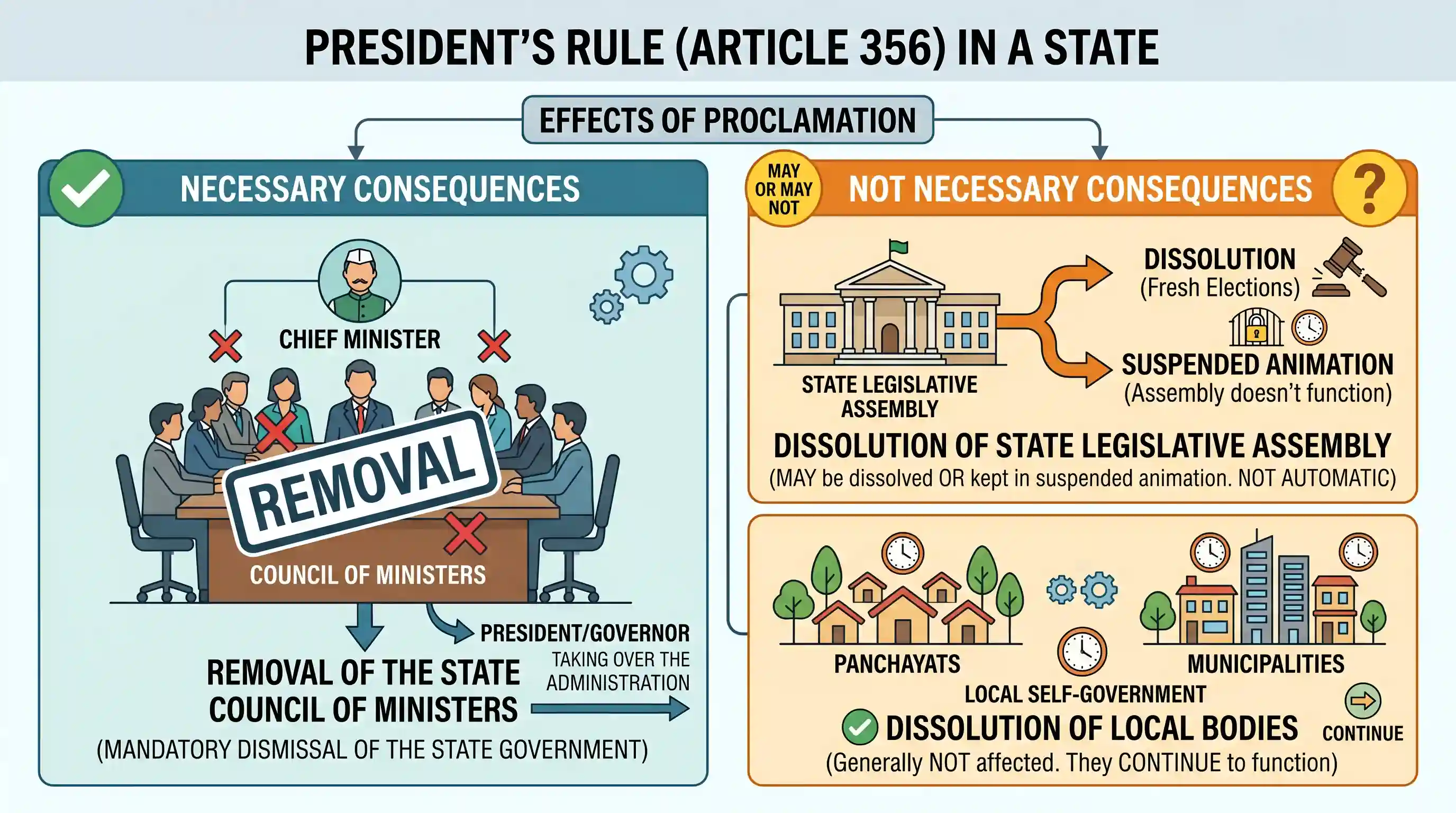
Dissolution of the State Legislative Assembly: This is not a necessary consequence. When President's Rule is imposed, the President has the option to either suspend the State Legislative Assembly (keep it in 'suspended animation', meaning it is not dissolved but cannot function) or dissolve it. Dissolution usually happens if the situation calls for fresh elections. So, it is not necessarily dissolved immediately or as a mandatory first step.
-
Removal of the Council of Ministers in the State: This is a necessary consequence. The State government, i.e., the Council of Ministers headed by the Chief Minister, is dismissed when President's Rule is imposed, and the administration is taken over by the Governor on behalf of the President.
-
Dissolution of the local bodies: This is not a necessary consequence. President's Rule primarily impacts the State Executive and Legislature. It does not automatically lead to the dissolution of local self-government bodies like Panchayats (rural local bodies) or Municipalities (urban local bodies). Their functioning generally continues as per state laws, unless specific directives are issued affecting them, which is rare as a direct consequence of President's Rule.
Therefore, statements 1 and 3 are not necessarily consequences of the proclamation of President's Rule.
Related questions
More UPSC Prelims practice from the same subject and topic.
- Prelims 2017GS1polity-and-governance
Local self-government can be best explained as an exercise in
- Prelims 2017GS1polity-and-governance
With reference to the 'Prohibition of Benami Property Transactions Act, 1988 (PBPT Act)', consider the following statements: 1. A property transaction is not treated as a benami transaction if the own…
- Prelims 2017GS1polity-and-governance
Which of the following are the objectives of 'National Nutrition Mission'? 1. To create awareness relating to malnutrition among pregnant women and lactating mothers. 2. To reduce the incidence of ana…
- Prelims 2017GS1polity-and-governance
Who among the following can join the National Pension System (NPS)?
- Prelims 2017GS1polity-and-governance
According to the Wildlife (Protection) Act, 1972, which of the following animals cannot be hunted by any person except under some provisions provided by law? 1. Gharial 2. Indian wild ass 3. Wild buff…
- Prelims 2017GS1polity-and-governance
With reference to 'Quality Council of India (QCI)', consider the following statements: 1. QCI was set up jointly by the Government of India and the Indian Industry. 2. Chairman of QCI is appointed by …