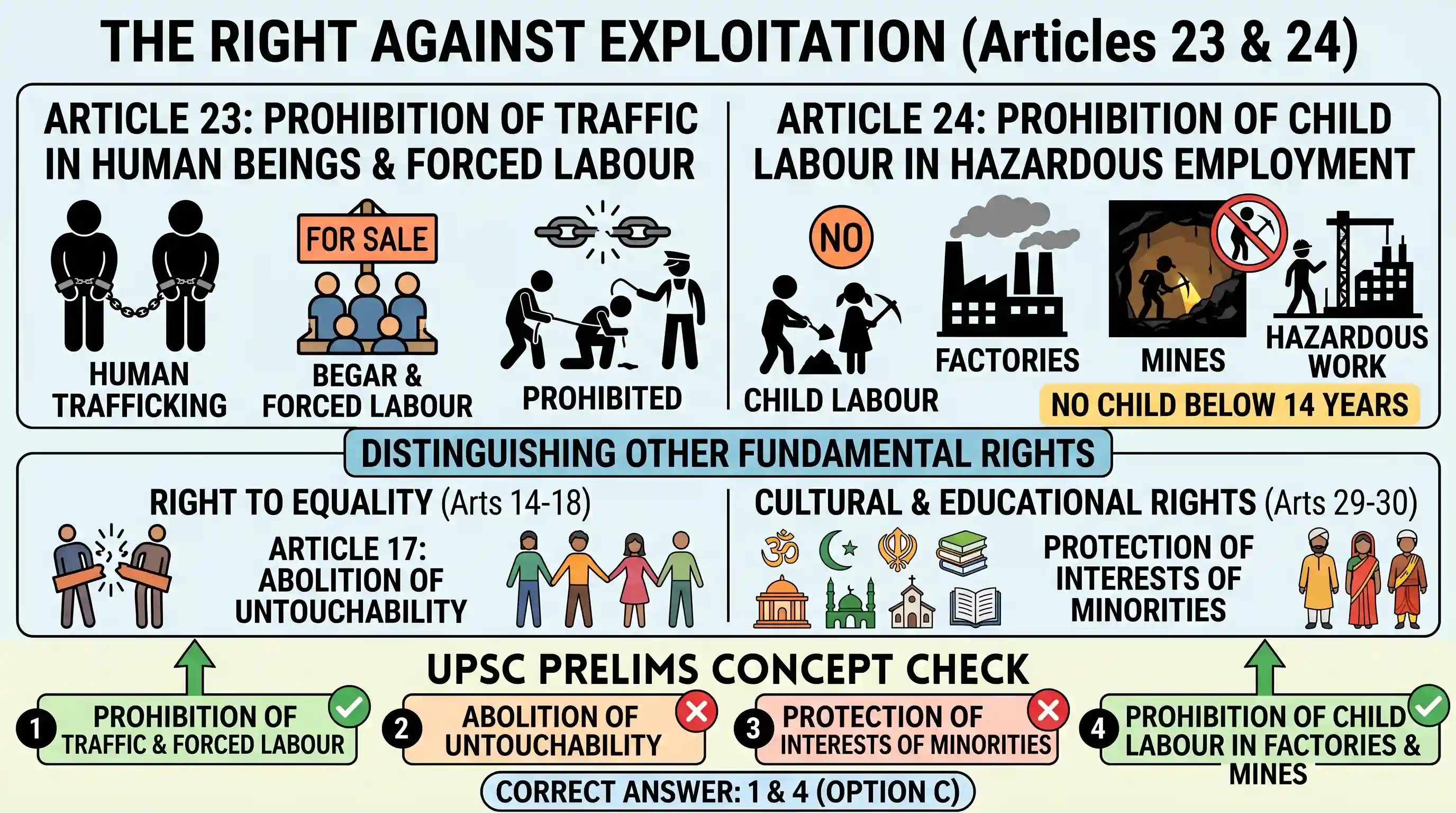
Which of the following are envisaged by the Right against Exploitation in the Constitution of India? 1. Prohibition of traffic in human beings and forced labour 2. Abolition of untouchability 3. Protection of the interests of minorities 4. Prohibition of employment of children in factories and mines Select the correct answer using the code given below:

- A1, 2 and 4 only
- B2, 3 and 4 only
- C1 and 4 onlyCorrect
- D1, 2, 3 and 4
Explanation
The Right against Exploitation is enshrined in Articles 23 and 24 of the Indian Constitution.
Let's examine which of the given points are envisaged by this right:
-
Prohibition of traffic in human beings and forced labour: This is explicitly covered under Article 23(1) of the Constitution, which prohibits 'traffic in human beings and begar and other similar forms of forced labour'. So, this statement is correct.
-
Abolition of untouchability: This is covered under Article 17, which falls under the 'Right to Equality' (Articles 14-18), not the Right against Exploitation. So, this statement is incorrect.
-
Protection of the interests of minorities: This is covered under Articles 29 and 30, which fall under 'Cultural and Educational Rights', not the Right against Exploitation. So, this statement is incorrect.
-
Prohibition of employment of children in factories and mines: This is explicitly covered under Article 24, which states, 'No child below the age of fourteen years shall be employed to work in any factory or mine or engaged in any other hazardous employment.' So, this statement is correct.
Therefore, only statements 1 and 4 are envisaged by the Right against Exploitation.
Related questions
More UPSC Prelims practice from the same subject and topic.
- Prelims 2017GS1polity-and-governance
Which principle among the following was added to the Directive Principles of State Policy by the 42nd Amendment to the Constitution?
- Prelims 2017GS1polity-and-governance
Which one of the following statements is/are correct? A) Rights are claims of the State against the citizens. B) Rights are privileges which are incorporated in the Constitution of a State. C) Rights …
- Prelims 2017GS1polity-and-governance
Consider the following statements: With reference to the Constitution of India, the Directive Principles of State Policy constitute limitations upon 1. legislative function. 2. executive function. Whi…
- Prelims 2017GS1polity-and-governance
Which of the following statements is/are true of the Fundamental Duties of an Indian citizen? 1. A legislative process has been provided to enforce these duties. 2. They are correlative to legal dutie…
- Prelims 2017GS1polity-and-governance
Which one of the following objectives is not embodied in the Preamble to the Constitution of India?
- Prelims 2017GS1polity-and-governance
In the context of India, which one of the following is the correct relationship between Rights and Duties?