India's educational system is modelled on the mass education system that developed in the 19th century in Europe and later spread around the world. The goal of the system is to condition children as 'good' citizens and productive workers. This suited the industrial age that needed the constant supply of a compliant workforce with a narrow set of capabilities. Our educational institutes resemble factories with bells, uniforms and batch-processing of learners, designed to get learners to conform. But, from an economic point of view, the environment today is very different. It is a complex, volatile and globally interconnected world. With reference to the above passage, the following assumptions have been made: 1. India continues to be a developing country essentially due to its faulty education system. 2. Today's learners need to acquire new-age skill-sets. 3. A good number of Indians go to some developed countries for education because the educational systems there are a perfect reflection of the societies in which they function. Which of the above assumptions is/are valid?

- A1 and 3 only
- B2 onlyCorrect
- C2 and 3 only
- D1, 2 and 3
Explanation
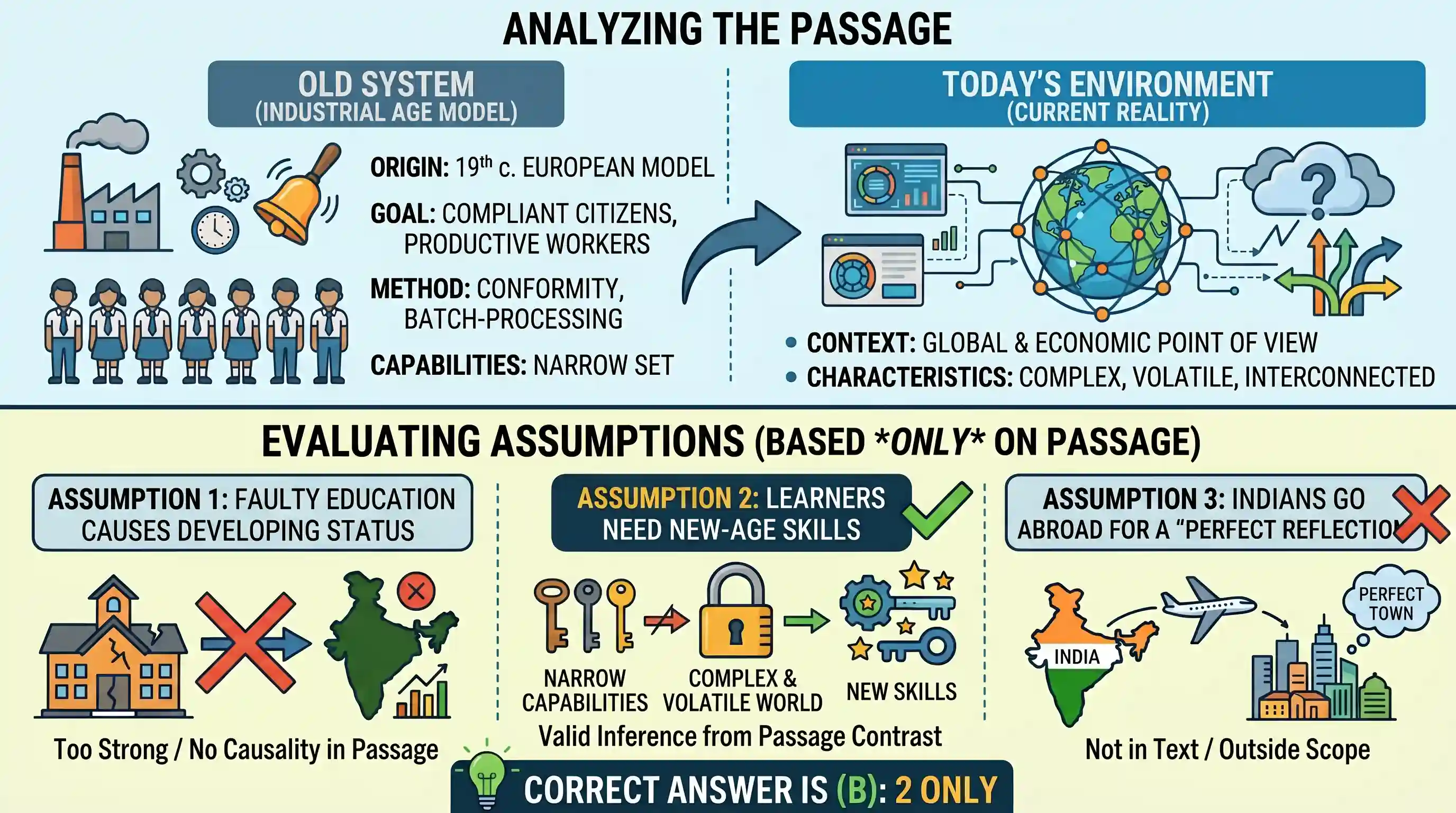
The passage describes India's education system as outdated, designed for the industrial age to produce a compliant workforce with narrow capabilities, and contrasts it with today's "complex, volatile and globally interconnected world."
Let's analyze each statement:
-
India continues to be a developing country essentially due to its faulty education system. The passage highlights a mismatch between the education system and the current economic environment. However, it does not state that this system is the essential or primary reason for India being a developing country. The word "essentially" makes this assumption too strong and goes beyond what the passage implies.
-
Today's learners need to acquire new-age skill-sets. The passage explicitly states that the old system suited an industrial age needing a "compliant workforce with a narrow set of capabilities." It then contrasts this with today's "complex, volatile and globally interconnected world," which is "very different." This strongly implies that the old "narrow set of capabilities" is insufficient and that learners now require different, "new-age skill-sets" to navigate this new environment. This is a valid inference.
-
A good number of Indians go to some developed countries for education because the educational systems there are a perfect reflection of the societies in which they function. The passage does not mention Indians going abroad for education, nor does it discuss the educational systems of developed countries or their reflection of society. This statement introduces information completely outside the scope of the provided passage.
Therefore, only statement 2 is a valid assumption based on the passage.
The final answer is B.
Related questions
More UPSC Prelims practice from the same subject and topic.
- Prelims 2018CSATReading Comprehension
Global population was around 1.6 billion in 1990- today it is around 7.2 billion and growing. Recent estimates on population growth predict a global population of 9.6 billion in 2050 and 10.9 billion …
- Prelims 2018CSATReading Comprehension
Many pathogens that cause foodborne illnesses are unknown. Food contamination can occur at any stage from farm to plate. Since most cases of food poisoning go unreported, the true extent of global foo…
- Prelims 2018CSATReading Comprehension
Though I have discarded much of past tradition and custom, and am anxious that India should rid herself of all shackles that bind and contain her and divide her people, and suppress vast numbers of th…
- Prelims 2018CSATReading Comprehension
I am a scientist, privileged to be somebody who tries to understand nature using the tools of science. But it is also clear that there are some really important questions that science cannot really an…
- Prelims 2018CSATReading Comprehension
It is no longer enough for us to talk about providing for universal access to education. Making available schooling facilities is an essential prerequisite, but is insufficient to ensure that all chil…
- Prelims 2018CSATReading Comprehension
It is no longer enough for us to talk about providing for universal access to education. Making available schooling facilities is an essential prerequisite, but is insufficient to ensure that all chil…