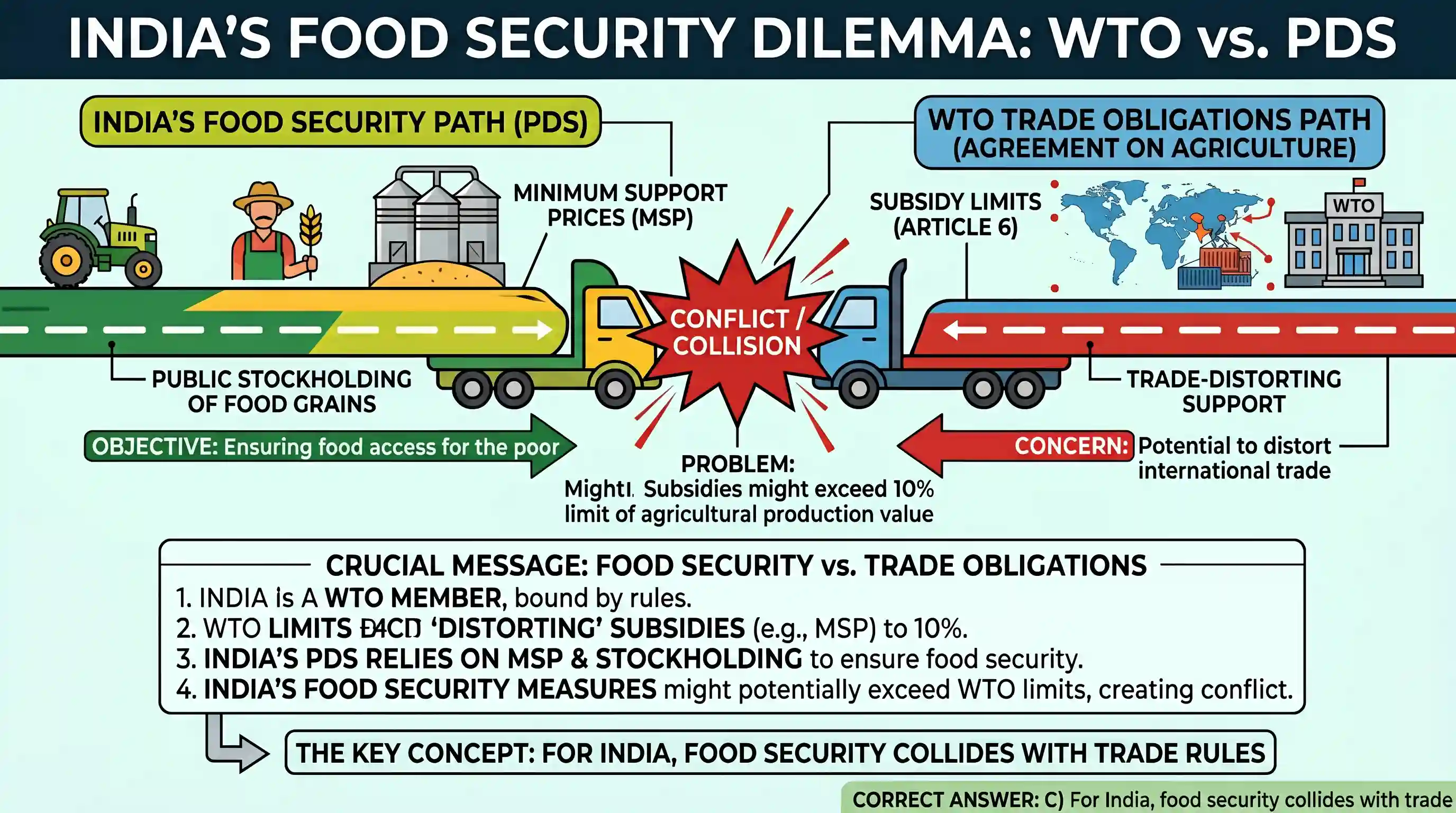
Being a member of the WTO, India is bound by the agreements that have been signed and ratified by its members, including itself. According to Article 6 of the Agriculture Agreement, providing minimum support prices for agricultural products is considered distorting and is subject to limits. The subsidy arising from 'minimal supports' cannot exceed 10 per cent of the value of agricultural production for developing countries. PDS in India entails minimum support prices and public stockholding of food grains. It is possible that, in some years, the subsidy to producers will exceed 10 per cent of the value of agricultural production. What is the crucial message conveyed by the above passage?

- AIndia should revise its PDS
- BIndia should not be a member of WTO
- CFor India, food security collides with tradeCorrect
- DIndia provides food security to its poor.
Explanation
The passage describes a situation where India's domestic policy of providing minimum support prices (MSPs) and public stockholding for food grains, which are essential for its food security, might exceed the subsidy limits set by the WTO's Agriculture Agreement. This creates a direct conflict between India's goal of ensuring food security and its obligations under international trade rules.
Option C is correct because it precisely captures this dilemma: "For India, food security collides with trade." The passage highlights how India's food security measures (PDS, MSPs) could potentially violate WTO trade rules (subsidy limits), thus demonstrating a collision between these two objectives.
Option A is incorrect because the passage describes a problem; it does not offer a solution or make a recommendation like revising PDS. Option B is incorrect because the passage points out a challenge within WTO membership, not a reason to abandon it. It doesn't suggest India should not be a member. Option D is incorrect because while it states a fact mentioned in the passage, it is only part of the context. The crucial message of the passage is not just that India provides food security, but the problem that arises from doing so in the context of WTO rules.
Related questions
More UPSC Prelims practice from the same subject and topic.
- Prelims 2018CSATReading Comprehension
Global population was around 1.6 billion in 1990- today it is around 7.2 billion and growing. Recent estimates on population growth predict a global population of 9.6 billion in 2050 and 10.9 billion …
- Prelims 2018CSATReading Comprehension
Many pathogens that cause foodborne illnesses are unknown. Food contamination can occur at any stage from farm to plate. Since most cases of food poisoning go unreported, the true extent of global foo…
- Prelims 2018CSATReading Comprehension
Though I have discarded much of past tradition and custom, and am anxious that India should rid herself of all shackles that bind and contain her and divide her people, and suppress vast numbers of th…
- Prelims 2018CSATReading Comprehension
I am a scientist, privileged to be somebody who tries to understand nature using the tools of science. But it is also clear that there are some really important questions that science cannot really an…
- Prelims 2018CSATReading Comprehension
It is no longer enough for us to talk about providing for universal access to education. Making available schooling facilities is an essential prerequisite, but is insufficient to ensure that all chil…
- Prelims 2018CSATReading Comprehension
It is no longer enough for us to talk about providing for universal access to education. Making available schooling facilities is an essential prerequisite, but is insufficient to ensure that all chil…