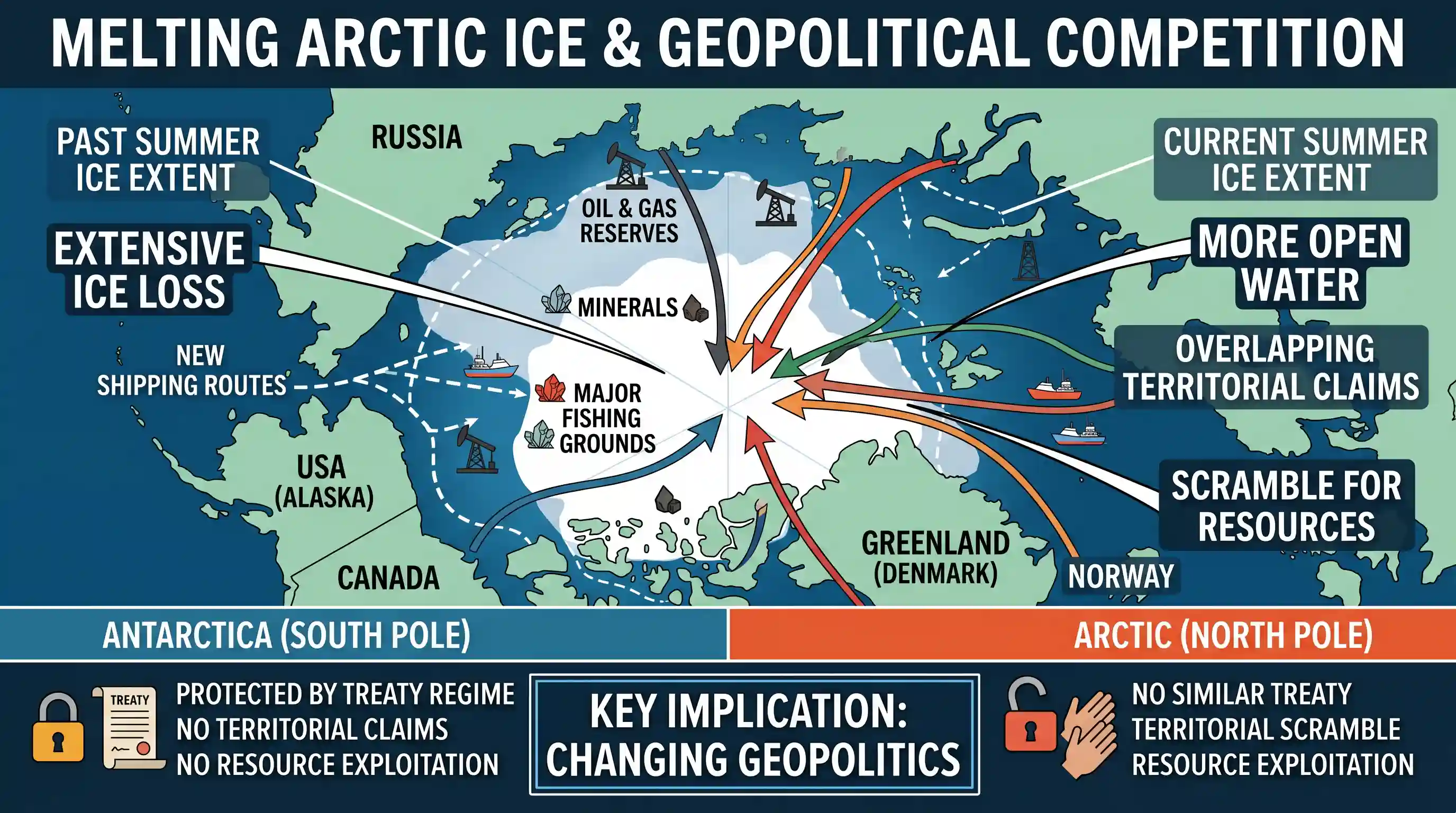
The Arctic's vast reserves of fossil fuel, fish and minerals are now accessible for a longer period in a year. But unlike Antarctica, which is protected from exploitation by the Antarctic Treaty framed during the Cold War and is not subject to territorial claims by any country, there is no legal regime protecting the Arctic from industrialization, especially at a time when the world craves for more and more resources. The distinct possibility of ice-free summer has prompted countries with Arctic coastline to scramble for great chunks of the melting ocean. Which one of the following is the most important implication of the passage?

- AIndia can have territorial claims in the Arctic territory and free access to its resources
- BMelting of summer ice in the Arctic leads to changes in the geopoliticsCorrect
- CThe Arctic region will solve the world's future problem of resource crunch
- DThe Arctic region has more resources than Antarctica.
Explanation
The passage highlights that the melting of Arctic ice makes its resources accessible, and unlike Antarctica, there's no legal regime to protect it. This situation has prompted countries with Arctic coastlines to "scramble for great chunks of the melting ocean."
Let's analyze the options:
A) India can have territorial claims in the Arctic territory and free access to its resources. The passage states that "countries with Arctic coastline" are scrambling for territory. India does not have an Arctic coastline, so this claim is not supported by the passage.
B) Melting of summer ice in the Arctic leads to changes in the geopolitics. The passage explicitly states that the "distinct possibility of ice-free summer has prompted countries with Arctic coastline to scramble for great chunks of the melting ocean." This "scramble" for territory and resources, driven by the melting ice and lack of a protective legal framework, directly implies competition, potential conflicts, and shifts in international relations and power dynamics, which is the essence of geopolitics. This is the most direct and significant implication conveyed.
C) The Arctic region will solve the world's future problem of resource crunch. While the passage mentions the Arctic has "vast reserves" and the "world craves for more and more resources," it does not state that the Arctic will solve the world's future resource problems. It only points to it as a source of resources causing a scramble, not a definitive solution to global scarcity.
D) The Arctic region has more resources than Antarctica. The passage mentions "vast reserves" in the Arctic and that Antarctica is "protected from exploitation." It does not provide any information to compare the quantity of resources between the two regions. We only know Arctic resources are becoming accessible and exploited, while Antarctica's are not.
Therefore, the "scramble for great chunks of the melting ocean" by countries due to ice melt and lack of regulation directly points to significant changes in international politics and resource competition, making B the most important implication.
Related questions
More UPSC Prelims practice from the same subject and topic.
- Prelims 2018CSATReading Comprehension
Global population was around 1.6 billion in 1990- today it is around 7.2 billion and growing. Recent estimates on population growth predict a global population of 9.6 billion in 2050 and 10.9 billion …
- Prelims 2018CSATReading Comprehension
Many pathogens that cause foodborne illnesses are unknown. Food contamination can occur at any stage from farm to plate. Since most cases of food poisoning go unreported, the true extent of global foo…
- Prelims 2018CSATReading Comprehension
Though I have discarded much of past tradition and custom, and am anxious that India should rid herself of all shackles that bind and contain her and divide her people, and suppress vast numbers of th…
- Prelims 2018CSATReading Comprehension
I am a scientist, privileged to be somebody who tries to understand nature using the tools of science. But it is also clear that there are some really important questions that science cannot really an…
- Prelims 2018CSATReading Comprehension
It is no longer enough for us to talk about providing for universal access to education. Making available schooling facilities is an essential prerequisite, but is insufficient to ensure that all chil…
- Prelims 2018CSATReading Comprehension
It is no longer enough for us to talk about providing for universal access to education. Making available schooling facilities is an essential prerequisite, but is insufficient to ensure that all chil…