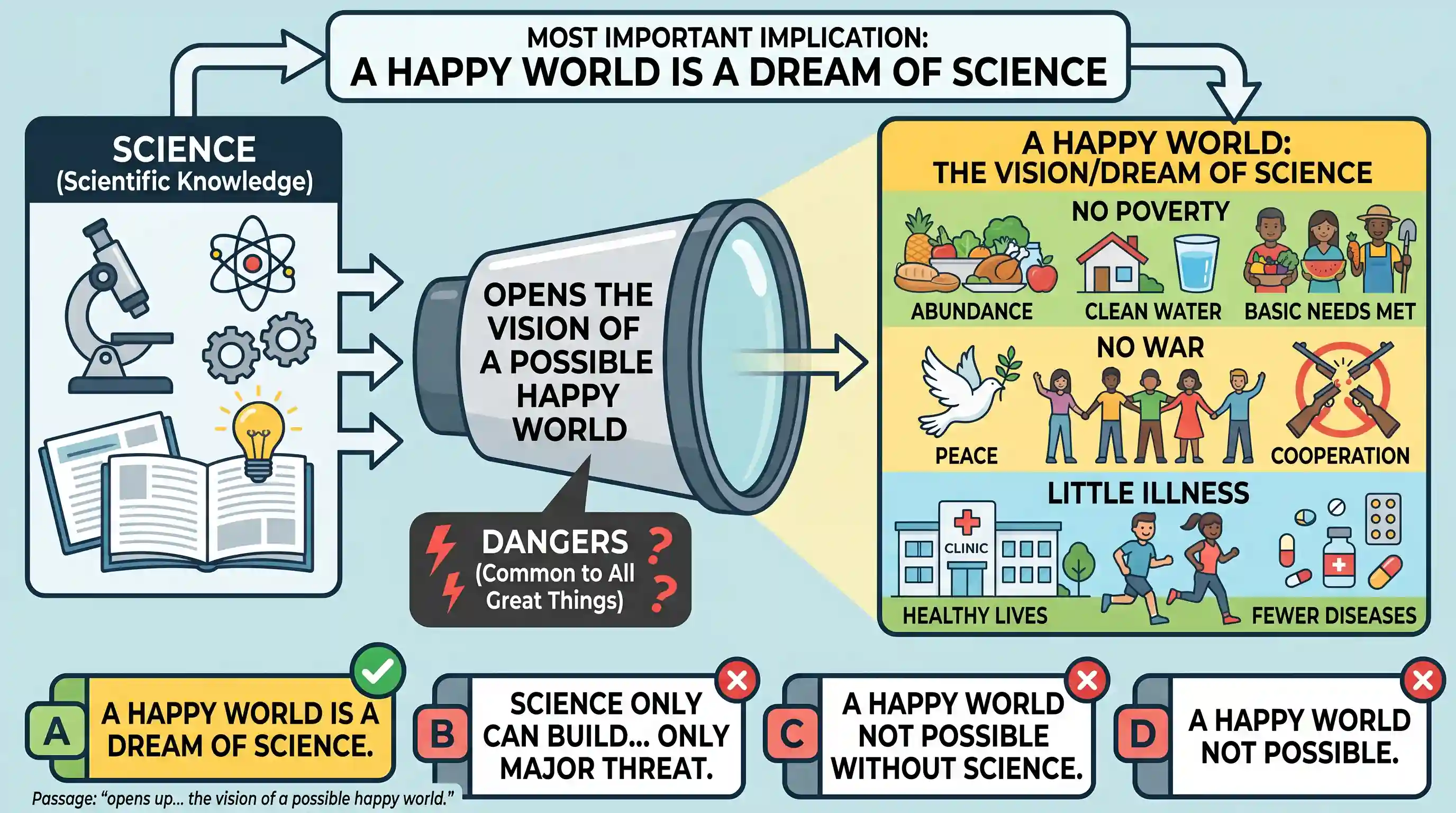
Scientific knowledge has its dangers, but so has every great thing. Over and beyond the dangers with which it threatens the present, it opens up as nothing else can, the vision of a possible happy world; a world without poverty, without war, with little illness. Science, whatever unpleasant consequences it may have by the way, is in its very nature a liberator. Which one of the following is the most important implication of the passage?

- AA happy world is a dream of scienceCorrect
- BScience only can build a happy world, but it is also the only major threat
- CA happy world is not possible without science
- DA happy world is not at all possible with or without science.
Explanation
The passage highlights that despite its dangers, scientific knowledge uniquely "opens up... the vision of a possible happy world." This "vision" refers to an ideal, an aspiration, or a conceived future state.
Let's analyze the options:
A) A happy world is a dream of science. This option directly aligns with the passage's statement that science "opens up... the vision of a possible happy world." A "vision of a possible world" is essentially an ideal or an aspiration, which can be described as a "dream." Science, through its potential, presents this ideal future. This is a strong implication.
B) Science only can build a happy world, but it is also the only major threat. The passage states science "opens up... the vision" of a happy world "as nothing else can," implying its unique role in conceiving this possibility, but it doesn't explicitly state science is the only thing that can build it. Furthermore, while it acknowledges "dangers," it doesn't claim science is the "only major threat." It says dangers exist, "but so has every great thing," implying other things also pose dangers. This option is too extreme and not fully supported.
C) A happy world is not possible without science. The passage states science "opens up as nothing else can, the vision of a possible happy world." This means science is uniquely capable of revealing or conceiving this possibility. While this strongly suggests science is indispensable for the conception or perception of such a world's possibility, stating it's "not possible without science" is a very definitive claim about the actualization or inherent possibility itself. The passage focuses on science providing the vision of possibility, which is a subtle but important distinction from being the sole enabler of that possibility. Option A, focusing on the "dream" or "vision," is a more direct interpretation of the passage's emphasis.
D) A happy world is not at all possible with or without science. This option directly contradicts the passage, which explicitly states science "opens up... the vision of a possible happy world."
Conclusion: The most important implication of the passage is that science provides the ideal or aspiration for a happy world. The phrase "vision of a possible happy world" is best captured by the idea of a "dream of science."
The final answer is A
Related questions
More UPSC Prelims practice from the same subject and topic.
- Prelims 2018CSATReading Comprehension
Global population was around 1.6 billion in 1990- today it is around 7.2 billion and growing. Recent estimates on population growth predict a global population of 9.6 billion in 2050 and 10.9 billion …
- Prelims 2018CSATReading Comprehension
Many pathogens that cause foodborne illnesses are unknown. Food contamination can occur at any stage from farm to plate. Since most cases of food poisoning go unreported, the true extent of global foo…
- Prelims 2018CSATReading Comprehension
Though I have discarded much of past tradition and custom, and am anxious that India should rid herself of all shackles that bind and contain her and divide her people, and suppress vast numbers of th…
- Prelims 2018CSATReading Comprehension
I am a scientist, privileged to be somebody who tries to understand nature using the tools of science. But it is also clear that there are some really important questions that science cannot really an…
- Prelims 2018CSATReading Comprehension
It is no longer enough for us to talk about providing for universal access to education. Making available schooling facilities is an essential prerequisite, but is insufficient to ensure that all chil…
- Prelims 2018CSATReading Comprehension
It is no longer enough for us to talk about providing for universal access to education. Making available schooling facilities is an essential prerequisite, but is insufficient to ensure that all chil…