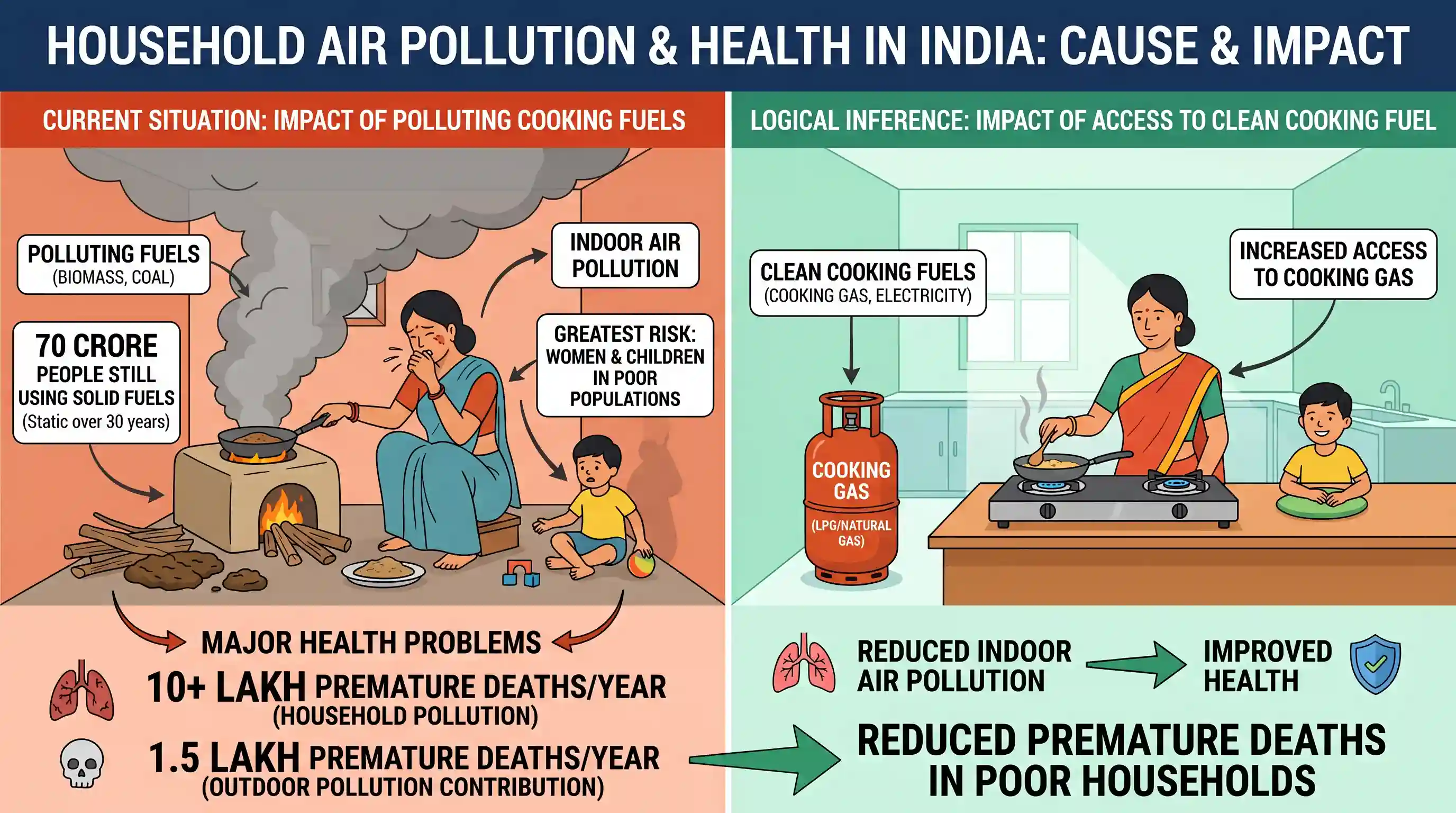
Cooking with biomass and coal in India is now recognized to cause major health problems, with women and children in poor populations facing the greatest risk. There are more than 10 lakh premature deaths each year from household air pollution due to polluting cooking fuels with another 1.5 lakh due to their contribution to general outdoor air pollution in the country. Although the fraction of the Indian population using clean cooking fuels, such as LPG, natural gas and electricity, is slowly rising, the number using polluting solid fuels as their primary cooking fuel has remained static for nearly 30 years at about 70 crore. Which of the following is the most crucial and logical inferencethat can be made from the above passage?

- ARural people are giving up the use of polluting solid fuels due to then increasing awareness of health hazards
- BSubsidizing the use of clean cooking fuels will solve the problem of India's indoor air pollution
- CIndia should increase its import of natural gas and produce more electricity
- DAccess to cooking gas can reduce premature deaths in poor households.Correct
Explanation
The passage highlights that cooking with polluting fuels (biomass, coal) causes major health problems and premature deaths, especially among women and children in poor populations. It also mentions that LPG, natural gas, and electricity are clean cooking fuels.
Let's analyze the options:
A) Rural people are giving up the use of polluting solid fuels due to increasing awareness of health hazards. Incorrect. The passage states, "the number using polluting solid fuels as their primary cooking fuel has remained static for nearly 30 years at about 70 crore," which contradicts the idea that people are giving them up.
B) Subsidizing the use of clean cooking fuels will solve the problem of India's indoor air pollution. Not the most crucial inference. While subsidies might help, the passage doesn't state that subsidies alone will solve the entire complex problem. It's a potential policy, not a direct inference about the problem's core dynamics or impact.
C) India should increase its import of natural gas and produce more electricity. Not the most crucial inference. This is a policy recommendation for increasing the supply of clean fuels. While it might be a necessary step, the passage itself doesn't directly infer this specific action as the most crucial point. It's about what should be done, not the impact of clean fuels on the problem.
D) Access to cooking gas can reduce premature deaths in poor households. Correct. The passage explicitly links polluting cooking fuels to "major health problems" and "more than 10 lakh premature deaths each year," with "women and children in poor populations facing the greatest risk." It then identifies "LPG, natural gas" as clean cooking fuels. Therefore, it logically follows that providing access to these clean fuels (cooking gas) would mitigate the health risks and reduce premature deaths in the affected poor households. This is a direct and crucial inference connecting the problem with its solution's impact.
Related questions
More UPSC Prelims practice from the same subject and topic.
- Prelims 2018CSATReading Comprehension
Global population was around 1.6 billion in 1990- today it is around 7.2 billion and growing. Recent estimates on population growth predict a global population of 9.6 billion in 2050 and 10.9 billion …
- Prelims 2018CSATReading Comprehension
Many pathogens that cause foodborne illnesses are unknown. Food contamination can occur at any stage from farm to plate. Since most cases of food poisoning go unreported, the true extent of global foo…
- Prelims 2018CSATReading Comprehension
Though I have discarded much of past tradition and custom, and am anxious that India should rid herself of all shackles that bind and contain her and divide her people, and suppress vast numbers of th…
- Prelims 2018CSATReading Comprehension
I am a scientist, privileged to be somebody who tries to understand nature using the tools of science. But it is also clear that there are some really important questions that science cannot really an…
- Prelims 2018CSATReading Comprehension
It is no longer enough for us to talk about providing for universal access to education. Making available schooling facilities is an essential prerequisite, but is insufficient to ensure that all chil…
- Prelims 2018CSATReading Comprehension
It is no longer enough for us to talk about providing for universal access to education. Making available schooling facilities is an essential prerequisite, but is insufficient to ensure that all chil…