Directions: The following table gives the GDP growth rate and Teldensity data of different States of a country in a particular year. Study the table and answer the two items that follow. +----------+-------------------------+------------------------+--------------+ | States | Per Capita income () | GDP growth rate (%) | Tele-density | +----------+-------------------------+------------------------+--------------+ | State 1 | 704 | 9.52 | 70.27 | | State 2 | 419 | 5.31 | 35.88 | | State 3 | 254 | 10.83 | 50.07 | | State 4 | 545 | 9.78 | 5.94 | | State 5 | 891 | 10.8 | 76.12 | | State 6 | 1077 | 11.69 | 77.5 | | State 7 | 900 | 8.88 | 104.86 | | State 8 | 395 | 5.92 | 6 | | State 9 | 720 | 7.76 | 82.25 | | State 10 | 893 | 9.55 | 96.7 | | State 11 | 363 | 4.7 | 57.7 | | State 12 | 966 | 7.85 | 63.8 | | State 13 | 495 | 9.37 | 52.3 | | State 14 | 864 | 5.46 | 97.9 | | State 15 | 497 | 7.48 | 62.3 | | State 16 | 777 | 7.03 | 93.8 | | State 17 | 335 | 5.8 | 49.9 | | State 18 | 599 | 7.49 | 47.84 | +----------+-------------------------+------------------------+--------------+ With reference to the above table, the following assumptions have been made: 1. Nowadays, the prosperity of an already high performing State cannot be sustained without making further large investments in its telecom infrastructure. 2. Nowadays, a very high Tele-density is the most essential condition for promoting business and economic growth in a Stage. Which of the above assumptions is/are valid?

- A1 only
- B2 only
- CBoth 1 and 2
- DNeither 1 nor 2Correct
Explanation
The question asks us to evaluate the validity of two assumptions based on the provided table.
Analysis of Assumption 1: "Nowadays, the prosperity of an already high performing State cannot be sustained without making further large investments in its telecom infrastructure."
- "High performing State": We can identify high performing states by high Per Capita Income and/or high GDP growth rate. For example, State 6 has the highest Per Capita Income (1077) and the highest GDP growth rate (11.69%). State 5 also shows high performance (891 PC income, 10.8% growth).
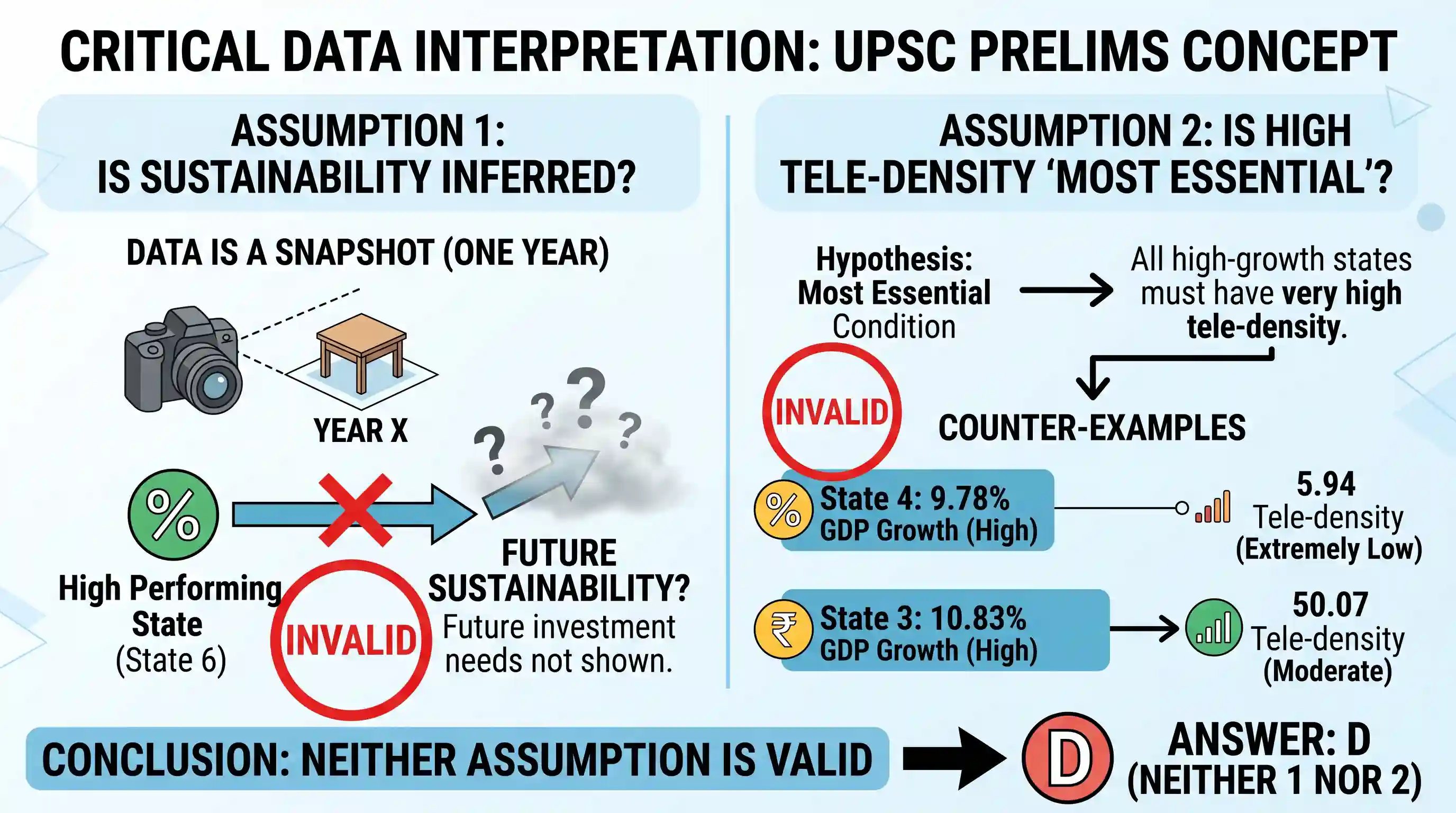
- "Cannot be sustained without making further large investments": The table provides a snapshot of data for a particular year. It shows the current tele-density. It does not provide any information about the sustainability of prosperity over time, nor does it indicate the necessity of future investments. We cannot infer from this data whether current tele-density levels are sufficient for sustainability or if further investments are indispensable. For instance, State 12 has a high Per Capita Income (966) and a decent GDP growth rate (7.85%) with a moderate tele-density (63.8). We cannot conclude that its prosperity cannot be sustained without further large investments based solely on this single year's data. The assumption makes a strong claim about future necessity which is not supported by the given cross-sectional data.
Therefore, Assumption 1 is not valid.
Analysis of Assumption 2: "Nowadays, a very high Tele-density is the most essential condition for promoting business and economic growth in a State."
- "Most essential condition for promoting business and economic growth": This implies a strong positive correlation and a critical dependency. We should look for states with high economic growth (GDP growth rate) and see if they consistently have very high tele-density.
- Counter-examples:
- State 4 has a very high GDP growth rate (9.78%) but an extremely low tele-density (5.94). This directly contradicts the idea that a very high tele-density is the most essential condition for promoting growth.
- State 3 also shows a very high GDP growth rate (10.83%) with a moderate tele-density (50.07), which is not "very high".
- While some high-growth states (e.g., State 6, State 5) do have high tele-density, the existence of counter-examples like State 4 and State 3 disproves the claim that it is the most essential condition. Other factors clearly contribute significantly to growth.
Therefore, Assumption 2 is not valid.
Since neither Assumption 1 nor Assumption 2 is valid based on the provided table, the correct option is D.
The final answer is D
Related questions
More UPSC Prelims practice from the same subject and topic.
- Prelims 2018CSATReading Comprehension
Global population was around 1.6 billion in 1990- today it is around 7.2 billion and growing. Recent estimates on population growth predict a global population of 9.6 billion in 2050 and 10.9 billion …
- Prelims 2018CSATReading Comprehension
Many pathogens that cause foodborne illnesses are unknown. Food contamination can occur at any stage from farm to plate. Since most cases of food poisoning go unreported, the true extent of global foo…
- Prelims 2018CSATReading Comprehension
Though I have discarded much of past tradition and custom, and am anxious that India should rid herself of all shackles that bind and contain her and divide her people, and suppress vast numbers of th…
- Prelims 2018CSATReading Comprehension
I am a scientist, privileged to be somebody who tries to understand nature using the tools of science. But it is also clear that there are some really important questions that science cannot really an…
- Prelims 2018CSATReading Comprehension
It is no longer enough for us to talk about providing for universal access to education. Making available schooling facilities is an essential prerequisite, but is insufficient to ensure that all chil…
- Prelims 2018CSATReading Comprehension
It is no longer enough for us to talk about providing for universal access to education. Making available schooling facilities is an essential prerequisite, but is insufficient to ensure that all chil…