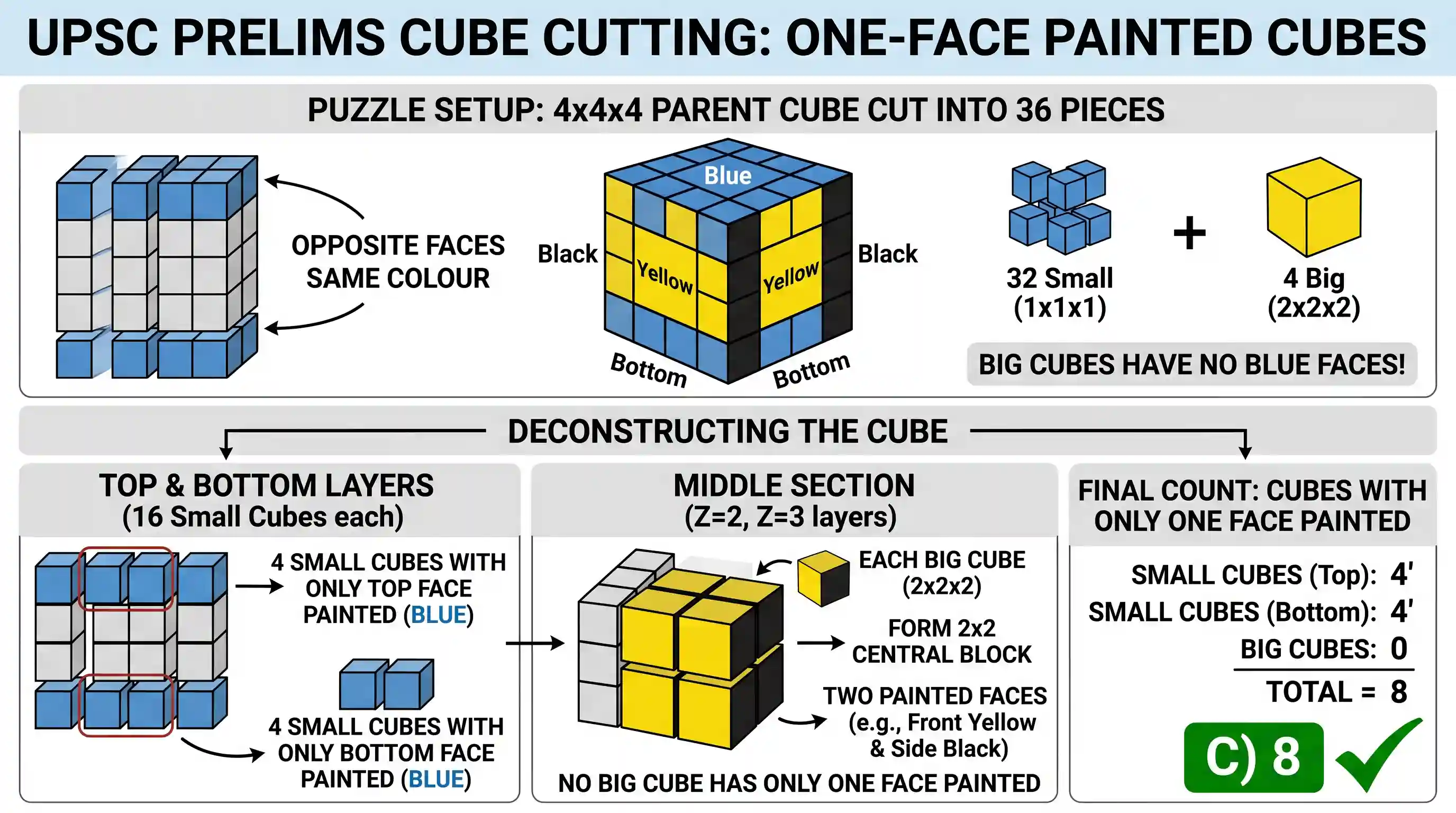
A solid cube is painted yellow, blue and black such that opposite faces are of same colour. The cube is then cut into 36 cubes of two different sizes such that 32 cubes are small and the other four cubes are Big. None of the faces of the bigger cubes is painted blue. How many cubes have only one face painted?

- A4
- B6
- C8Correct
- D10
Explanation
The problem describes a solid cube painted with three colors (yellow, blue, black) such that opposite faces have the same color. This means there are two yellow faces, two blue faces, and two black faces. Let's assume the top and bottom faces are blue, the front and back faces are yellow, and the left and right faces are black.
The cube is cut into 36 smaller cubes: 32 small and 4 big. The crucial constraint is: "None of the faces of the bigger cubes is painted blue."
Let's deduce the structure of the original cube and the sizes of the smaller cubes:
-
Cube Sizes and Total Volume: Let the small cubes be 1x1x1 units. Let the big cubes be BxBxB units. If we assume the big cubes are 2x2x2 units, then:
- Volume of 32 small cubes = 32 * (1^3) = 32 units.
- Volume of 4 big cubes = 4 * (2^3) = 4 * 8 = 32 units.
- Total volume = 32 + 32 = 64 units.
- If the total volume is 64 units, the original solid cube must have been a 4x4x4 cube (since 4x4x4 = 64). This interpretation is consistent and commonly used in such problems.
-
Placement of Big Cubes: The original cube is a 4x4x4 arrangement of 1x1x1 unit cells.
- We assumed blue faces are on the top (Z=4) and bottom (Z=1) layers.
- Since none of the big cubes have blue faces, they cannot be in the top or bottom layers. They must be entirely within the middle layers (Z=2 and Z=3).
- The middle section of a 4x4x4 cube consists of two layers, each 4x4 units, making a total of 4x4x2 = 32 unit cells.
- Since the 4 big cubes (each 2x2x2 = 8 unit cells) occupy 4 * 8 = 32 unit cells, this means the entire middle section (layers Z=2 and Z=3) is filled by these 4 big cubes.
- The remaining 32 small cubes (1x1x1) must therefore occupy the top layer (Z=4, 16 cubes) and the bottom layer (Z=1, 16 cubes). This matches the problem statement of 32 small cubes.
-
Counting Cubes with Only One Face Painted:
-
Small Cubes (32 cubes): These are located in the top (Z=4) and bottom (Z=1) layers. Each layer is a 4x4 grid of small cubes.
- For a 4x4 face of a cube, the cubes with only one face painted are the inner cubes, not touching the edges. The number of such cubes is (side_length - 2)^2.
- For the top layer (4x4), number of 1-face painted cubes = (4-2)^2 = 2^2 = 4 cubes. These 4 cubes have only their top face painted blue.
- For the bottom layer (4x4), number of 1-face painted cubes = (4-2)^2 = 2^2 = 4 cubes. These 4 cubes have only their bottom face painted blue.
- Total small cubes with one face painted = 4 + 4 = 8 cubes.
-
Big Cubes (4 cubes): These are located in the middle section (Z=2 and Z=3).
- As established, their top (Z=3) and bottom (Z=2) faces are internal and not painted blue.
- These 4 big cubes form a 2x2 arrangement within the 4x4 middle section. Each big cube is effectively at a "corner" of this 2x2 arrangement.
- Consider one big cube, for example, the one in the front-left position of the middle section. Its front face would be exposed to the original cube's front (yellow) face, and its left face would be exposed to the original cube's left (black) face. The other four faces (top, bottom, back, right) are internal to the big cube or touch other big cubes, and thus are not painted.
- Therefore, each of the 4 big cubes has exactly two faces painted (one yellow, one black).
- None of the big cubes have only one face painted.
-
-
Total: The total number of cubes with only one face painted is 8 (from small cubes) + 0 (from big cubes) = 8.
The final answer is C.
The final answer is C
Related questions
More UPSC Prelims practice from the same subject and topic.
- Prelims 2019CSATQuantitative Aptitude
P, Q and R are three towns. The distance between P and Q is 60 km, whereas the distance between P and R is 80 km. Q is in the West of P and R is in the South of P. What is the distance between Q and R…
- Prelims 2019CSATQuantitative Aptitude
The number of times the digit 5 will appear while writing the integers from 1 to 1000 is
- Prelims 2019CSATQuantitative Aptitude
A and B are two heavy steel blocks. If B is placed on the top of A, the weight increases by 60%. How much weight will reduce with respect to the total weight of A and B, if B is removed from the top o…
- Prelims 2019CSATQuantitative Aptitude
The number of parallelograms that can be formed from a set of four parallel lines intersecting another set of four parallel lines, is
- Prelims 2019CSATQuantitative Aptitude
In a school every student is assigned a unique identification number. A student is a football player if and only if the identification number is divisible by 4, whereas a student is a cricketer if and…
- Prelims 2019CSATQuantitative Aptitude
When a runner was crossing the 12 km mark, she was informed that she had completed only 80% of the race. How many kilometres was the runner supposed to run in this event?