The number of parallelograms that can be formed from a set of four parallel lines intersecting another set of four parallel lines, is

- A18
- B24
- C32
- D36Correct
Explanation
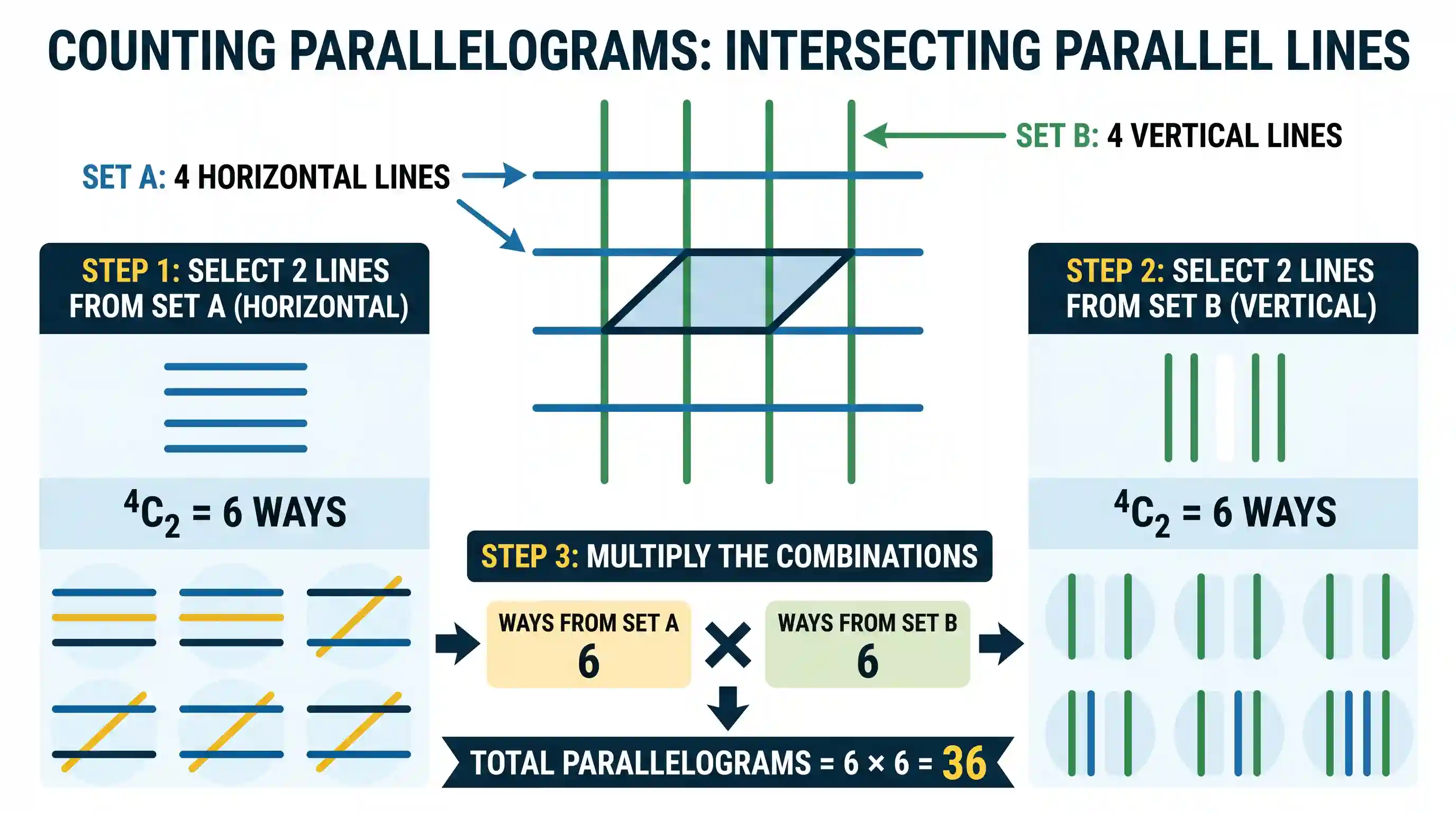
To form a parallelogram, we need to select two parallel lines from the first set and two parallel lines from the second set.
-
Number of ways to choose 2 lines from the first set of 4 parallel lines: This is a combination problem, C(n, k) = n! / (k! * (n-k)!). C(4, 2) = 4! / (2! * (4-2)!) = (4 * 3 * 2 * 1) / ((2 * 1) * (2 * 1)) = 24 / 4 = 6.
-
Number of ways to choose 2 lines from the second set of 4 parallel lines: Similarly, C(4, 2) = 6.
-
Total number of parallelograms: To find the total number of parallelograms, we multiply the number of ways to choose lines from each set, as any selection from the first set can be combined with any selection from the second set. Total parallelograms = (Ways to choose from first set) * (Ways to choose from second set) Total parallelograms = 6 * 6 = 36.
Therefore, the correct answer is D) 36.
Related questions
More UPSC Prelims practice from the same subject and topic.
- Prelims 2019CSATQuantitative Aptitude
In a conference, out of a total 100 participants, 70 are Indians. If 60 of the total participants are vegetarian, then which of the following statements is/are correct? 1. At least 30 Indian participa…
- Prelims 2019CSATQuantitative Aptitude
All members of a club went to Mumbai and stayed in a hotel. On the first day, 80% went for shopping and 50% went for sightseeing, whereas 10% took rest in the hotel. Which of the following conclusion(…
- Prelims 2019CSATQuantitative Aptitude
Each face of a cube can be painted in black or white colours. In how many different ways can the cube be painted?
- Prelims 2019CSATQuantitative Aptitude
How many triplets (x,y,z) satisfy the equation x + y + z = 6 , where x, y and z are natural numbers?
- Prelims 2019CSATQuantitative Aptitude
In a group of 15 people; 7 can read French, 8 can read English while 3 of them can read neither of these two languages. The number of people who can read exactly one language is
- Prelims 2019CSATQuantitative Aptitude
The number of times the digit 5 will appear while writing the integers from 1 to 1000 is