All members of a club went to Mumbai and stayed in a hotel. On the first day, 80% went for shopping and 50% went for sightseeing, whereas 10% took rest in the hotel. Which of the following conclusion(s) can be drawn from the above data? 1. 40% members went for shopping as well as sightseeing. 2. 20% members went for only shopping. Select the correct answer using the code given below:

- A1 only
- B2 only
- CBoth 1 and 2
- DNeither 1 nor 2Correct
Explanation
The problem involves overlapping sets of activities. Let's denote the percentage of members who went for shopping as S, sightseeing as T, and resting as R. Given: S = 80% T = 50% R = 10%
The total percentage of activities mentioned is 80% + 50% + 10% = 140%. Since this is greater than 100%, there must be overlaps between these activities. We cannot assume that the 10% who took rest did not also go for shopping or sightseeing.
Let X be the percentage of members who went for shopping as well as sightseeing (S intersection T). Let Y be the percentage of members who went for shopping as well as resting (S intersection R). Let Z be the percentage of members who went for sightseeing as well as resting (T intersection R). Let W be the percentage of members who went for shopping, sightseeing, and resting (S intersection T intersection R).
Assuming all members participated in at least one of these activities (shopping, sightseeing, or resting), the total union of these three sets is 100%. The formula for the union of three sets is: |S U T U R| = |S| + |T| + |R| - (|X| + |Y| + |Z|) + |W| 100% = 80% + 50% + 10% - (X + Y + Z) + W 100% = 140% - (X + Y + Z) + W This simplifies to: X + Y + Z - W = 40%
Let's analyze each statement:
Statement 1: "40% members went for shopping as well as sightseeing." (i.e., X = 40%)
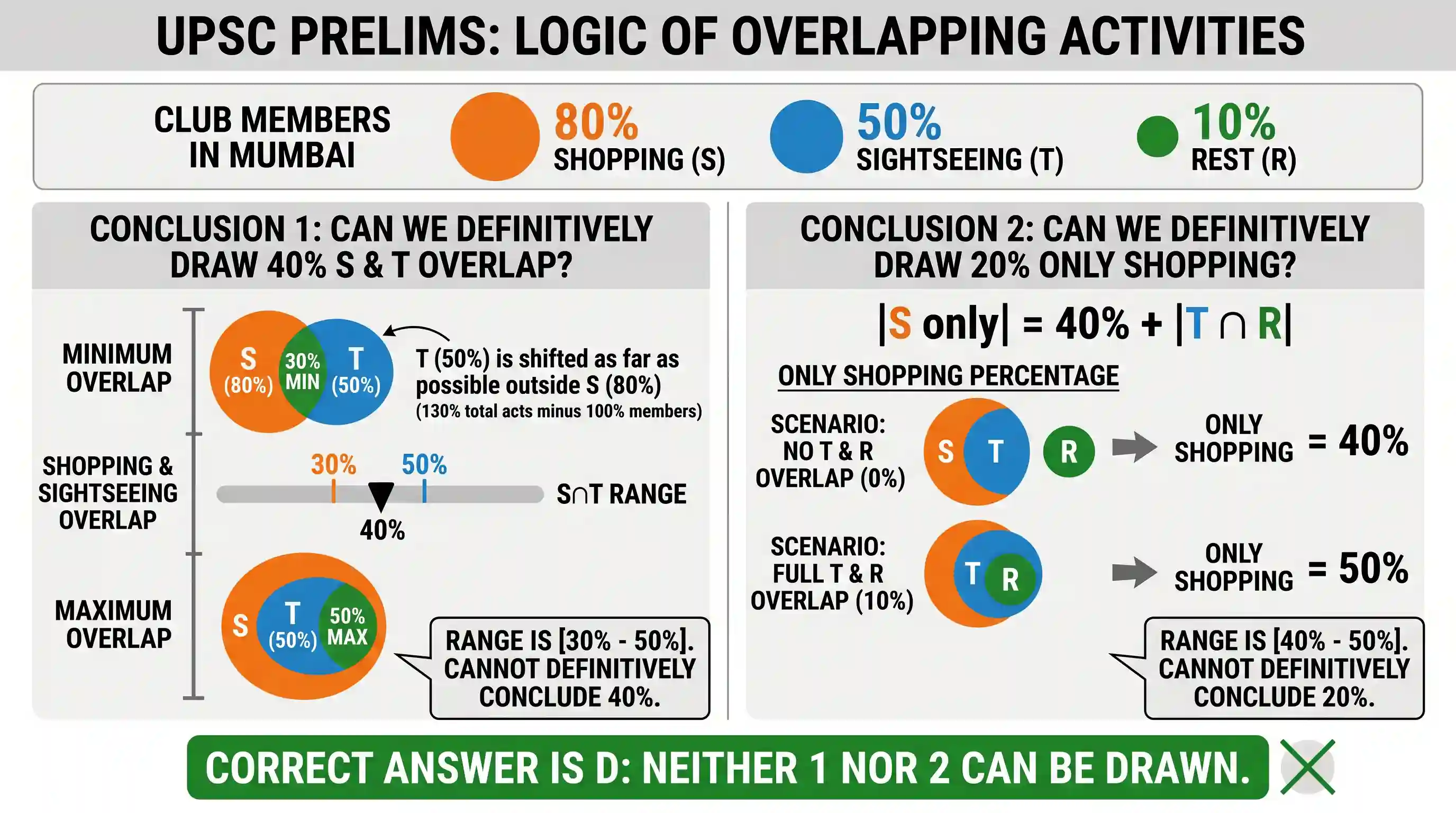
- We know that the sum of percentages for shopping and sightseeing is 80% + 50% = 130%. Since the total members cannot exceed 100%, at least 30% must have done both. So, X >= 30%.
- Also, the percentage of members who did both shopping and sightseeing cannot exceed the smaller of the two groups, which is 50% (sightseeing). So, X <= 50%.
- Therefore, X is in the range [30%, 50%].
- Since X is not definitively 40% (it could be 30%, 50%, or any value in between), Statement 1 cannot be drawn as a conclusion.
Statement 2: "20% members went for only shopping."
- The percentage of members who went for only shopping is given by: |S only| = |S| - X - Y + W.
- From our derived equation: X + Y + Z - W = 40%. We can rearrange this to find Y - W: Y - W = 40% - X - Z.
- Substitute this into the "only shopping" expression: |S only| = 80% - X - (40% - X - Z) |S only| = 80% - X - 40% + X + Z |S only| = 40% + Z
- Here, Z represents the percentage of members who went for sightseeing as well as resting (|T intersection R|).
- Z can range from 0% (if no one who rested also went sightseeing) to 10% (if all who rested also went sightseeing, as R is 10%).
- Therefore, the percentage of members who went for only shopping can range from 40% + 0% = 40% to 40% + 10% = 50%.
- Since the percentage for only shopping is in the range [40%, 50%], it cannot be definitively concluded that it is 20%. Statement 2 cannot be drawn as a conclusion.
Since neither Statement 1 nor Statement 2 can be definitively concluded from the given data, the correct answer is D.
The final answer is D
Related questions
More UPSC Prelims practice from the same subject and topic.
- Prelims 2019CSATQuantitative Aptitude
The number of parallelograms that can be formed from a set of four parallel lines intersecting another set of four parallel lines, is
- Prelims 2019CSATQuantitative Aptitude
In a conference, out of a total 100 participants, 70 are Indians. If 60 of the total participants are vegetarian, then which of the following statements is/are correct? 1. At least 30 Indian participa…
- Prelims 2019CSATQuantitative Aptitude
Each face of a cube can be painted in black or white colours. In how many different ways can the cube be painted?
- Prelims 2019CSATQuantitative Aptitude
How many triplets (x,y,z) satisfy the equation x + y + z = 6 , where x, y and z are natural numbers?
- Prelims 2019CSATQuantitative Aptitude
In a group of 15 people; 7 can read French, 8 can read English while 3 of them can read neither of these two languages. The number of people who can read exactly one language is
- Prelims 2019CSATQuantitative Aptitude
The number of times the digit 5 will appear while writing the integers from 1 to 1000 is