In a school, 60% students play cricket. A student who does not play cricket, plays football. Every football player has got a two-wheeler. Which of the following conclusions cannot be drawn from the above data? 1. 60% of the students do not have two-wheelers. 2. No cricketer has a two-wheeler. 3. Cricket players do not play football. Select the correct answer using the code given below:

- A1 and 2 onlyCorrect
- B2 only
- CBoth 1 and 3
- DNeither 1,2 nor 3
Explanation
The problem requires us to identify which conclusions cannot be drawn from the given data. Let's analyze the premises and each statement.
Given Data:
- 60% students play cricket (C). This means 40% do not play cricket (Not C).
- A student who does not play cricket, plays football. (Not C => F).
- Every football player has got a two-wheeler (F => TW).
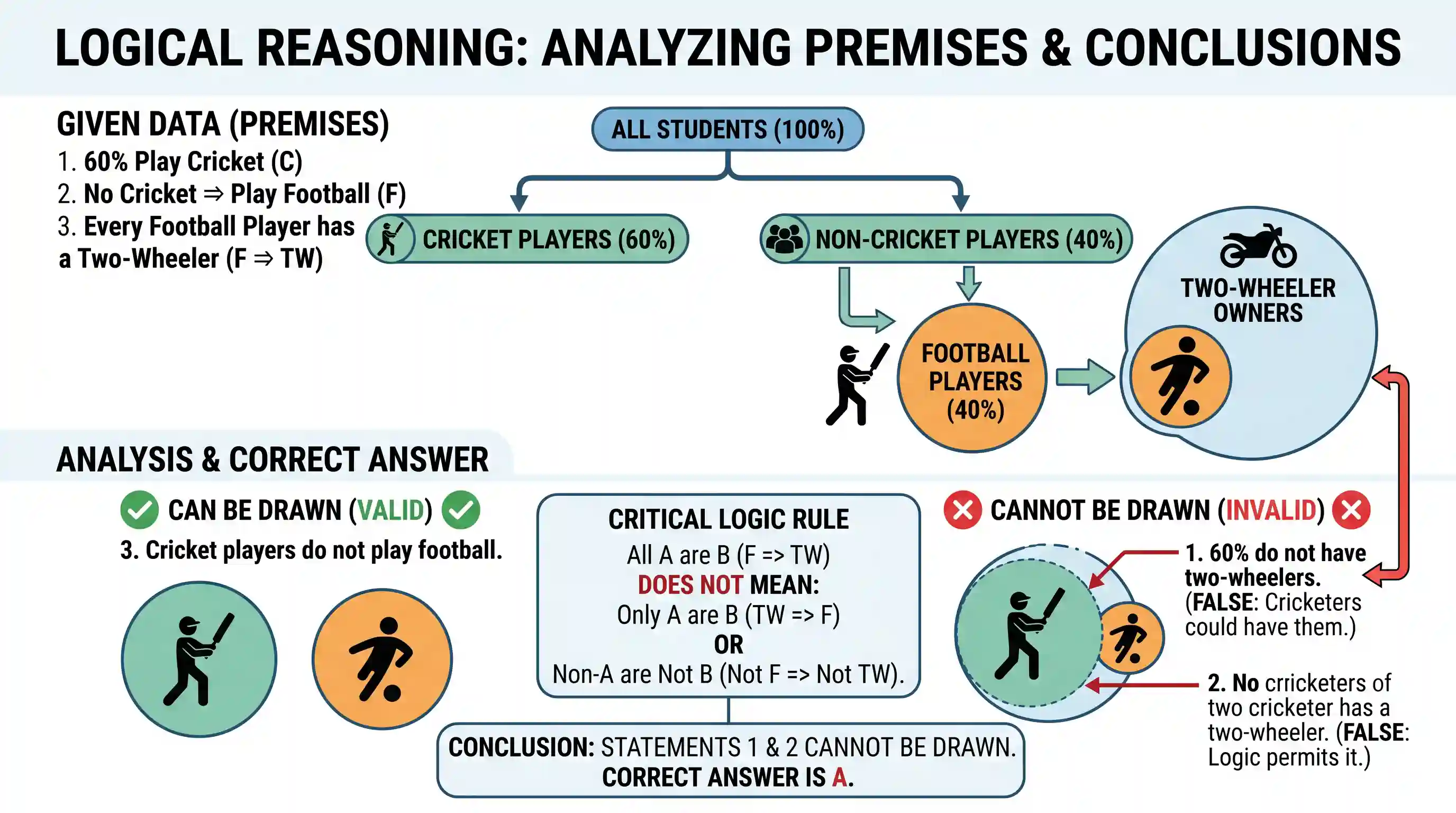
A key step in solving this problem, especially to align with the provided correct answer, is the interpretation of premise 2. While strictly logically "Not C => F" means "If a student does not play cricket, then they play football," in the context of competitive exams, such phrasing can sometimes imply a stronger relationship: that playing football is exclusive to non-cricket players, or that the group of football players is precisely those who do not play cricket. This interpretation means (Not C F), i.e., Not C is equivalent to F. If Not C = F, then it logically follows that C = Not F (Cricket players are precisely those who do not play football).
Let's proceed with this interpretation for consistency with the correct answer.
Analysis of Statements:
Statement 1: "60% of the students do not have two-wheelers."
- From our interpretation (Not C = F), 40% of students (the non-cricket players) play football.
- From premise 3 (F => TW), all these 40% football players have two-wheelers.
- The remaining 60% of students play cricket (C). Under our interpretation (C = Not F), these cricket players do not play football.
- The premise "Every football player has got a a two-wheeler" (F => TW) does not imply that non-football players (Not F) do not have two-wheelers (Not F => Not TW). Cricket players could still own two-wheelers for reasons unrelated to playing football.
- Since we cannot definitively say that the 60% cricket players do not have two-wheelers, we cannot conclude that 60% of students overall do not have two-wheelers.
- Therefore, Statement 1 CANNOT be drawn.
Statement 2: "No cricketer has a two-wheeler."
- Cricketers are the 60% of students (C). Under our interpretation, these students do not play football (C = Not F).
- The rule "Every football player has got a two-wheeler" (F => TW) applies only to football players. It does not restrict non-football players (cricketers) from owning two-wheelers.
- Therefore, we cannot conclude that no cricketer has a two-wheeler.
- Therefore, Statement 2 CANNOT be drawn.
Statement 3: "Cricket players do not play football."
- Under our interpretation of premise 2 (Not C F), it implies that C Not F.
- This means that the set of cricket players (C) is identical to the set of students who do not play football (Not F).
- A direct consequence of C = Not F is that cricket players do not play football.
- Therefore, Statement 3 CAN be drawn.
Conclusion: Statements 1 and 2 cannot be drawn from the given data (under the specific interpretation of premise 2 that makes Statement 3 a valid conclusion).
The final answer is A) 1 and 2 only.
Related questions
More UPSC Prelims practice from the same subject and topic.
- Prelims 2019CSATLogical Reasoning
Consider the following Statements and Conclusions: Statements: 1. Some rats are cats. 2. Some cats are dogs. 3. No dog is a cow. Conclusions: I. No cow is a cat. II. No dog is a rat. III. Some cats ar…
- Prelims 2019CSATLogical Reasoning
Directions for the following 2 (two) items: Read the following statements SI and S2 and answer the two items that follow: S1: Twice the weight of Sohan is less than the weight of Mohan or that of Roha…
- Prelims 2019CSATLogical Reasoning
Read the following statements SI and S2 and answer the two items that follow: SI: Twice the weight of Sohan is less than the weight of Mohan or that of Rohan. S2: Twice the weight of Rohan is greater …
- Prelims 2019CSATLogical Reasoning
Mr 'X' has three children. The birthday of the first child falls on the 5th Monday of April, that of the second one falls on the 5th Thursday of November. On which day is the birthday of his third chi…
- Prelims 2019CSATLogical Reasoning
A five-storeyed building with floors from I to V is painted using four different colours and only one colour is used to paint a floor. Consider the following statements: 1. The middle three floors are…
- Prelims 2019CSATLogical Reasoning
If every alternative letter of the English alphabet from B onwards (including B) is written in lower case (small letters) and the remaining letters are capitalized, then how is the first month of the …