A five-storeyed building with floors from I to V is painted using four different colours and only one colour is used to paint a floor. Consider the following statements: 1. The middle three floors are painted in different colours. 2. The second (II) and the fourth (IV) floors are painted in different colours. 3. The first (I) and the fifth (V) floors are painted red. To ensure that any two consecutive floors have different colours

- AOnly statement 2 is sufficient
- B(b) Only statement 3 is sufficientCorrect
- C(c) Statement 1 is not sufficient, but statement 1 along with statement 2 is sufficient
- D(d) Statement 3 is not sufficient, but statement 3 along with statement 2 is sufficient
Explanation
The question asks which statement(s) are sufficient "To ensure that any two consecutive floors have different colours". This implies that if the statement is true, then it must be possible to paint the building such that no two consecutive floors have the same colour, and the statement itself doesn't inherently lead to a violation. We have 5 floors (I to V) and 4 different colours available.
Let's analyze each statement:
-
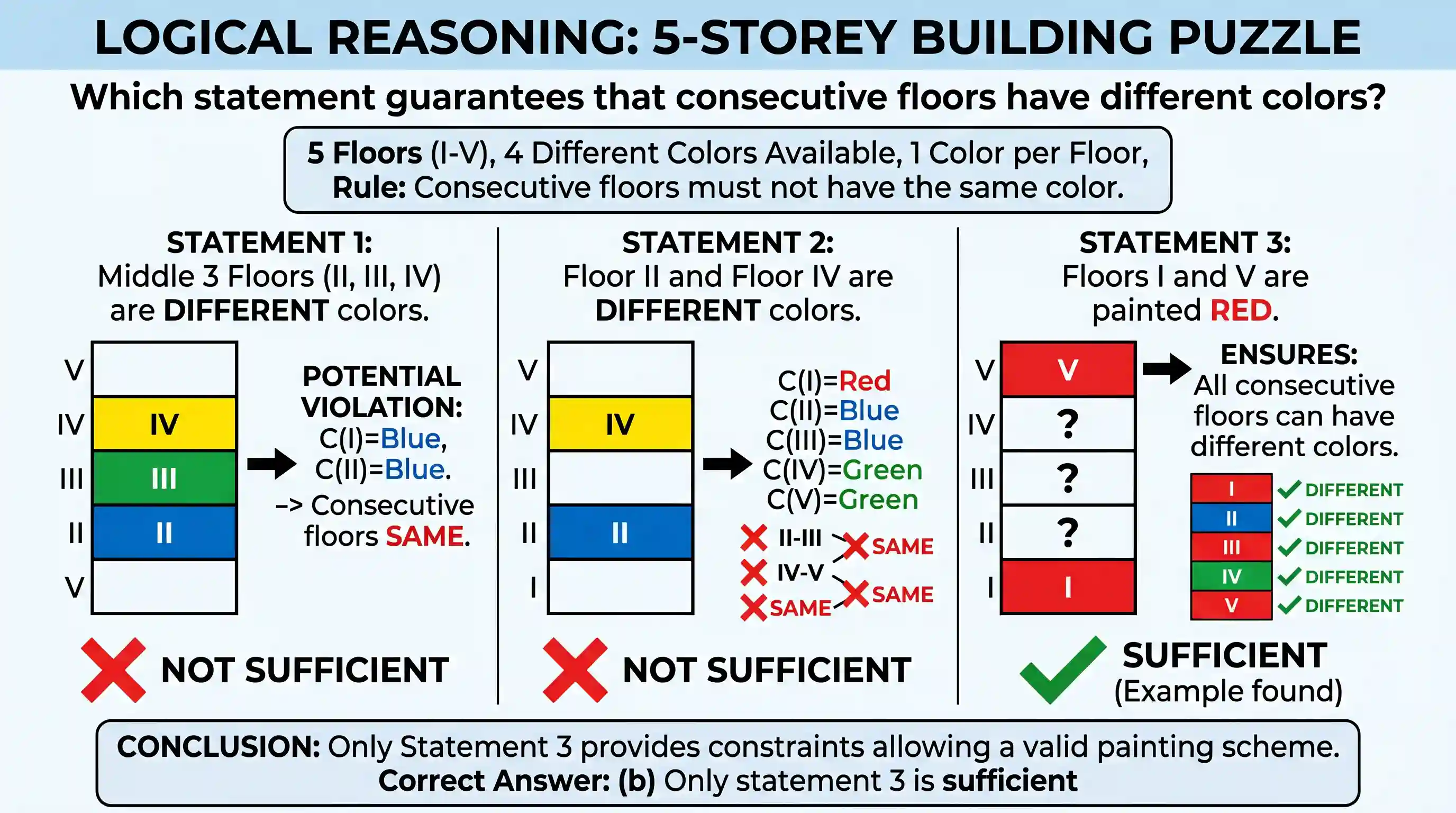
Statement 1: The middle three floors are painted in different colours. This means C(II), C(III), and C(IV) are distinct colours. Let's say C(II)=A, C(III)=B, C(IV)=C (where A, B, C are distinct colours from the 4 available). This statement guarantees that C(II) != C(III) and C(III) != C(IV). However, it does not guarantee anything about C(I) vs C(II) or C(IV) vs C(V). For example, if C(II)=Red, C(III)=Blue, C(IV)=Green (satisfies Statement 1). We could then paint C(I)=Red. In this case, C(I) = C(II), violating the condition that any two consecutive floors must have different colours. Therefore, Statement 1 alone is NOT sufficient, as it doesn't prevent a violation for the end floors.
-
Statement 2: The second (II) and the fourth (IV) floors are painted in different colours. This means C(II) != C(IV). This is a very weak condition. For example, we could paint C(I)=Red, C(II)=Blue, C(III)=Blue, C(IV)=Green, C(V)=Green. Here, C(II) != C(IV) (Blue != Green), but C(II)=C(III) and C(IV)=C(V), violating the condition. Therefore, Statement 2 alone is NOT sufficient.
-
Statement 3: The first (I) and the fifth (V) floors are painted red. This means C(I) = Red and C(V) = Red. For the condition "any two consecutive floors have different colours" to hold, we must have: C(I) != C(II) => Red != C(II) C(II) != C(III) C(III) != C(IV) C(IV) != C(V) => C(IV) != Red
So, if Statement 3 is true, we know C(I)=Red and C(V)=Red. We need to determine if we can always choose colours for C(II), C(III), and C(IV) from the 4 available colours (let's say Red, Blue, Green, Yellow) to satisfy the conditions. From C(I) != C(II), C(II) cannot be Red. From C(IV) != C(V), C(IV) cannot be Red. So, C(II) and C(IV) must be chosen from {Blue, Green, Yellow}. Let's pick C(II) = Blue. Let's pick C(IV) = Green. Now we have: Red, Blue, C(III), Green, Red. We still need to satisfy C(II) != C(III) (Blue != C(III)) and C(III) != C(IV) (C(III) != Green). We can choose C(III) to be Red (since Red is not Blue and not Green). So, a valid painting sequence is: Red, Blue, Red, Green, Red. All consecutive floors have different colours. Since we were able to find a valid painting scheme, Statement 3 is sufficient to ensure that the condition can be met.
Comparing the statements: Statement 1 is not sufficient because even if the middle three floors are different, the end floors can still be painted to violate the condition. Statement 2 is too weak and clearly not sufficient. Statement 3 is sufficient because it provides a strong enough constraint (the ends are the same colour) that, with 4 available colours, we can always find a valid way to paint the intermediate floors to meet the "no consecutive floors are the same" condition.
Therefore, only Statement 3 is sufficient.
The final answer is $\boxed{B}$
Related questions
More UPSC Prelims practice from the same subject and topic.
- Prelims 2019CSATLogical Reasoning
Six students A, B, C, D, E and F appeared in several tests. Either C or F scores the highest. Whenever C scores the highest, then E scores the least. Whenever F scores the highest, B scores the least.…
- Prelims 2019CSATLogical Reasoning
Six students A, B, C, D, E and F appeared in several tests. Either C or F scores the highest. Whenever C scores the highest, then E scores the least. Whenever F scores the highest, B scores the least.…
- Prelims 2019CSATLogical Reasoning
Six students A, B, C, D, E and F appeared in several tests. Either C or F scores the highest. Whenever C scores the highest, then E scores the least. Whenever F scores the highest, B scores the least.…
- Prelims 2019CSATLogical Reasoning
A' started from his house and walked 20 m towards East, where his friend 13' joined him. They together walked 10 m in the same direction. Then 'A' turned left while 'B' turned right and travelled 2 m …
- Prelims 2019CSATLogical Reasoning
Mr 'X' has three children. The birthday of the first child falls on the 5th Monday of April, that of the second one falls on the 5th Thursday of November. On which day is the birthday of his third chi…
- Prelims 2019CSATLogical Reasoning
Consider the following Statements and Conclusions: Statements: 1. Some rats are cats. 2. Some cats are dogs. 3. No dog is a cow. Conclusions: I. No cow is a cat. II. No dog is a rat. III. Some cats ar…