Six students A, B, C, D, E and F appeared in several tests. Either C or F scores the highest. Whenever C scores the highest, then E scores the least. Whenever F scores the highest, B scores the least. In all the tests they got different marks; D scores higher than A, but they are close competitors; A scores higher than B; C scores higher than A. If E is ranked third, then which one of the following is correct?

- AE gets more marks than C
- BC gets more marks than ECorrect
- CA is ranked fourth
- DD is ranked fifth
Explanation
The problem provides several conditions about the ranks of six students (A, B, C, D, E, F) in a test. We need to determine the correct statement if E is ranked third.
Let's break down the given information:
- Highest Scorer: Either C or F scores the highest.
- Conditional Least Scorer:
- If C scores highest, then E scores the least (6th rank).
- If F scores highest, then B scores the least (6th rank).
- Relative Ranks:
- D scores higher than A (D > A).
- A scores higher than B (A > B).
- C scores higher than A (C > A).
- "D scores higher than A, but they are close competitors" implies D and A are adjacent in rank, with D immediately above A.
Now, let's apply the condition "If E is ranked third":
Step 1: Determine the highest and lowest scorers.
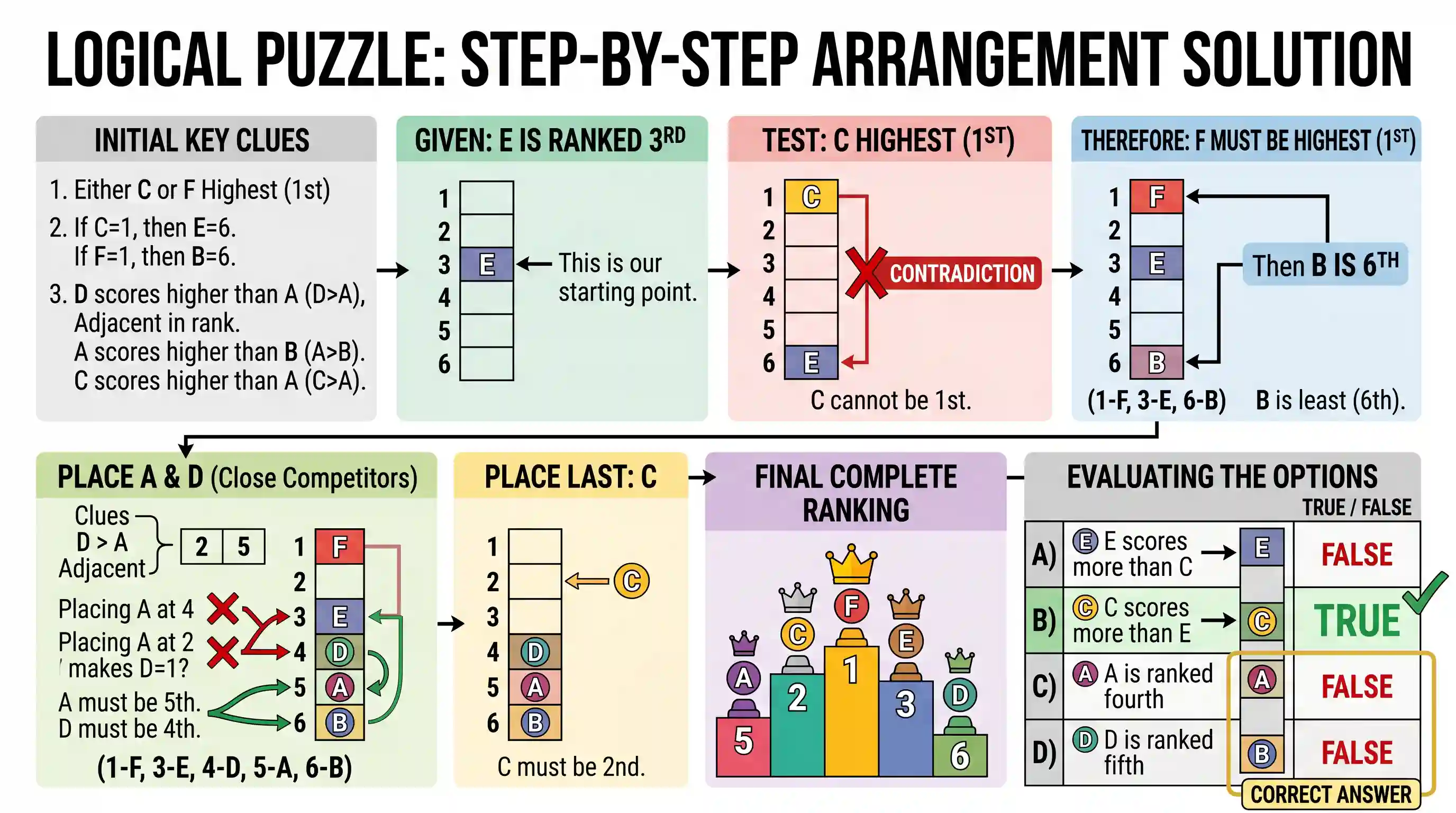
- If C were highest (1st rank), then E would be least (6th rank). This contradicts the given information that E is ranked third.
- Therefore, C cannot be highest. F must be the highest scorer (1st rank).
- Since F scores highest, according to condition 2, B scores the least (6th rank).
So far, we have: 1st: F 2nd: ? 3rd: E (given) 4th: ? 5th: ? 6th: B
Step 2: Place A and D using the "close competitors" condition.
- We know D > A, and they are adjacent. This means D is immediately above A in rank.
- From the relative ranks, we have C > A > B. Since B is 6th, A must be higher than 6th.
- A cannot be 1st (F is 1st), 3rd (E is 3rd), or 6th (B is 6th). So A can be 2nd, 4th, or 5th.
- If A is 2nd, then D would have to be 1st (to be immediately above A), but F is 1st. So A cannot be 2nd.
- If A is 4th, then D would have to be 3rd (to be immediately above A), but E is 3rd. So A cannot be 4th.
- Therefore, A must be 5th.
- If A is 5th, then D must be 4th (to be immediately above A).
Now the ranking looks like this: 1st: F 2nd: ? 3rd: E 4th: D 5th: A 6th: B
Step 3: Place the remaining student (C).
- The only remaining student is C, and the only remaining rank is 2nd.
- So, C must be 2nd.
The complete and unique ranking is: F (1st) > C (2nd) > E (3rd) > D (4th) > A (5th) > B (6th).
Step 4: Evaluate the options based on this ranking.
A) E gets more marks than C. E is 3rd, C is 2nd. C gets more marks than E. So, this statement is False.
B) C gets more marks than E. C is 2nd, E is 3rd. C gets more marks than E. So, this statement is True.
C) A is ranked fourth. A is ranked fifth. So, this statement is False.
D) D is ranked fifth. D is ranked fourth. So, this statement is False.
Therefore, the correct statement is B.
The final answer is B
Related questions
More UPSC Prelims practice from the same subject and topic.
- Prelims 2019CSATLogical Reasoning
A five-storeyed building with floors from I to V is painted using four different colours and only one colour is used to paint a floor. Consider the following statements: 1. The middle three floors are…
- Prelims 2019CSATLogical Reasoning
Six students A, B, C, D, E and F appeared in several tests. Either C or F scores the highest. Whenever C scores the highest, then E scores the least. Whenever F scores the highest, B scores the least.…
- Prelims 2019CSATLogical Reasoning
Six students A, B, C, D, E and F appeared in several tests. Either C or F scores the highest. Whenever C scores the highest, then E scores the least. Whenever F scores the highest, B scores the least.…
- Prelims 2019CSATLogical Reasoning
A' started from his house and walked 20 m towards East, where his friend 13' joined him. They together walked 10 m in the same direction. Then 'A' turned left while 'B' turned right and travelled 2 m …
- Prelims 2019CSATLogical Reasoning
Mr 'X' has three children. The birthday of the first child falls on the 5th Monday of April, that of the second one falls on the 5th Thursday of November. On which day is the birthday of his third chi…
- Prelims 2019CSATLogical Reasoning
Consider the following Statements and Conclusions: Statements: 1. Some rats are cats. 2. Some cats are dogs. 3. No dog is a cow. Conclusions: I. No cow is a cat. II. No dog is a rat. III. Some cats ar…