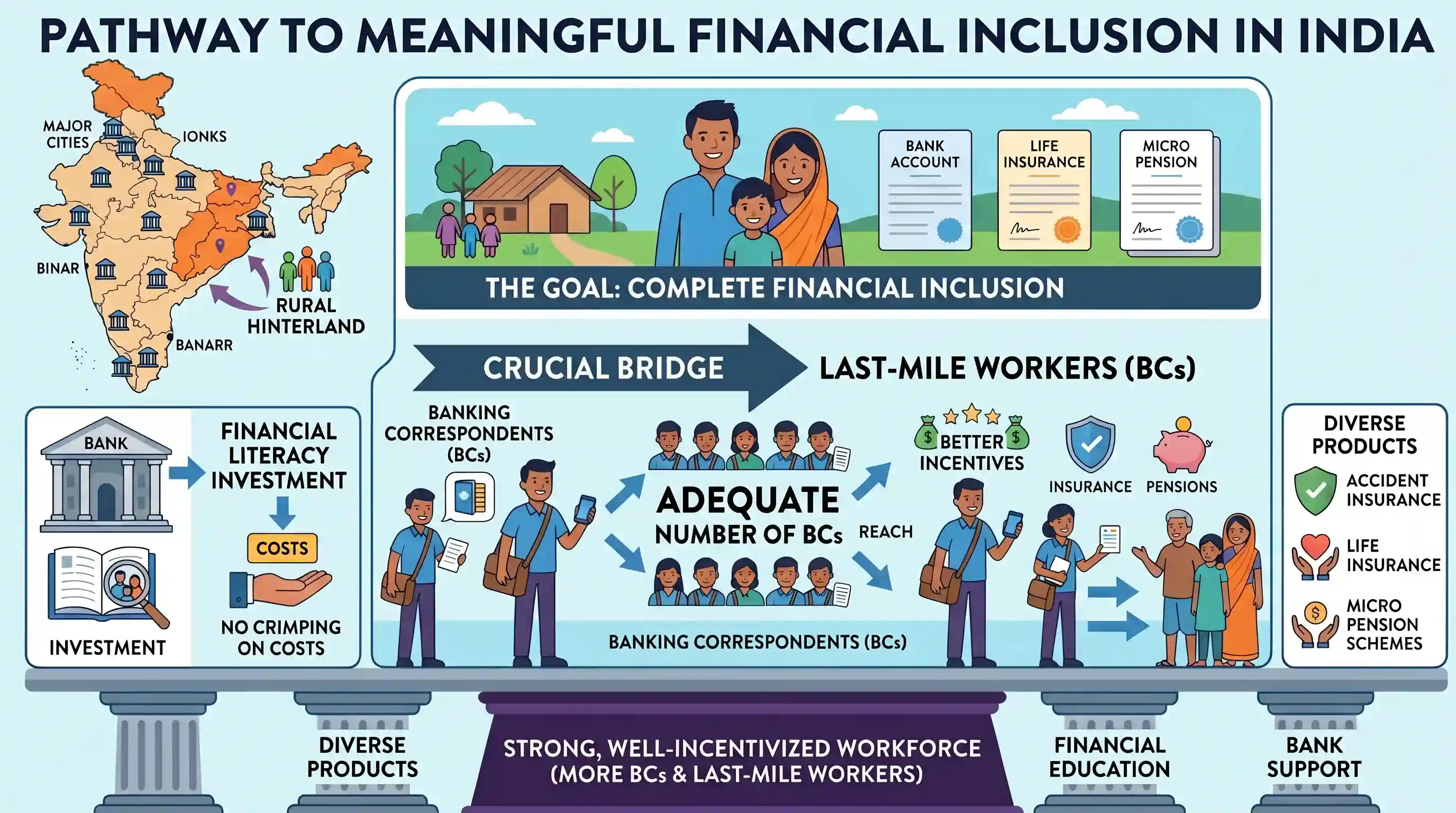
India has banking correspondents, who help bring people in the hinterland into the banking fold. For them to succeed, banks cannot crimp on costs. They also cannot afford to ignore investing in financial education and literacy. Banking correspondents are way too small to be viewed as a systemic risk. Yet India's banking regulator has restricted them to serving only one bank, perhaps to prevent arbitrage.'Efforts at banking outreach may succeed only if there are better incentives at work for such last-mile workers and also those providers who ensure not just basic bank accounts but also products such as accident and life insurance and micro pension schemes. Which one of the following is the most logical, rational and crucial inference that can be derived from the above passage?

- AEfforts to bring people in India's hinterland into the banking system are not successful
- BFor meaningful financial inclusion, India's banking system needs more number of banking correspondents and other such last-mile workersCorrect
- CMeaningful financial inclusion in India requires that banking correspondents have diverse skills
- DBetter banking outreach would be impossible unless each banking correspondent is allowed to serve a number of banks
Explanation
The passage highlights the critical role of banking correspondents (BCs) and other last-mile workers in achieving financial inclusion in India's hinterland. It points out that for these efforts to succeed, banks must not cut costs, must invest in financial education, and there must be better incentives for these last-mile workers and providers of diverse financial products. The overall tone suggests that the current system is not optimally structured or supported to achieve "meaningful financial inclusion."
Let's analyze the options:
A) Efforts to bring people in India's hinterland into the banking system are not successful. This is too strong a conclusion. The passage states "Efforts at banking outreach may succeed only if..." implying that current efforts could be more successful or are not fully successful under present conditions, but it doesn't definitively declare them "not successful." It's more about how to ensure success.
B) For meaningful financial inclusion, India's banking system needs more number of banking correspondents and other such last-mile workers. The passage emphasizes the crucial role of "banking correspondents" and "last-mile workers" in bringing people into the banking fold and providing diverse products. It states that "Efforts at banking outreach may succeed only if there are better incentives at work for such last-mile workers and also those providers..." This implies that the current system, in terms of its reach and effectiveness, is insufficient for "meaningful financial inclusion." To cover the vast "hinterland" and provide a range of services, a robust, well-incentivized, and implicitly, sufficiently numerous network of these workers is essential. The need for "better incentives" for these workers for efforts to "succeed" suggests that the current workforce might be inadequate in quantity or quality, or both, to achieve the desired level of inclusion. Thus, strengthening this workforce, which includes potentially increasing their number, is a logical and crucial inference.
C) Meaningful financial inclusion in India requires that banking correspondents have diverse skills. The passage mentions "providers who ensure not just basic bank accounts but also products such as accident and life insurance and micro pension schemes." While this implies a need for diverse offerings, it doesn't explicitly state that BCs themselves must possess all these diverse skills. It refers to "providers" generally. While plausible, it's not the most crucial or direct inference about the overall system's needs.
D) Better banking outreach would be impossible unless each banking correspondent is allowed to serve a number of banks. The passage notes the regulator's restriction on BCs serving only one bank but doesn't state that lifting this restriction is the only way for better outreach, or that outreach would be "impossible" without it. It presents it as a current policy and then immediately shifts to "better incentives" as a condition for success. "Impossible" is too strong a word not supported by the passage.
The most logical, rational, and crucial inference is B because the passage consistently highlights the importance of last-mile workers and the need to improve their conditions and the services they provide to achieve "meaningful financial inclusion" in the "hinterland." This inherently suggests a need for a stronger, more effective, and widespread network of such workers.
Related questions
More UPSC Prelims practice from the same subject and topic.
- Prelims 2019CSATReading Comprehension
What stands in the way of the widespread and careful adoption of 'Genetic Modification (GM)' technology is an 'Intellectual Property Rights' regime that seeks to create private monopolies for such tec…
- Prelims 2019CSATReading Comprehension
Passage-1 What stands in the way of the widespread and careful adoption of 'Genetic Modification (GM)' technology is an 'Intellectual Property Rights' regime that seeks to create private monopolies fo…
- Prelims 2019CSATReading Comprehension
Most invasive species are neither terribly successful nor very harmful. Britain's invasive plants are not widespread, not spreading especially quickly, and often less of a nuisance than vigorous nativ…
- Prelims 2019CSATReading Comprehension
Diarrhoeal deaths among Indian children are mostly due to food and water contamination. Use of contaminated groundwater and unsafe chemicals in agriculture, poor hygiene in storage and handling of foo…
- Prelims 2019CSATReading Comprehension
The interests of working and poor people have historically been neglected in the planning of our cities. Our cities are increasingly intolerant, unsafe and unlivable places for large numbers of citize…
- Prelims 2019CSATReading Comprehension
A vast majority of Indians are poor, with barely 10 percent employed in the organised sector. We are being convinced that vigorous economic growth is generating substantial employment. But this is not…