Passage-1 What stands in the way of the widespread and careful adoption of 'Genetic Modification (GM)' technology is an 'Intellectual Property Rights' regime that seeks to create private monopolies for such technologies. If GM technology is largely corporate driven, it seeks to maximize profits and that too in the short run. That is why corporations make major investments for herbicide- tolerant and pest- resistant crops. Such properties have only a short window, as soon enough, pests and weeds will evolve to overcome such resistance. This suits the corporations. The National Farmers Commission pointed out that priority must be given in genetic modification to the incorporation of genes that can help impart resistance to drought, salinity and other stresses. On the basis of the above passage, the following assumptions have been made: 1. The issue of effects of natural calamities on agriculture is not given due consideration by GM technology companies. 2. In the long run, GM technology will not be able to solve agricultural problems arising due to global warming. Which of the above assumptions is/are valid?

- A1 onlyCorrect
- B2 only
- CBoth 1 and 2
- DNeither 1 nor 2
Explanation
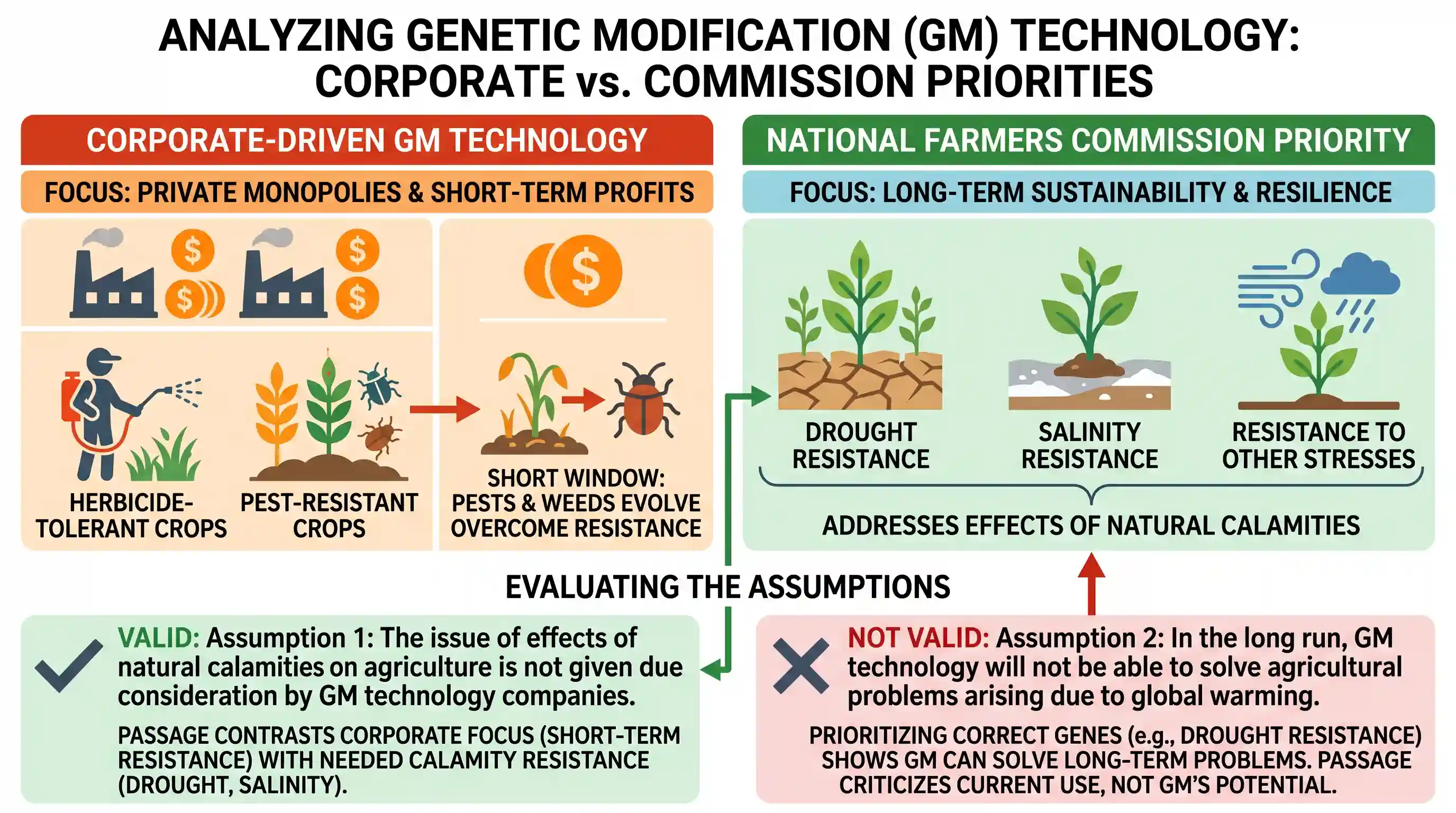
The passage highlights that the current corporate-driven Genetic Modification (GM) technology primarily focuses on short-term profits, leading to investments in herbicide-tolerant and pest-resistant crops. It explicitly contrasts this with the National Farmers Commission's recommendation to prioritize genes that impart resistance to drought, salinity, and other stresses (which are effects of natural calamities).
Let's analyze each assumption:
-
The issue of effects of natural calamities on agriculture is not given due consideration by GM technology companies.
- The passage states that corporations make major investments for herbicide-tolerant and pest-resistant crops.
- It then immediately follows by saying the National Farmers Commission pointed out that priority must be given in genetic modification to genes that can help impart resistance to drought, salinity, and other stresses.
- The contrast implies that these issues (effects of natural calamities like drought and salinity) are not currently the priority or are not given due consideration by the corporate-driven GM technology, which is focused on other areas for short-term profit.
- Therefore, this assumption is valid.
-
In the long run, GM technology will not be able to solve agricultural problems arising due to global warming.
- The passage criticizes the current corporate-driven approach to GM technology, which focuses on short-term profits and crops with limited effectiveness due to evolving pests/weeds.
- However, it does not state that GM technology itself (as a scientific tool) is inherently incapable of solving long-term agricultural problems, including those arising from global warming (like drought and salinity resistance). In fact, the National Farmers Commission's suggestion implies that GM technology could be used for these purposes if priorities were shifted.
- The passage points to issues with the application and motivation of GM technology under a specific regime, not its fundamental inability to solve problems in the long run.
- Therefore, this assumption is not valid.
Based on the analysis, only assumption 1 is valid.
The final answer is A
Related questions
More UPSC Prelims practice from the same subject and topic.
- Prelims 2019CSATReading Comprehension
What stands in the way of the widespread and careful adoption of 'Genetic Modification (GM)' technology is an 'Intellectual Property Rights' regime that seeks to create private monopolies for such tec…
- Prelims 2019CSATReading Comprehension
Most invasive species are neither terribly successful nor very harmful. Britain's invasive plants are not widespread, not spreading especially quickly, and often less of a nuisance than vigorous nativ…
- Prelims 2019CSATReading Comprehension
Diarrhoeal deaths among Indian children are mostly due to food and water contamination. Use of contaminated groundwater and unsafe chemicals in agriculture, poor hygiene in storage and handling of foo…
- Prelims 2019CSATReading Comprehension
The interests of working and poor people have historically been neglected in the planning of our cities. Our cities are increasingly intolerant, unsafe and unlivable places for large numbers of citize…
- Prelims 2019CSATReading Comprehension
A vast majority of Indians are poor, with barely 10 percent employed in the organised sector. We are being convinced that vigorous economic growth is generating substantial employment. But this is not…
- Prelims 2019CSATReading Comprehension
India has banking correspondents, who help bring people in the hinterland into the banking fold. For them to succeed, banks cannot crimp on costs. They also cannot afford to ignore investing in financ…