What stands in the way of the widespread and careful adoption of 'Genetic Modification (GM)' technology is an 'Intellectual Property Rights' regime that seeks to create private monopolies for such technologies. If GM technology is largely corporate driven, it seeks to maximize profits and that too in the short run. That is why corporations make major investments for herbicide- tolerant and pest- resistant crops. Such properties have only a short window, as soon enough, pests and weeds will evolve to overcome such resistance. This suits the corporations. The National Farmers Commission pointed out that priority must be given in genetic modification to the incorporation of genes that can help impart resistance to drought, salinity and other stresses. Which one of the following is the most logical, rational and crucial message conveyed by the above passage?

- APublic research institutions should take the lead in GM technology and prioritise the technology agendaCorrect
- BDeveloping countries should raise this issue in WTO and ensure the abolition of Intellectual Property Rights
- CPrivate corporations should not be allowed to do agribusiness in India, particularly the seed business
- DPresent Indian circumstances do not favour the cultivation of genetically modified crops.
Explanation
The passage highlights two main problems:
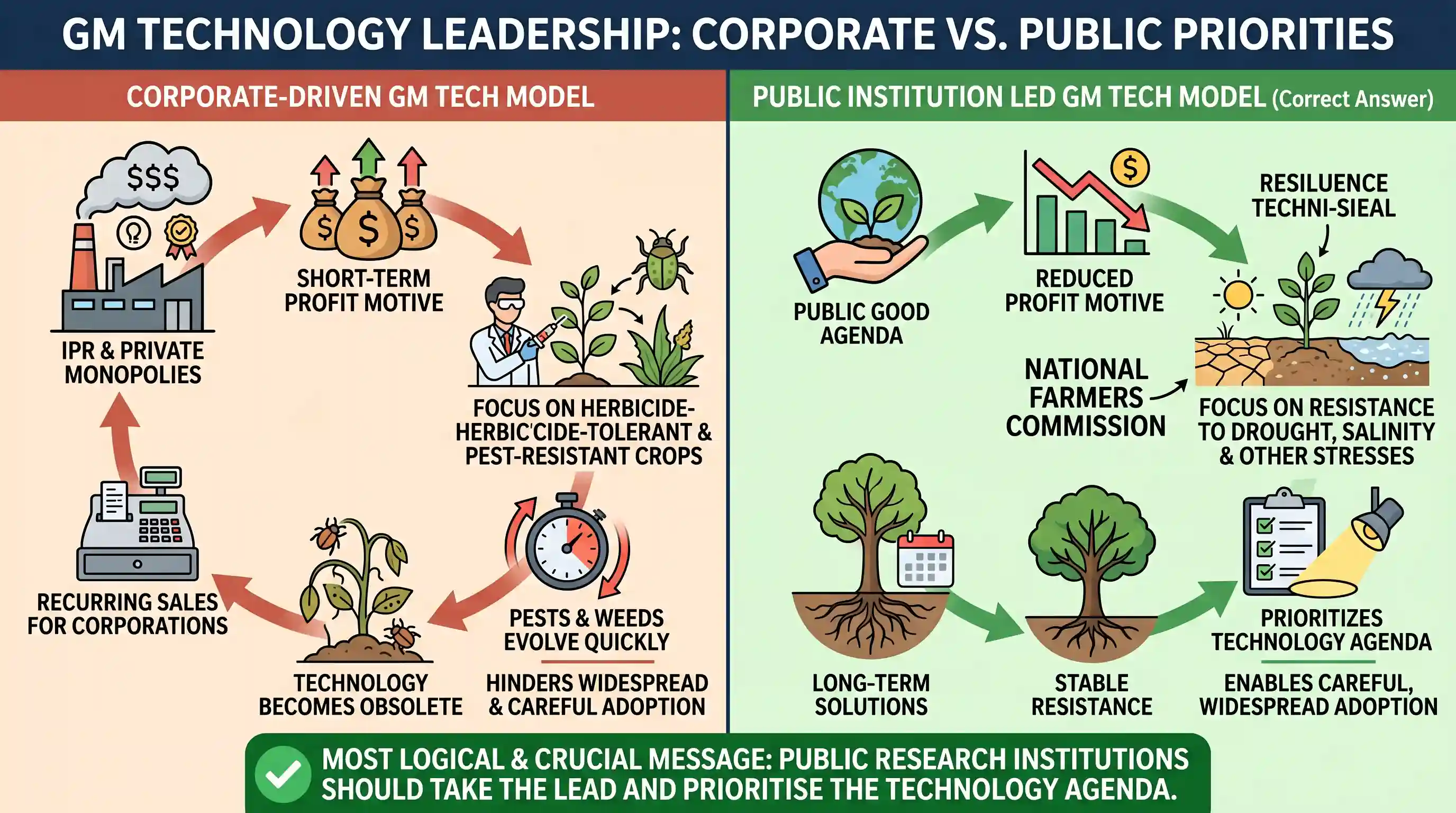
- The Intellectual Property Rights (IPR) regime creates private monopolies, hindering widespread and careful adoption of GM technology.
- GM technology is largely corporate-driven, focusing on short-term profits (e.g., herbicide/pest resistance that quickly becomes obsolete, ensuring recurring sales) rather than long-term public good (e.g., drought/salinity resistance, as recommended by the National Farmers Commission).
Let's analyze the options:
A) Public research institutions should take the lead in GM technology and prioritise the technology agenda. This option directly addresses both problems. If public institutions lead, the profit motive (driven by IPRs and corporate interests) is reduced, allowing for a focus on the public good agenda (drought, salinity resistance) as advocated by the National Farmers Commission. This would facilitate "widespread and careful adoption" of beneficial GM traits. This is the most logical, rational, and crucial message.
B) Developing countries should raise this issue in WTO and ensure the abolition of Intellectual Property Rights. While IPRs are mentioned as a barrier, the passage critiques the misdirection of GM technology due to corporate interests enabled by IPRs, not necessarily calling for the complete abolition of IPRs. Abolition is an extreme measure not explicitly advocated as the primary solution. The core issue is the prioritization of research, not just the existence of IPRs.
C) Private corporations should not be allowed to do agribusiness in India, particularly the seed business. The passage criticizes the focus and short-term profit motive of corporate-driven GM, not the existence of private corporations in agribusiness altogether. This option is too extreme and goes beyond the scope of the passage's specific critique.
D) Present Indian circumstances do not favour the cultivation of genetically modified crops. The passage does not state that GM crops are unsuitable for India. Instead, it argues that the type of GM research being prioritized (corporate-driven, short-term profit) is problematic, and that other types of GM (drought, salinity resistance) would be beneficial, implying that GM technology itself could be valuable if directed properly.
Therefore, option A provides the most comprehensive and direct solution to the problems identified in the passage.
Related questions
More UPSC Prelims practice from the same subject and topic.
- Prelims 2019CSATReading Comprehension
Passage-1 What stands in the way of the widespread and careful adoption of 'Genetic Modification (GM)' technology is an 'Intellectual Property Rights' regime that seeks to create private monopolies fo…
- Prelims 2019CSATReading Comprehension
Most invasive species are neither terribly successful nor very harmful. Britain's invasive plants are not widespread, not spreading especially quickly, and often less of a nuisance than vigorous nativ…
- Prelims 2019CSATReading Comprehension
Diarrhoeal deaths among Indian children are mostly due to food and water contamination. Use of contaminated groundwater and unsafe chemicals in agriculture, poor hygiene in storage and handling of foo…
- Prelims 2019CSATReading Comprehension
The interests of working and poor people have historically been neglected in the planning of our cities. Our cities are increasingly intolerant, unsafe and unlivable places for large numbers of citize…
- Prelims 2019CSATReading Comprehension
A vast majority of Indians are poor, with barely 10 percent employed in the organised sector. We are being convinced that vigorous economic growth is generating substantial employment. But this is not…
- Prelims 2019CSATReading Comprehension
India has banking correspondents, who help bring people in the hinterland into the banking fold. For them to succeed, banks cannot crimp on costs. They also cannot afford to ignore investing in financ…