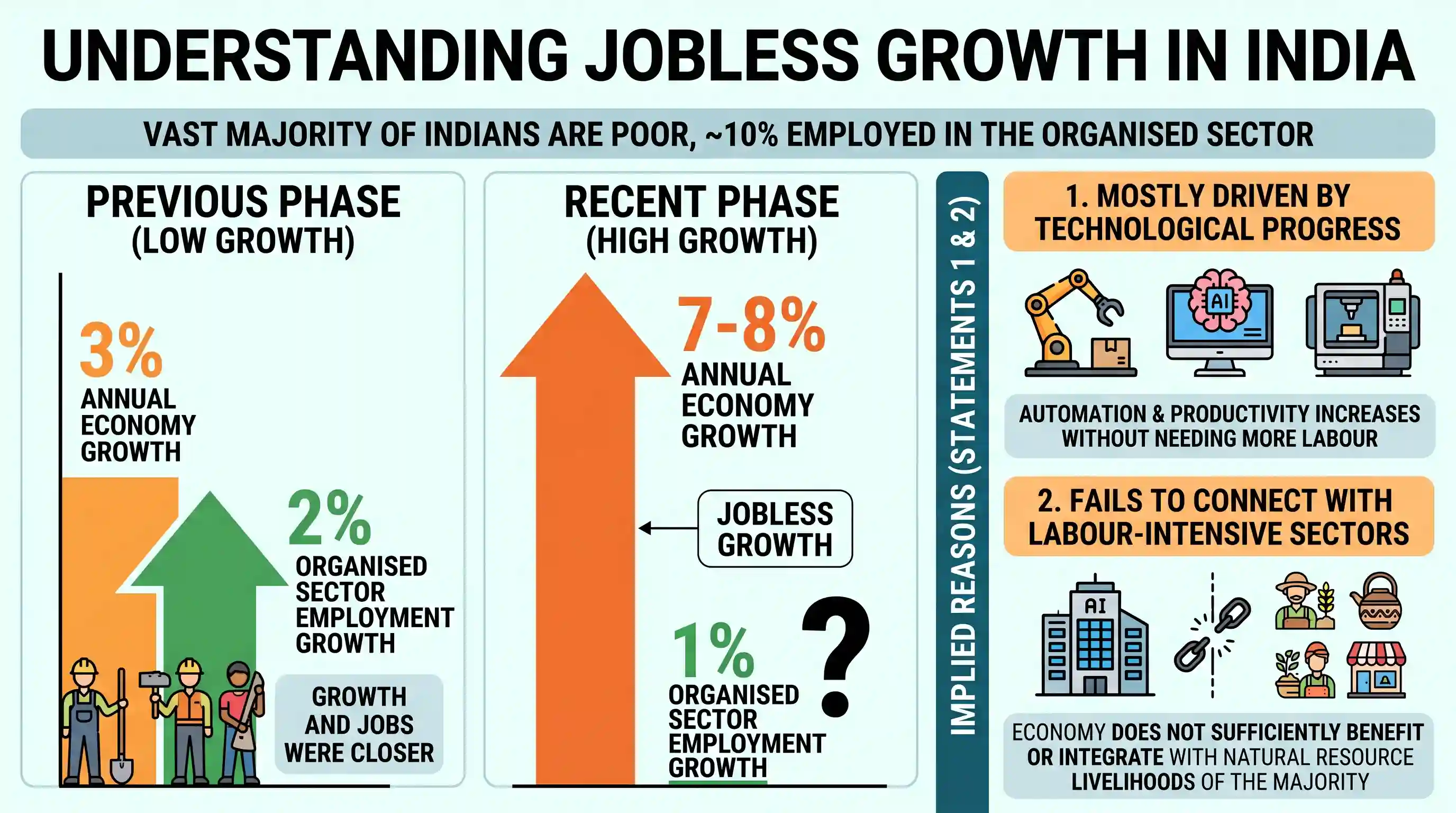
A vast majority of Indians are poor, with barely 10 percent employed in the organised sector. We are being convinced that vigorous economic growth is generating substantial employment. But this is not so. When our economy was growing at 3 percent per year, employment in the organised sector was growing at 2 percent per year. As the economy began to grow at 7 - 8 percent per year, the rate of growth of employment in the organised sector actually declined to 1 percent per year. The above passage seems to imply that 1. most of modern economic growth is based on technological progress. 2. much of modern Indian economy does not nurture sufficient symbiotic relationship with labour-intensive, natural resource-based livelihoods. 3. service sector in India is not very labour-intensive. 4. literate rural population is not willing to enter organised sector. Which of the statements given above are correct?

- A1 and 2 onlyCorrect
- B3 and 4 only
- C1, 2 and 3 only
- D1, 2, 3 and 4
Explanation
The passage describes a situation where high economic growth (7-8% per year) is accompanied by very low growth in organised sector employment (1% per year), a phenomenon often referred to as "jobless growth." This contrasts with an earlier period where 3% economic growth led to 2% organised sector employment growth.
Let's analyze each statement:
-
most of modern economic growth is based on technological progress.
- If the economy is growing rapidly but not creating many jobs, it implies that the growth is driven by factors that increase productivity per worker rather than by increasing the number of workers. Technological progress (e.g., automation, advanced machinery, efficient processes) is a primary driver of such productivity-led, less labor-intensive growth. This statement is strongly implied by the "jobless growth" described.
-
much of modern Indian economy does not nurture sufficient symbiotic relationship with labour-intensive, natural resource-based livelihoods.
- The passage states that a "vast majority of Indians are poor, with barely 10 percent employed in the organised sector." This means the majority rely on the unorganised sector, agriculture, or other traditional, often labour-intensive and natural resource-based livelihoods. The fact that high economic growth is not generating substantial employment, particularly in the organised sector, suggests a disconnect. The benefits of modern economic growth are not sufficiently trickling down to or integrating with these traditional, labour-intensive sectors, failing to improve the livelihoods of the majority. This statement is implied.
-
service sector in India is not very labour-intensive.
- The passage discusses overall economic growth and organised sector employment. It does not provide specific data or insights into the labour intensity of different sectors (like manufacturing or services). While "jobless growth" could affect the service sector, we cannot conclude that the entire service sector is not very labour-intensive solely from the given information.
-
literate rural population is not willing to enter organised sector.
- The passage focuses on the supply of jobs (or lack thereof) in the organised sector despite high economic growth. It does not discuss the willingness of any particular demographic to enter this sector. The problem highlighted is the nature of growth, not the attitude of the workforce.
Based on the analysis, statements 1 and 2 are directly implied by the passage's description of "jobless growth" and the disconnect between overall economic prosperity and widespread employment generation for the majority.
The final answer is A
Related questions
More UPSC Prelims practice from the same subject and topic.
- Prelims 2019CSATReading Comprehension
What stands in the way of the widespread and careful adoption of 'Genetic Modification (GM)' technology is an 'Intellectual Property Rights' regime that seeks to create private monopolies for such tec…
- Prelims 2019CSATReading Comprehension
Passage-1 What stands in the way of the widespread and careful adoption of 'Genetic Modification (GM)' technology is an 'Intellectual Property Rights' regime that seeks to create private monopolies fo…
- Prelims 2019CSATReading Comprehension
Most invasive species are neither terribly successful nor very harmful. Britain's invasive plants are not widespread, not spreading especially quickly, and often less of a nuisance than vigorous nativ…
- Prelims 2019CSATReading Comprehension
Diarrhoeal deaths among Indian children are mostly due to food and water contamination. Use of contaminated groundwater and unsafe chemicals in agriculture, poor hygiene in storage and handling of foo…
- Prelims 2019CSATReading Comprehension
The interests of working and poor people have historically been neglected in the planning of our cities. Our cities are increasingly intolerant, unsafe and unlivable places for large numbers of citize…
- Prelims 2019CSATReading Comprehension
India has banking correspondents, who help bring people in the hinterland into the banking fold. For them to succeed, banks cannot crimp on costs. They also cannot afford to ignore investing in financ…