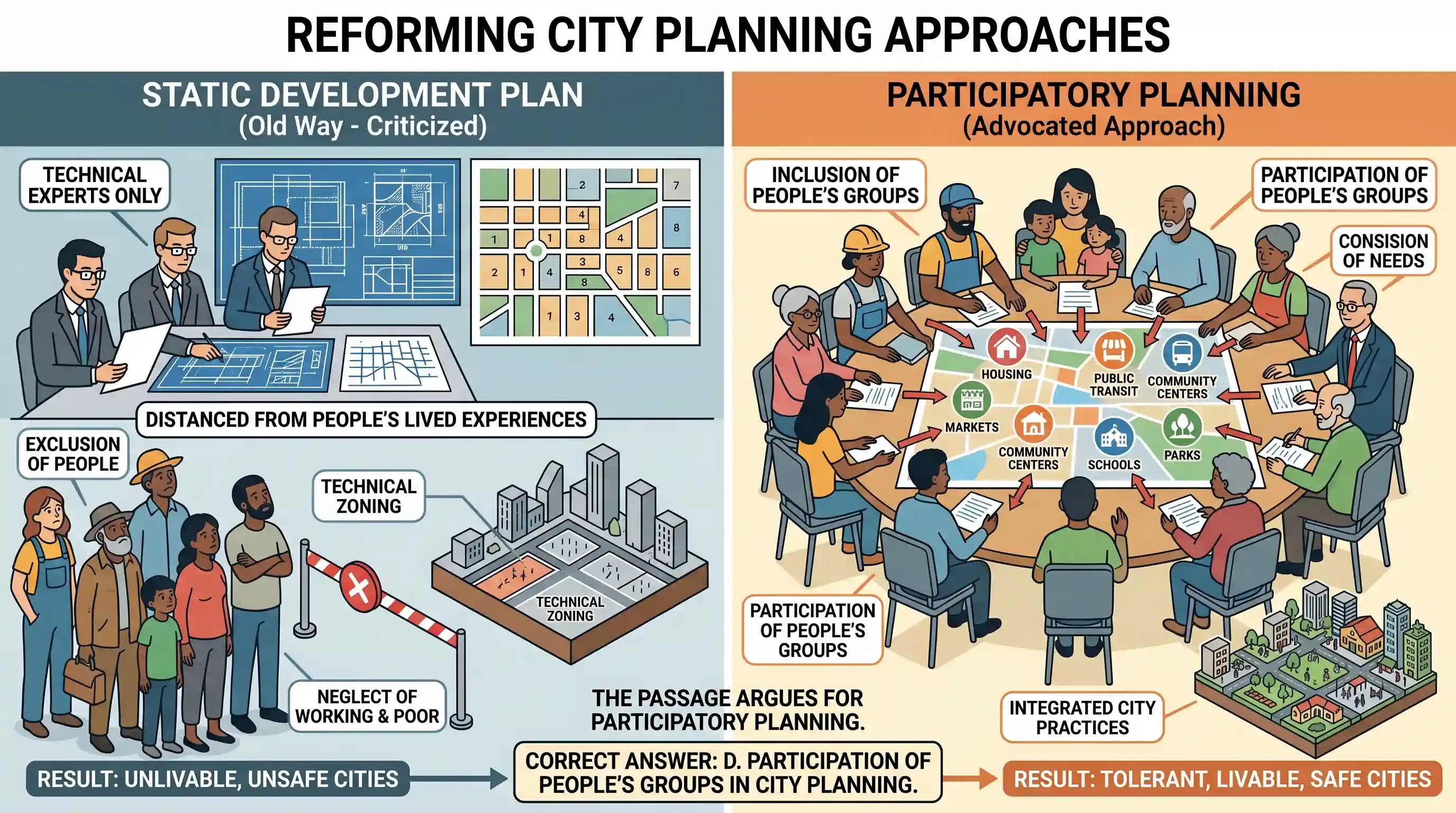
The interests of working and poor people have historically been neglected in the planning of our cities. Our cities are increasingly intolerant, unsafe and unlivable places for large numbers of citizens and yet we continue to plan via the old ways – the static Development Plan – that draws exclusively from technical expertise, distanced from people's live experiences and needs, and actively excluding large number of people, places, activities and practices that are an integral part of the city. The passage seems to argue

- Aagainst the monopoly of builders and the interests of elite groups
- Bagainst the need for global and smart cities
- Cin favour of planning cities mainly for working class and poor people
- Din favour of participation of peoples' groups in city planning.Correct
Explanation
The passage criticizes the current city planning method for being "distanced from people's live experiences and needs" and "actively excluding large number of people." It highlights that the interests of working and poor people have been "neglected."
Let's analyze the options:
A) against the monopoly of builders and the interests of elite groups The passage mentions neglect of working and poor people, which might indirectly relate to elite interests, but it doesn't explicitly mention builders or their monopoly. The primary focus is on the method of planning and its exclusionary nature, not specific groups benefiting from it.
B) against the need for global and smart cities The passage does not mention "global" or "smart cities" at all. This option introduces concepts not discussed in the text.
C) in favour of planning cities mainly for working class and poor people While the passage states that the interests of working and poor people have been neglected, it argues against exclusion and for incorporating "people's live experiences and needs." This implies inclusive planning, not necessarily planning mainly for one group to the exclusion of others. The argument is for their inclusion, not their sole priority.
D) in favour of participation of peoples' groups in city planning. This option directly addresses the core criticism of the passage. The passage laments planning that is "distanced from people's live experiences and needs" and "actively excluding large number of people." The logical counter-argument, and what the passage implicitly advocates for, is a planning process that includes people's live experiences and needs, which means "participation of peoples' groups in city planning." This directly solves the problem of exclusion and distance from real-life experiences.
Therefore, D is the most accurate reflection of the passage's argument.
Related questions
More UPSC Prelims practice from the same subject and topic.
- Prelims 2019CSATReading Comprehension
What stands in the way of the widespread and careful adoption of 'Genetic Modification (GM)' technology is an 'Intellectual Property Rights' regime that seeks to create private monopolies for such tec…
- Prelims 2019CSATReading Comprehension
Passage-1 What stands in the way of the widespread and careful adoption of 'Genetic Modification (GM)' technology is an 'Intellectual Property Rights' regime that seeks to create private monopolies fo…
- Prelims 2019CSATReading Comprehension
Most invasive species are neither terribly successful nor very harmful. Britain's invasive plants are not widespread, not spreading especially quickly, and often less of a nuisance than vigorous nativ…
- Prelims 2019CSATReading Comprehension
Diarrhoeal deaths among Indian children are mostly due to food and water contamination. Use of contaminated groundwater and unsafe chemicals in agriculture, poor hygiene in storage and handling of foo…
- Prelims 2019CSATReading Comprehension
A vast majority of Indians are poor, with barely 10 percent employed in the organised sector. We are being convinced that vigorous economic growth is generating substantial employment. But this is not…
- Prelims 2019CSATReading Comprehension
India has banking correspondents, who help bring people in the hinterland into the banking fold. For them to succeed, banks cannot crimp on costs. They also cannot afford to ignore investing in financ…