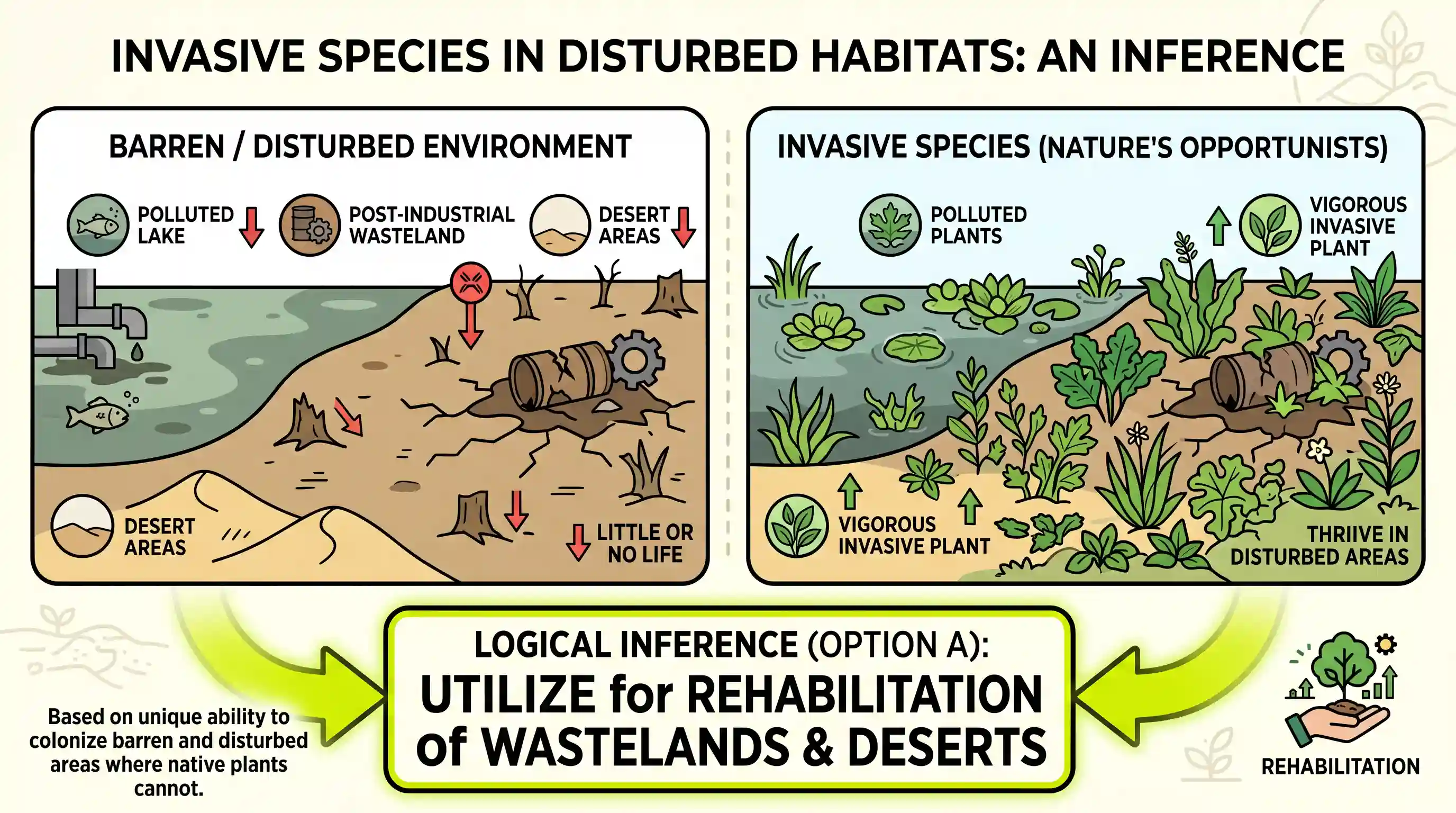
Most invasive species are neither terribly successful nor very harmful. Britain's invasive plants are not widespread, not spreading especially quickly, and often less of a nuisance than vigorous natives such as bracken. The arrival of new species almost always increases biological diversity in a region; in many cases, a flood of newcomers drives no native species to extinction. One reason is that invaders tend to colonise disturbed habitats like polluted lakes and post-industrial wasteland, where little else lives. They are nature's opportunists. Which one of the following is the most logical and rational inference that can be made from the above passage?

- AInvasive species should be used to rehabilitate desert areas and wastelands of a countryCorrect
- BLaws against the introduction of foreign plants are unnecessary
- CSometimes, the campaigns against foreign plants are pointless
- DForeign plants should be used to increase the biodiversity of a country.
Explanation
The passage argues that most invasive species are not very harmful and often increase biodiversity without causing extinction. Crucially, it states that "invaders tend to colonise disturbed habitats like polluted lakes and post-industrial wasteland, where little else lives. They are nature's opportunists."
Let's analyze the options:
A) Invasive species should be used to rehabilitate desert areas and wastelands of a country. This is the most logical inference. The passage explicitly highlights that these species colonize "disturbed habitats" and "wasteland" where "little else lives," acting as "nature's opportunists." This directly implies their potential utility in rehabilitating such barren or degraded areas, including wastelands and potentially desert areas (which can be considered disturbed or barren habitats).
B) Laws against the introduction of foreign plants are unnecessary. The passage uses terms like "most" and "many cases," implying that some invasive species might still be harmful or cause extinction. Therefore, concluding that all laws are unnecessary is too strong and goes beyond the scope of the passage's qualified statements.
C) Sometimes, the campaigns against foreign plants are pointless. While the passage suggests that many invasive species are not harmful and even beneficial, leading to the idea that campaigns against them might sometimes be pointless, option A is a more direct and positive inference about their potential use based on their described characteristics (colonizing disturbed habitats). The passage describes a specific function of invaders, which option A leverages.
D) Foreign plants should be used to increase the biodiversity of a country. The passage states that new species "almost always increases biological diversity." However, the concluding thought of the passage focuses on their role in colonizing disturbed habitats where little else lives, rather than a general recommendation for biodiversity enhancement across all ecosystems. Option A is more specific to the practical application highlighted in the passage's closing sentences.
Therefore, option A is the most direct and rational inference, as it proposes a practical application based on the described opportunistic nature of invasive species in disturbed and barren environments.
Related questions
More UPSC Prelims practice from the same subject and topic.
- Prelims 2019CSATReading Comprehension
What stands in the way of the widespread and careful adoption of 'Genetic Modification (GM)' technology is an 'Intellectual Property Rights' regime that seeks to create private monopolies for such tec…
- Prelims 2019CSATReading Comprehension
Passage-1 What stands in the way of the widespread and careful adoption of 'Genetic Modification (GM)' technology is an 'Intellectual Property Rights' regime that seeks to create private monopolies fo…
- Prelims 2019CSATReading Comprehension
Diarrhoeal deaths among Indian children are mostly due to food and water contamination. Use of contaminated groundwater and unsafe chemicals in agriculture, poor hygiene in storage and handling of foo…
- Prelims 2019CSATReading Comprehension
The interests of working and poor people have historically been neglected in the planning of our cities. Our cities are increasingly intolerant, unsafe and unlivable places for large numbers of citize…
- Prelims 2019CSATReading Comprehension
A vast majority of Indians are poor, with barely 10 percent employed in the organised sector. We are being convinced that vigorous economic growth is generating substantial employment. But this is not…
- Prelims 2019CSATReading Comprehension
India has banking correspondents, who help bring people in the hinterland into the banking fold. For them to succeed, banks cannot crimp on costs. They also cannot afford to ignore investing in financ…