How many triplets (x,y,z) satisfy the equation x + y + z = 6 , where x, y and z are natural numbers?

- A4
- B5
- C9
- D10Correct
Explanation
The problem asks for the number of triplets (x,y,z) of natural numbers that satisfy the equation x + y + z = 6. Natural numbers are positive integers (1, 2, 3, ...).
This is a classic combinatorial problem that can be solved using the "stars and bars" method.
-
Transform the variables: Since x, y, and z must be natural numbers (i.e., x >= 1, y >= 1, z >= 1), we can introduce new variables that are non-negative integers. Let x' = x - 1, y' = y - 1, z' = z - 1. Then x' >= 0, y' >= 0, z' >= 0.
-
Substitute into the equation: (x' + 1) + (y' + 1) + (z' + 1) = 6 x' + y' + z' + 3 = 6 x' + y' + z' = 3
-
Apply stars and bars: We now need to find the number of non-negative integer solutions to x' + y' + z' = 3. The formula for the number of non-negative integer solutions to x1 + x2 + ... + xk = n is C(n + k - 1, k - 1) or C(n + k - 1, n). In our case, n = 3 (the sum) and k = 3 (the number of variables).
Number of solutions = C(3 + 3 - 1, 3 - 1) = C(5, 2) C(5, 2) = 5! / (2! * (5-2)!) = 5! / (2! * 3!) = (5 * 4) / (2 * 1) = 10.
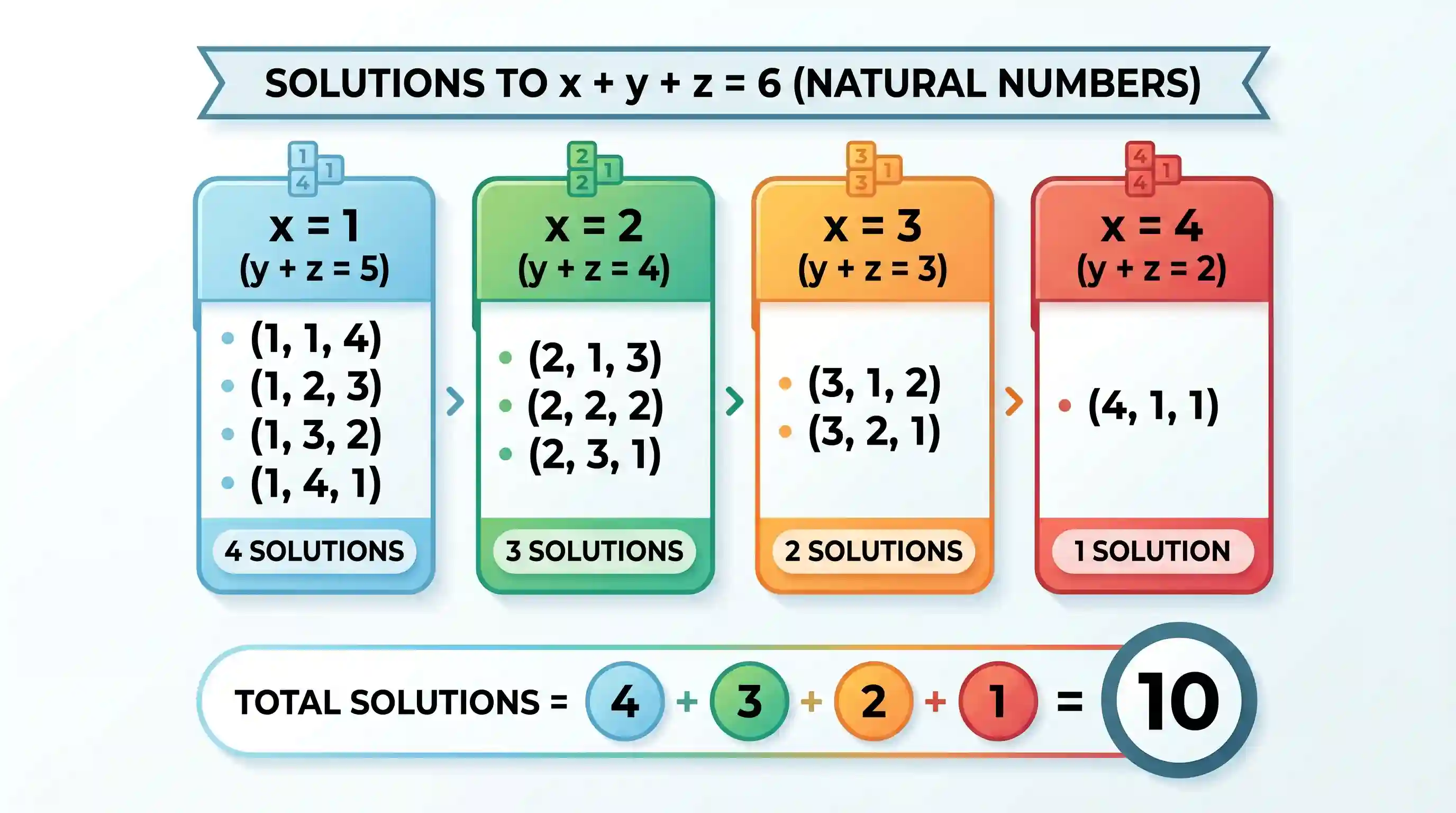
Alternatively, we can list the solutions systematically: Since x, y, z >= 1 and x + y + z = 6:
- If x = 1: y + z = 5. Possible (y,z) are (1,4), (2,3), (3,2), (4,1). (4 solutions)
- If x = 2: y + z = 4. Possible (y,z) are (1,3), (2,2), (3,1). (3 solutions)
- If x = 3: y + z = 3. Possible (y,z) are (1,2), (2,1). (2 solutions)
- If x = 4: y + z = 2. Possible (y,z) is (1,1). (1 solution)
- If x >= 5: y + z = 6 - x. If x = 5, y + z = 1, which has no solutions for y,z >= 1.
Total number of solutions = 4 + 3 + 2 + 1 = 10.
The final answer is 10.
The final answer is D
Related questions
More UPSC Prelims practice from the same subject and topic.
- Prelims 2019CSATQuantitative Aptitude
The number of parallelograms that can be formed from a set of four parallel lines intersecting another set of four parallel lines, is
- Prelims 2019CSATQuantitative Aptitude
In a conference, out of a total 100 participants, 70 are Indians. If 60 of the total participants are vegetarian, then which of the following statements is/are correct? 1. At least 30 Indian participa…
- Prelims 2019CSATQuantitative Aptitude
All members of a club went to Mumbai and stayed in a hotel. On the first day, 80% went for shopping and 50% went for sightseeing, whereas 10% took rest in the hotel. Which of the following conclusion(…
- Prelims 2019CSATQuantitative Aptitude
Each face of a cube can be painted in black or white colours. In how many different ways can the cube be painted?
- Prelims 2019CSATQuantitative Aptitude
In a group of 15 people; 7 can read French, 8 can read English while 3 of them can read neither of these two languages. The number of people who can read exactly one language is
- Prelims 2019CSATQuantitative Aptitude
The number of times the digit 5 will appear while writing the integers from 1 to 1000 is