Rakesh and Rajesh together bought 10 balls and 10 rackets. Rakesh spent 1300 and Rajesh spent 1500. If each racket costs three times a ball does, then what is the price of a racket?

- ARs 70
- BRs 90
- CRs 210Correct
- DRs 240
Explanation
Let 'b' be the price of a ball and 'r' be the price of a racket.
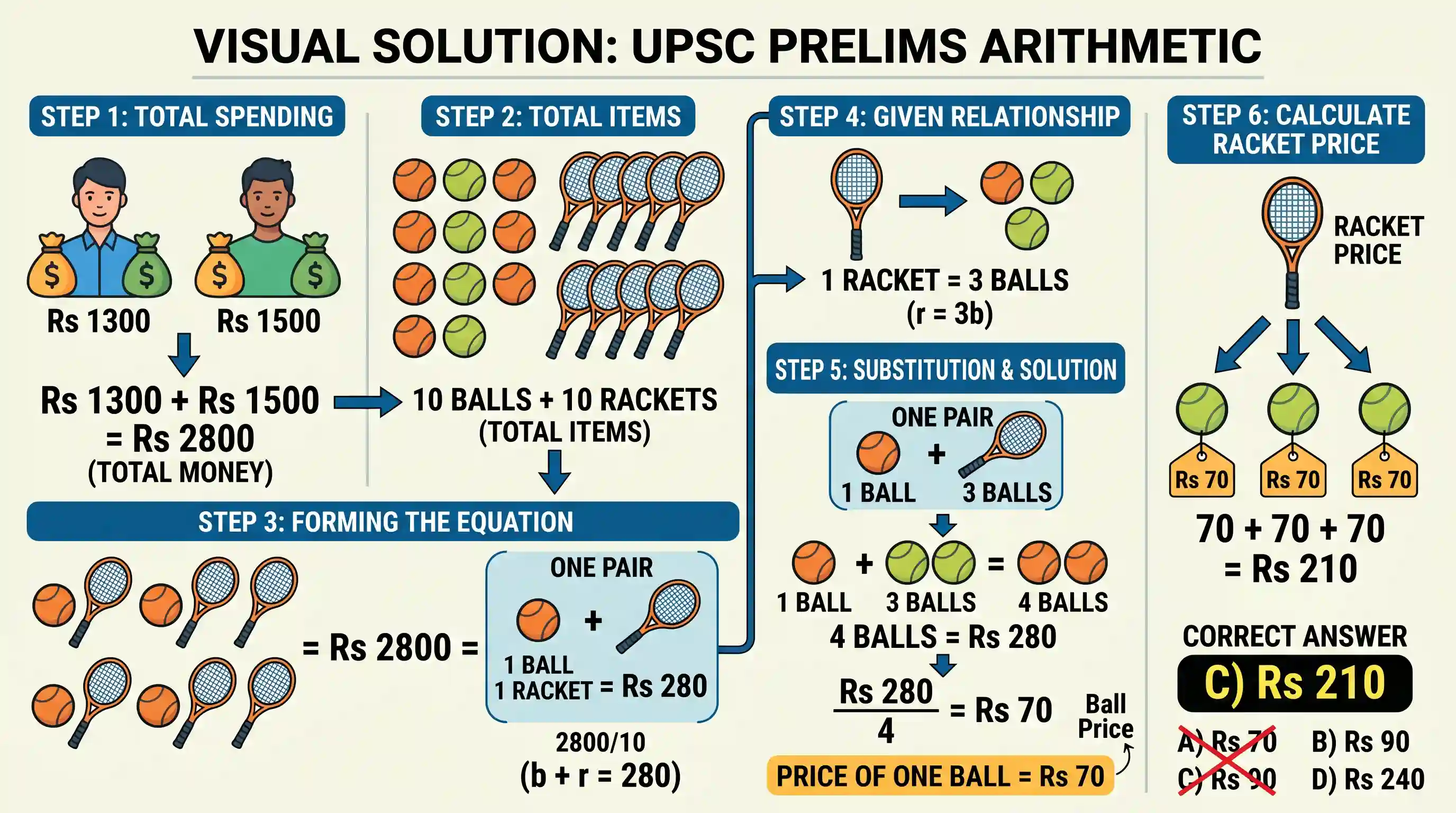
- Calculate the total money spent: Rakesh spent 1300 and Rajesh spent 1500. So, total money spent = 1300 + 1500 = 2800.
- Identify the total items bought: Together, they bought 10 balls and 10 rackets.
- Formulate an equation for the total cost: The total cost of 10 balls and 10 rackets is 10b + 10r. So, 10b + 10r = 2800. Divide the entire equation by 10: b + r = 280.
- Use the given relationship between prices: Each racket costs three times a ball, which means r = 3b.
- Substitute the relationship into the equation: Replace 'r' with '3b' in the equation b + r = 280. b + (3b) = 280 4b = 280 b = 280 / 4 b = 70. So, the price of a ball is Rs 70.
- Calculate the price of a racket: Since r = 3b, then r = 3 * 70 = 210.
Therefore, the price of a racket is Rs 210.
Analyzing the options: A) Rs 70: This is the price of a ball, not a racket. B) Rs 90: This is incorrect. C) Rs 210: This matches our calculated price for a racket. D) Rs 240: This is incorrect.
The final answer is C.
Related questions
More UPSC Prelims practice from the same subject and topic.
- Prelims 2019CSATQuantitative Aptitude
A and B are two heavy steel blocks. If B is placed on the top of A, the weight increases by 60%. How much weight will reduce with respect to the total weight of A and B, if B is removed from the top o…
- Prelims 2019CSATQuantitative Aptitude
When a runner was crossing the 12 km mark, she was informed that she had completed only 80% of the race. How many kilometres was the runner supposed to run in this event?
- Prelims 2019CSATQuantitative Aptitude
Raju has Rs. 9000 with him and he wants to buy a mobile handset; but he finds that he has only 75% of the amount required to buy the handset. Therefore, he borrows 2000 from a friend. Then
- Prelims 2019CSATQuantitative Aptitude
In 2002, Meenu's age was one-third of the age of Meera, whereas in 2010, Meenu's age was half the age of Meera. What is Meenu's year of birth?
- Prelims 2019CSATQuantitative Aptitude
In an examination, A has scored 20 marks more than B. If B has scored 5% less marks than A, how much has B scored?
- Prelims 2019CSATQuantitative Aptitude
Ena was born 4 years after her parents' marriage. Her mother is three years younger than her father and 24 years older than Ena, who is 13 years old. At what age did Ena's father get married