Seeta and Geeta go for a swim after a gap of every 2 days and every 3 days respectively. If on 1st January both of them went for a swim together, when will they go together next?

- A7th JanuaryCorrect
- B8th January
- C12th January
- D13th January
Explanation
The problem requires finding the next common day for two events that occur at regular intervals. This is a classic application of the Least Common Multiple (LCM).
-
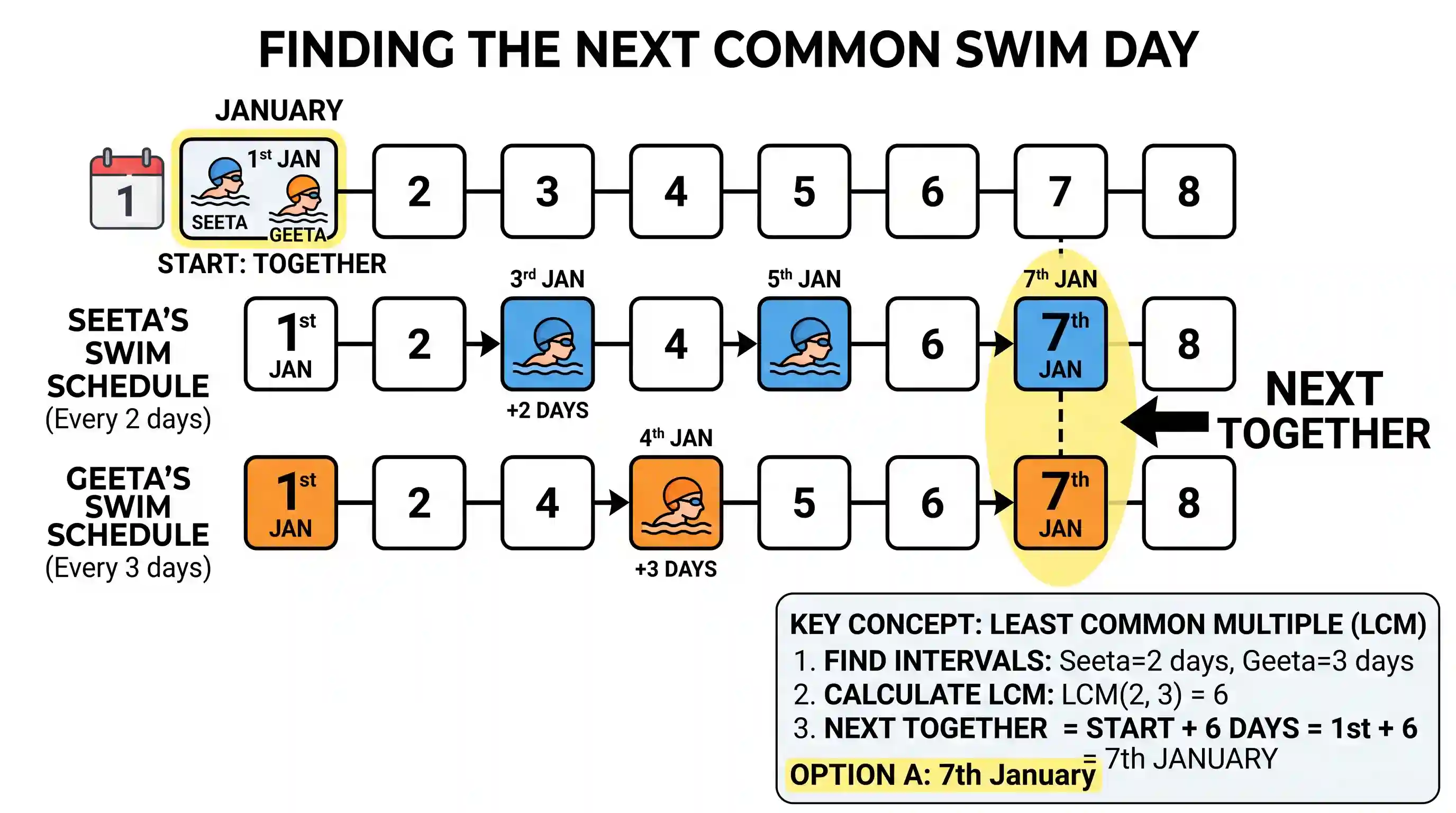
Understand the frequency for Seeta: Seeta goes for a swim "after a gap of every 2 days". In the context of such problems, this is typically interpreted as swimming every 2 days. So, if she swims on Day 1 (1st January), her subsequent swim days will be: 1 + 2 = 3rd January 3 + 2 = 5th January 5 + 2 = 7th January And so on. Seeta's swim days: 1st, 3rd, 5th, 7th, 9th, ... January.
-
Understand the frequency for Geeta: Geeta goes for a swim "after a gap of every 3 days". This is interpreted as swimming every 3 days. So, if she swims on Day 1 (1st January), her subsequent swim days will be: 1 + 3 = 4th January 4 + 3 = 7th January 7 + 3 = 10th January And so on. Geeta's swim days: 1st, 4th, 7th, 10th, 13th, ... January.
-
Find the next common day: Both Seeta and Geeta swam together on 1st January. We need to find the next day they will swim together. We look for the next common day in their schedules: Seeta's days: 1, 3, 5, 7, 9, ... Geeta's days: 1, 4, 7, 10, ...
The next common day after 1st January is 7th January.
-
Using LCM (alternative method): The interval for Seeta is 2 days. The interval for Geeta is 3 days. To find when they will next go together, we find the Least Common Multiple (LCM) of their intervals. LCM(2, 3) = 6. This means they will go together again 6 days after their last common swim. Last common swim: 1st January. Next common swim: 1st January + 6 days = 7th January.
-
Analyze the options: A) 7th January: This matches our calculation. B) 8th January: Incorrect. C) 12th January: Incorrect. D) 13th January: This would be the answer if "after a gap of N days" meant an interval of N+1 days (e.g., Seeta swims every 3 days, Geeta every 4 days, LCM(3,4)=12, so 1st Jan + 12 days = 13th Jan). However, given the options and typical interpretation in such questions, the "every N days" interpretation is intended.
The final answer is A.
Related questions
More UPSC Prelims practice from the same subject and topic.
- Prelims 2019CSATQuantitative Aptitude
The number of times the digit 5 will appear while writing the integers from 1 to 1000 is
- Prelims 2019CSATQuantitative Aptitude
In a school every student is assigned a unique identification number. A student is a football player if and only if the identification number is divisible by 4, whereas a student is a cricketer if and…
- Prelims 2019CSATQuantitative Aptitude
The ratio of a two-digit natural number to a number formed by reversing its digits is 4: 7. The number of such pairs is
- Prelims 2019CSATQuantitative Aptitude
An 8-digit number 4252746B leaves remainder 0 when divided by 3. How many values of B are possible?
- Prelims 2019CSATQuantitative Aptitude
A printer numbers the pages of a book starting with 1 and uses 3089 digits in all. How many pages does the book have?
- Prelims 2019CSATQuantitative Aptitude
Suppose you have sufficient amount of rupee currency in three denominations: Rs. 1, Rs. 10 and Rs. 50. In how many different ways can you pay a bill of Rs. 107?