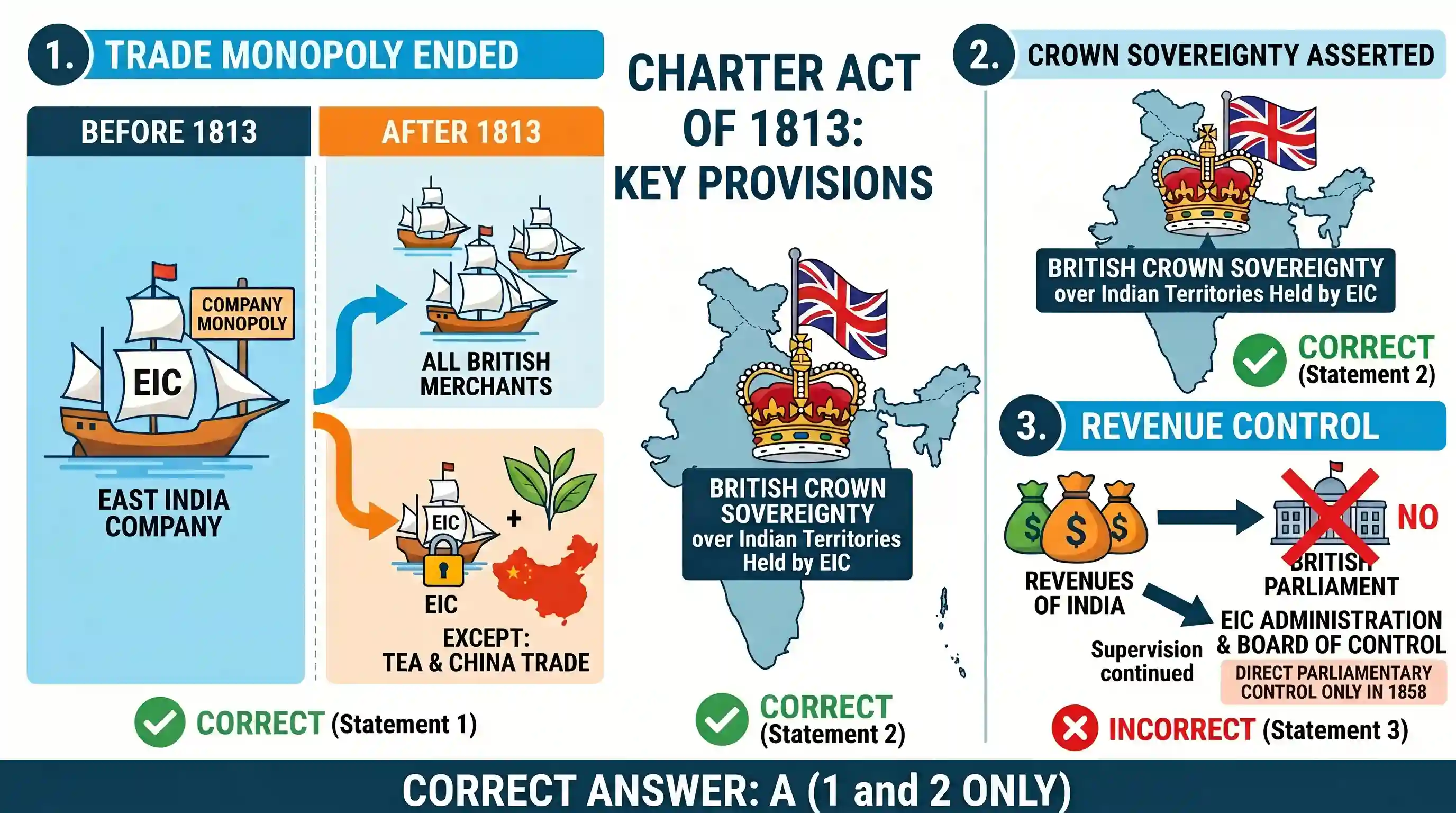
Consider the following statements about 'the Charter Act of 1813': 1. It ended the trade monopoly of the East India Company in India except for trade in tea and trade with China. 2. It asserted the sovereignty of the British Crown over the Indian territories held by the Company. 3. The revenues of India were now controlled by the British Parliament. Which of the statements given above are correct?

- A1 and 2 onlyCorrect
- B2 and 3 only
- C1 and 3 only
- D1, 2 and 3
Explanation
Statement 1 is correct. The Charter Act of 1813 significantly curtailed the trade monopoly of the East India Company in India. It ended the Company's monopoly on trade with India, opening it to all British merchants, except for the trade in tea and trade with China, which remained the Company's exclusive domain for another 20 years.
Statement 2 is correct. The Act explicitly asserted the sovereignty of the British Crown over the Company's territories in India. This was a crucial step towards direct British imperial rule and effectively underlined that the Company was a political agent of the Crown, not an independent sovereign entity.
Statement 3 is incorrect. While the Act asserted the Crown's sovereignty, the revenues of India were not directly controlled by the British Parliament at this stage. The Company continued to administer the territories and collect revenues under the supervision of the Board of Control, which was set up by Pitt's India Act of 1784. Direct parliamentary control over Indian revenues came much later, particularly after the Government of India Act of 1858, following the Sepoy Mutiny.
Related questions
More UPSC Prelims practice from the same subject and topic.
- Prelims 2019GS1history
With reference to Swadeshi Movement, consider the following statements: 1. It contributed to the revival of the indigenous artisan crafts and industries. 2. The National Council of Education was estab…
- Prelims 2019GS1history
Consider the following pairs: Movement/Organization Leader 1. All India Anti-Untouchability League : Mahatma Gandhi 2. All India Kisan Sabha : Swami Sahajanand Saraswati 3. Self-Respect Movement : E. …
- Prelims 2019GS1history
With reference to the British colonial rule in India, consider the following statements: 1. Mahatma Gandhi was instrumental in the abolition of the system of 'indentured labour'. 2. In 'Lord Chelmsfor…
- Prelims 2019GS1history
With reference to Indian National Movement, consider the following pairs: Person Position held 1. Sir Tej Bahadur Sapru : President, All India Liberal Federation 2. K. C. Neogy : Member, The Constitue…
- Prelims 2019GS1history
With reference to Mughal India, what is/are the difference/differences between Jagirdar and Zamindar? 1. Jagirdars were holders of land assignments in lieu of judicial and police duties, whereas Zamin…
- Prelims 2019GS1history
Which one of the following is not a Harappan site?