In India, 'extended producer responsibility' was introduced as an important feature in which of the following?

- AThe Bio-medical Waste (Management and Handling) Rules, 1998
- BThe Recycled Plastic (Manufacturing and Usage) Rules, 1999
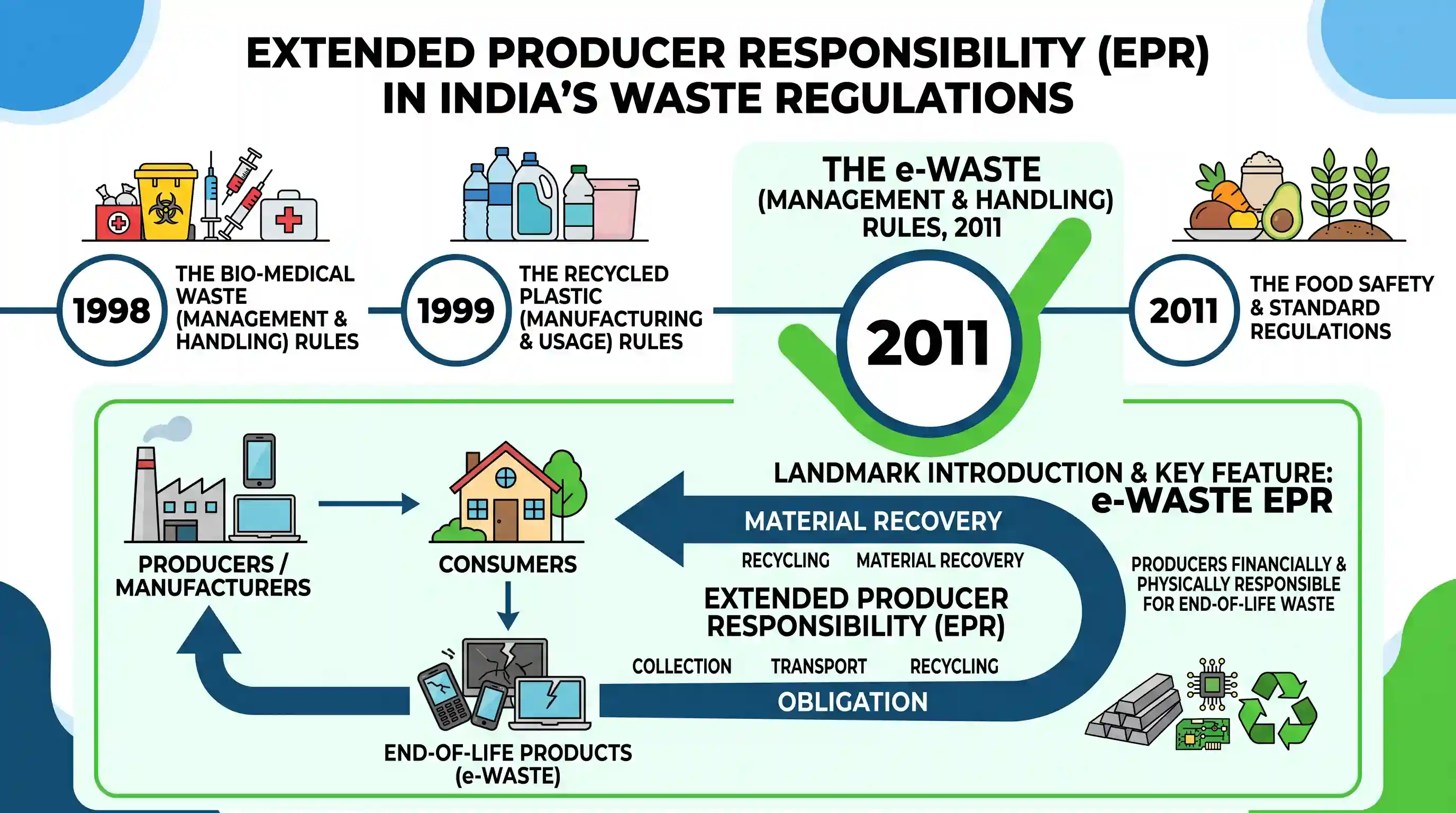
- CThe e-Waste (Management and Handling) Rules, 2011Correct
- DThe Food Safety and Standard Regulations, 2011
Explanation
'Extended Producer Responsibility' (EPR) is a policy approach under which producers are given a significant financial and/or physical responsibility for the treatment or disposal of post-consumer products. Assigning such responsibility could, in principle, provide incentives to producers to incorporate environmental considerations into the design of their products.
In India, EPR was notably introduced as an important feature in The e-Waste (Management and Handling) Rules, 2011. These rules made producers of electrical and electronic equipment responsible for managing e-waste generated from their products once they become waste. Subsequent e-Waste Management Rules (2016) further strengthened and elaborated on the EPR framework.
While the concept of producer responsibility exists in other waste management rules, the explicit and prominent introduction of 'Extended Producer Responsibility' as a core feature for end-of-life product management was a landmark in the e-Waste rules.
Related questions
More UPSC Prelims practice from the same subject and topic.
- Prelims 2019GS1economy
With reference to land reforms in independent India, which one of the following statements is correct?
- Prelims 2019GS1economy
Among the following, which one is the largest exporter of rice in the world in the last five years?
- Prelims 2019GS1economy
Consider the following statements: 1. Coal sector was nationalized by the Government of India under Indira Gandhi. 2. Now, coal blocks are allocated on lottery basis. 3. Till recently, India imported …
- Prelims 2019GS1economy
The Service Area Approach was implemented under the purview of
- Prelims 2019GS1economy
Which one of the following is not a sub-index of the World Bank's 'Ease of Doing Business Index'?
- Prelims 2019GS1economy
The economic cost of food grains to the Food Corporation of India is Minimum Support Price and bonus (if any) paid to the farmers plus