The money multiplier in an economy increases with which one of the following?

- AIncrease in the cash reserve ratio
- BIncrease in the banking habit of the populationCorrect
- CIncrease in the statutory liquidity ratio
- DIncrease in the population of the country
Explanation
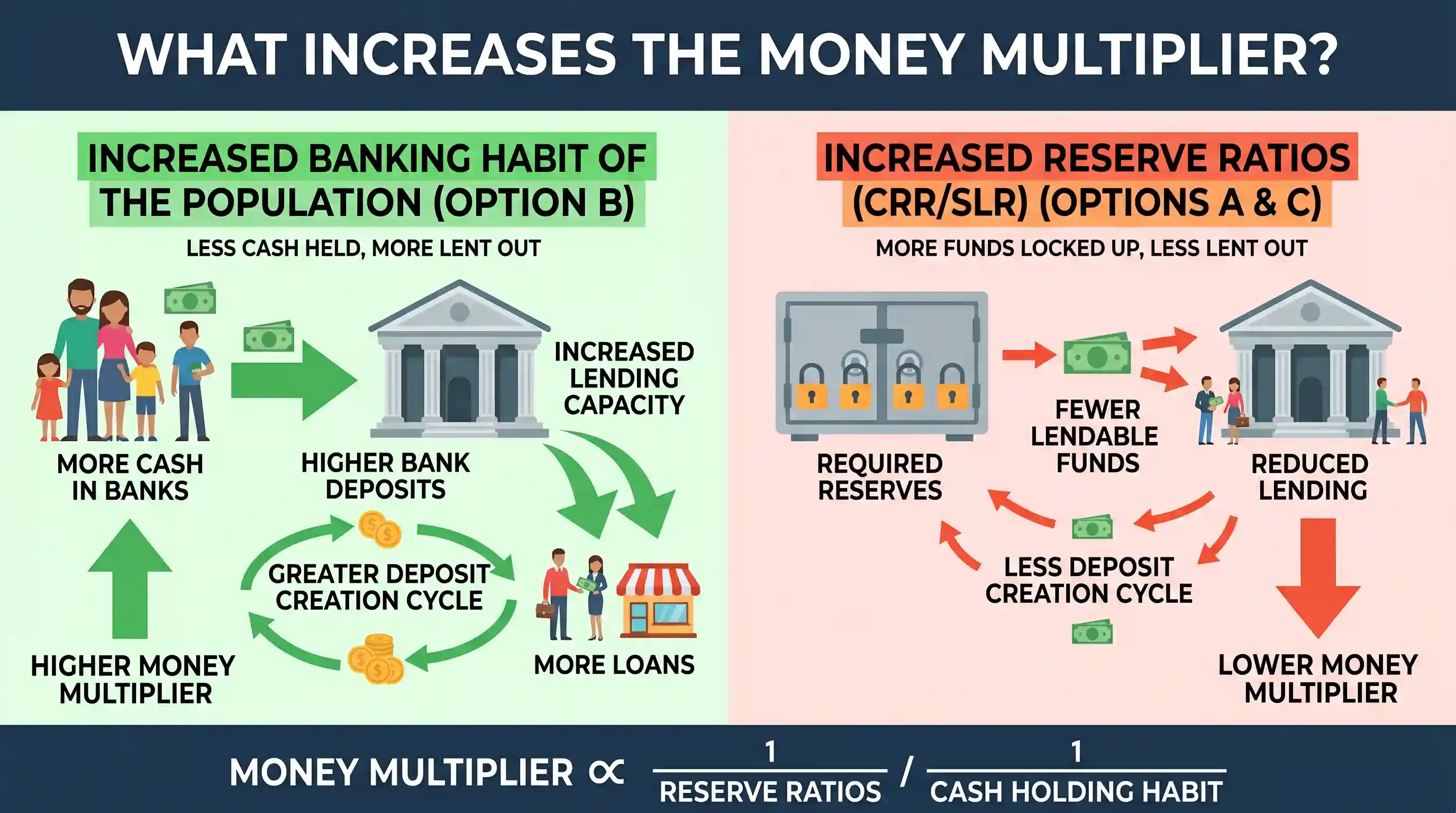
The money multiplier (or deposit multiplier) indicates how much the money supply changes for a given change in the monetary base. It is inversely related to the reserve ratio (including Cash Reserve Ratio and Statutory Liquidity Ratio) and the public's preference for holding cash.
The formula for the money multiplier is often simplified as 1 / (Cash Reserve Ratio + Excess Reserves + Currency Deposit Ratio).
Let's analyze the options:
A) Increase in the cash reserve ratio (CRR): If CRR increases, banks have to hold a larger proportion of their deposits as reserves, reducing the amount available for lending. This leads to a decrease in the money multiplier. B) Increase in the banking habit of the population: An increase in banking habit means people prefer to hold less cash and deposit more money in banks. This increases the bank's deposits and thus their ability to lend, leading to a higher money multiplier (as the currency deposit ratio decreases). C) Increase in the statutory liquidity ratio (SLR): If SLR increases, banks are required to hold a larger proportion of their deposits in liquid assets (like government securities), reducing the funds available for lending. This leads to a decrease in the money multiplier. D) Increase in the population of the country: An increase in population, by itself, does not directly lead to an increase in the money multiplier. Its effect depends on how it influences banking habits, savings, and credit demand, but it's not a direct or primary factor for the multiplier itself. Therefore, an increase in the banking habit of the population leads to an increase in the money multiplier.
Related questions
More UPSC Prelims practice from the same subject and topic.
- Prelims 2019GS1economy
Which of the following is not included in the assets of a commercial bank in India?
- Prelims 2019GS1economy
Which of the following is issued by registered foreign portfolio investors to overseas investors who want to be part of the Indian stock market without registering themselves directly?
- Prelims 2019GS1economy
What was the purpose of Inter-Creditor Agreement signed by Indian banks and financial institutions recently?
- Prelims 2019GS1economy
Which one of the following is not the most likely measure the Government/RBI takes to stop the slide of Indian rupee?
- Prelims 2019GS1economy
Consider the following statements: The Reserve Bank of India's recent directives relating to 'Storage of Payment System Data', popularly known as data diktat, command the payment system providers that…
- Prelims 2019GS1economy
With reference to land reforms in independent India, which one of the following statements is correct?