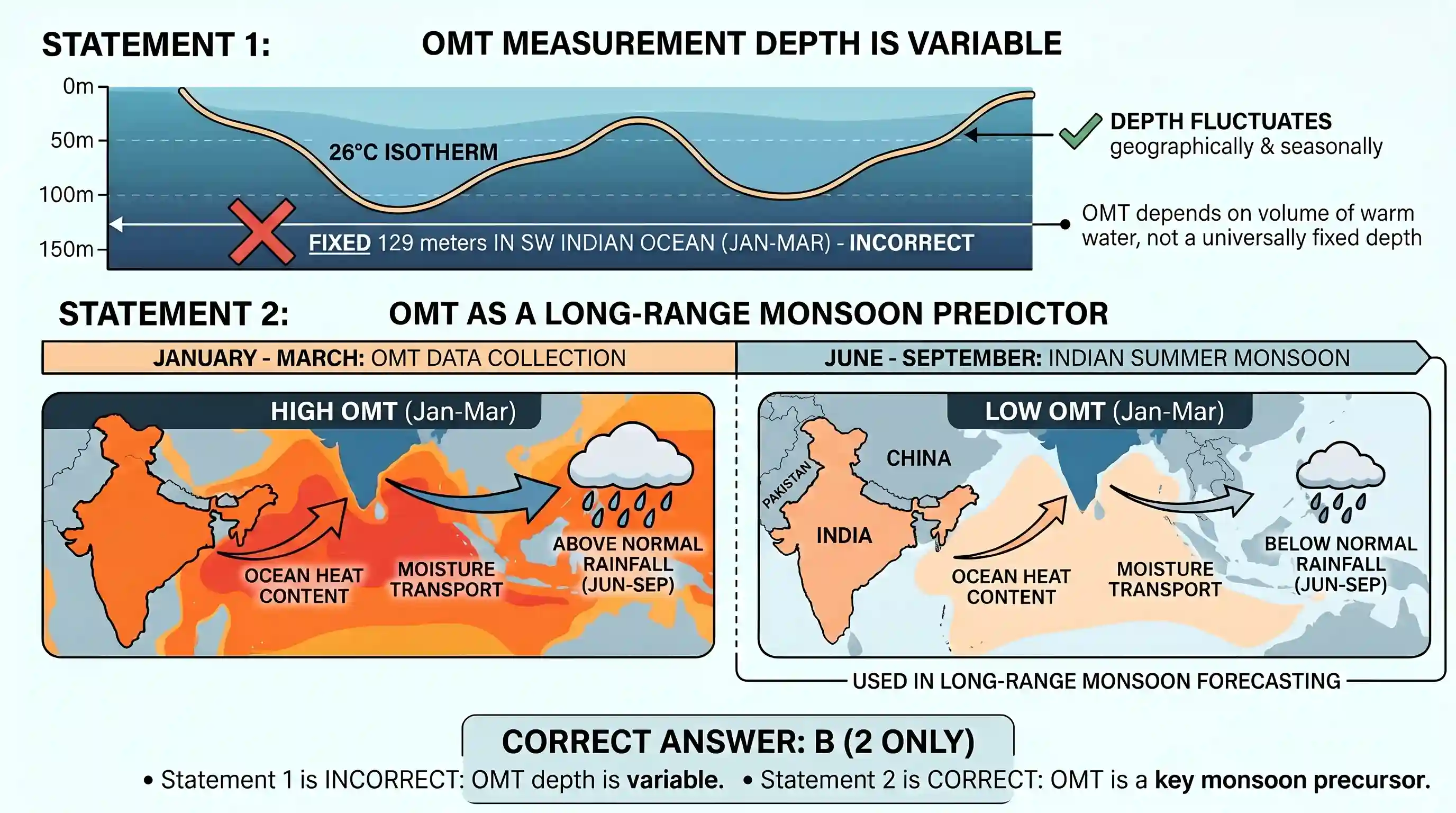
With reference to Ocean Mean Temperature (OMT), which of the following statements is/are correct? 1. OMT is measured up to a depth of 26°C isotherm which is 129 meters in the south-western Indian Ocean during January - March. 2. OMT collected during January - March can be used in assessing whether the amount of rainfall in monsoon will be less or more than a certain long-term mean. Select the correct answer using the code given below:

- A1 only
- B2 onlyCorrect
- CBoth 1 and 2
- DNeither 1 nor 2
Explanation
Let's analyze the statements concerning Ocean Mean Temperature (OMT) and its relation to the Indian monsoon:
-
OMT is measured up to a depth of 26°C isotherm which is 129 meters in the south-western Indian Ocean during January - March: This statement is incorrect in its precise numerical depth. While OMT is indeed defined as the average temperature of the ocean water up to a certain depth (often the depth of the 26°C isotherm), this specific depth (129 meters) is not a fixed or universal constant for the entire south-western Indian Ocean during January-March. The depth of the 26°C isotherm varies significantly with geographical location, ocean currents, and seasonal variations. Providing a precise, universal depth like '129 meters' makes the statement factually questionable. The important part of OMT for monsoon forecasting is the volume of warm water, not a fixed depth.
-
OMT collected during January - March can be used in assessing whether the amount of rainfall in monsoon will be less or more than a certain long-term mean: This statement is correct. Ocean Mean Temperature, particularly in the equatorial Indian Ocean and the South-West Indian Ocean during the pre-monsoon months (January to March or April), is considered a crucial predictor for the performance of the Indian Summer Monsoon. Higher OMT in these regions indicates a greater build-up of heat energy in the ocean, which can contribute to stronger atmospheric convection and moisture transport towards the Indian subcontinent, potentially leading to more rainfall during the monsoon. Conversely, lower OMT can indicate a weaker monsoon. Meteorological agencies, including the India Meteorological Department (IMD), use OMT as one of the key parameters for long-range monsoon forecasting.
Therefore, only statement 2 is correct.
Related questions
More UPSC Prelims practice from the same subject and topic.
- Prelims 2020GS1geography
Which of the following are the reasons/factors for exposure to benzene pollution? 1. Automobile exhaust 2. Tobacco smoke 3. Wood burning 4. Using varnished wooden furniture 5. Using products made of p…
- Prelims 2020GS1geography
Consider the following pairs: River Flows into 1. Mekong : Andaman Sea 2. Thames : Irish Sea 3. Volga : Caspian Sea 4. Zambezi : Indian Ocean Which of the pairs given above is/are correctly matched?
- Prelims 2020GS1geography
With reference to Indian elephants, consider the following statements: 1. The leader of an elephant group is a female. 2. The maximum gestation period can be 22 months. 3. An elephant can normally go …
- Prelims 2020GS1geography
Which of the following Protected Areas are located in Cauvery basin ? 1. Nagarhole National Park 2. Papikonda National Park 3. Sathyamangalam Tiger Reserve 4. Wayanad Wildlife Sanctuary Select the cor…
- Prelims 2020GS1geography
With reference to India's biodiversity, Ceylon frogmouth, Coppersmith barbet, Gray-chinned minivet and White-throated redstart are
- Prelims 2020GS1geography
Which one of the following protected areas is well-known for the conservation of a sub-species of the Indian swamp deer (Barasingha) that thrives well on hard ground and is exclusively graminivorous?