With reference to chemical fertilizers in India, consider the following statements : 1. At present, the retail price of chemical fertilizers is market-driven and not administered by the Government. 2. Ammonia, which is an input of urea, is produced from natural gas. 3. Sulphur, which is a raw material for phosphoric acid fertilizer, is a by-product of oil refineries. Which of the statements given above is/are correct?

- A1 only
- B2 and 3 onlyCorrect
- C2 only
- D1, 2 and 3
Explanation
Let's analyze the statements regarding chemical fertilizers in India:
-
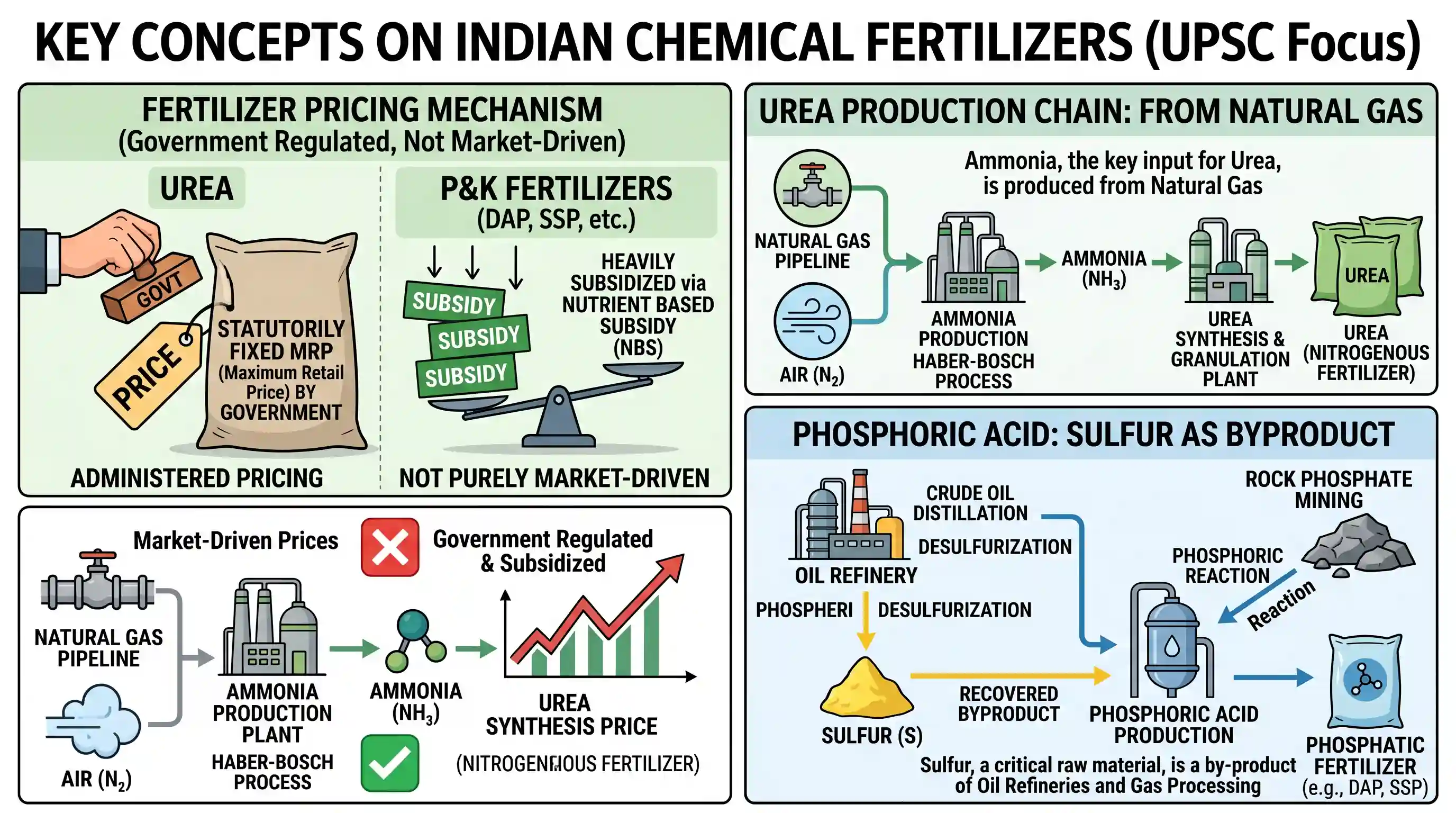
At present, the retail price of chemical fertilizers is market-driven and not administered by the Government: This statement is incorrect. The Indian government heavily regulates and subsidizes the retail prices of major chemical fertilizers, particularly Urea. The Maximum Retail Price (MRP) of urea is statutorily fixed by the government. For other Phosphatic and Potassic (P&K) fertilizers, the government implements a Nutrient Based Subsidy (NBS) scheme, under which a fixed amount of subsidy is provided on each grade of subsidized P&K fertilizers. While manufacturers/importers can determine the MRP for P&K fertilizers (within reasonable limits), the significant subsidy means their retail prices are not purely market-driven and are heavily influenced by government policy.
-
Ammonia, which is an input of urea, is produced from natural gas: This statement is correct. Ammonia (NH3), a primary feedstock for the production of urea (CO(NH2)2), is predominantly manufactured globally and in India through the Haber-Bosch process. This industrial process uses nitrogen from the air and hydrogen, with natural gas (methane, CH4) being the most common and cost-effective source of hydrogen production.
-
Sulphur, which is a raw material for phosphoric acid fertilizer, is a by-product of oil refineries: This statement is correct. Sulphur is a crucial raw material used to produce sulphuric acid (H2SO4), which is then reacted with rock phosphate to produce phosphoric acid (H3PO4). Phosphoric acid is a key component in the manufacturing of phosphatic fertilizers (e.g., DAP, SSP). A significant portion of the elemental sulfur used worldwide, including for fertilizer production, is recovered as a by-product from the desulfurization of crude oil and natural gas in oil refineries and gas processing plants.
Therefore, statements 2 and 3 are correct.
Related questions
More UPSC Prelims practice from the same subject and topic.
- Prelims 2020GS1economy
The term 'West Texas Intermediate', sometimes found in news, refers to a grade of
- Prelims 2020GS1economy
With reference to the Indian economy after the 1991 economic liberalization, consider the following statements: 1. Worker productivity (₹ per worker at 2004-05 prices) increased in urban areas while i…
- Prelims 2020GS1economy
Consider the following statements: 1. In terms of short-term credit delivery to the agriculture sector, District Central Cooperative Banks (DCCBs) deliver more credit in comparison to Scheduled Commer…
- Prelims 2020GS1economy
In India, which of the following can be considered as public investment in agriculture? 1. Fixing Minimum Support Price for agricultural produce of all crops 2. Computerization of Primary Agricultural…
- Prelims 2020GS1economy
Which of the following factors/policies were affecting the price of rice in India in the recent past? 1. Minimum Support Price 2. Government's trading 3. Government's stockpiling 4. Consumer subsidies…
- Prelims 2020GS1economy
In which one of the following groups are all the four countries members of G20?