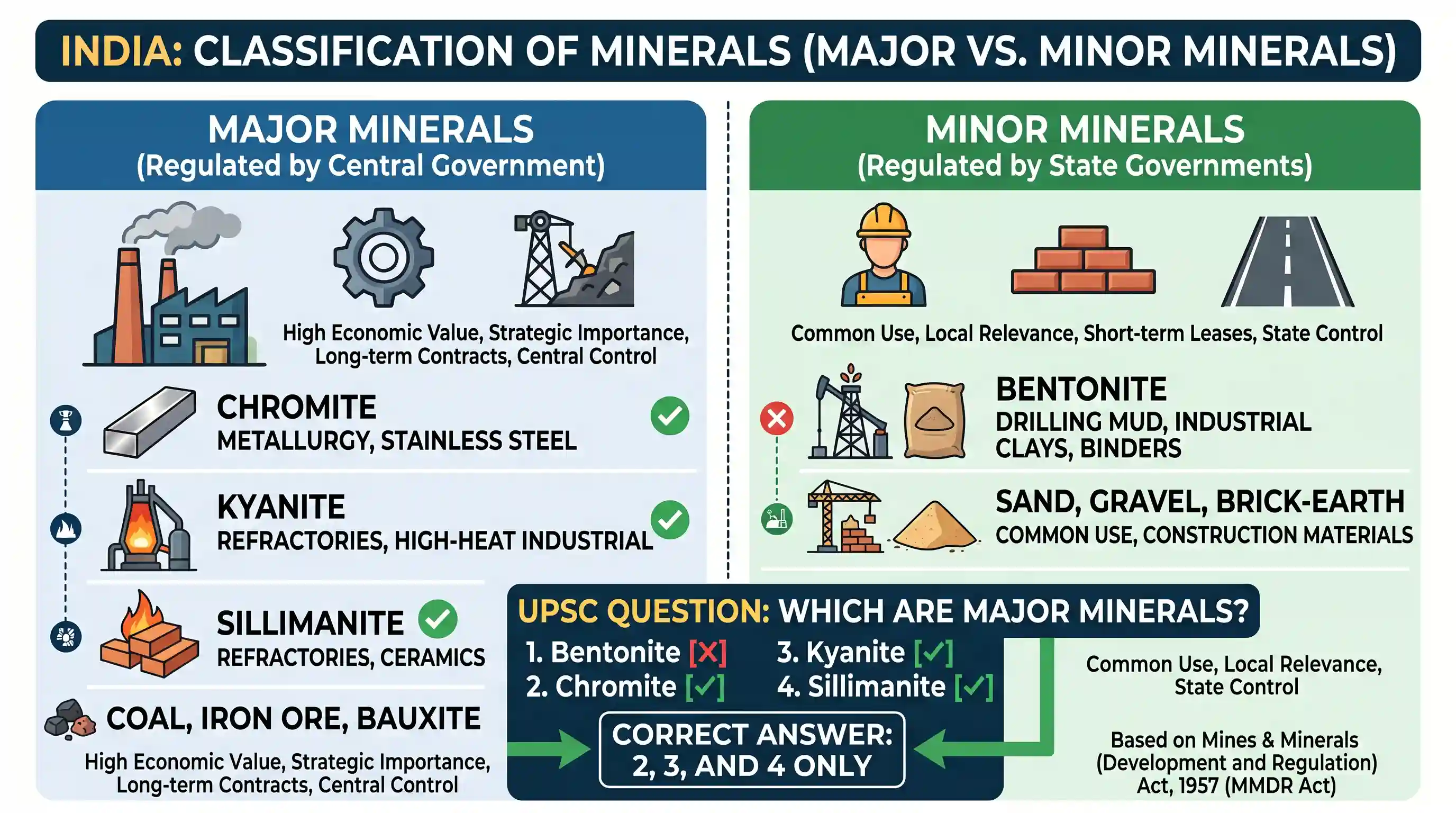
Consider the following minerals : 1. Bentonite 2. Chromite 3. Kyanite 4. Sillimanite In India, which of the above is/are officially designated as major minerals?

- A1 and 2 only
- B4 only
- C1 and 3 only
- D2, 3 and 4 onlyCorrect
Explanation
In India, minerals are categorized as 'major minerals' or 'minor minerals' under the Mines and Minerals (Development and Regulation) Act, 1957 (MMDR Act) and subsequent notifications by the Central Government. The classification primarily depends on their end-use, economic value, and the level of governmental control over their extraction and trade. The Central Government regulates major minerals, while State Governments regulate minor minerals.
Let's classify the given minerals:
-
Bentonite: This is a clay mineral used in drilling muds, binders, and other industrial applications. As per the MMDR Act and notifications, Bentonite is classified as a 'minor mineral'.
-
Chromite: This is an ore mineral from which chromium is extracted. Chromite is a crucial metallic mineral used in metallurgy (stainless steel production) and refractory applications. It is officially designated as a 'major mineral'.
-
Kyanite: Kyanite is an aluminosilicate mineral primarily used as a refractory material (materials resistant to high temperatures) and in ceramic industries. It is officially designated as a 'major mineral'.
-
Sillimanite: Like kyanite, Sillimanite is also an aluminosilicate mineral with refractory properties, used in high-temperature applications. It is officially designated as a 'major mineral'.
Therefore, Chromite, Kyanite, and Sillimanite are officially designated as major minerals in India.
Related questions
More UPSC Prelims practice from the same subject and topic.
- Prelims 2020GS1economy
The term 'West Texas Intermediate', sometimes found in news, refers to a grade of
- Prelims 2020GS1economy
With reference to the Indian economy after the 1991 economic liberalization, consider the following statements: 1. Worker productivity (₹ per worker at 2004-05 prices) increased in urban areas while i…
- Prelims 2020GS1economy
Consider the following statements: 1. In terms of short-term credit delivery to the agriculture sector, District Central Cooperative Banks (DCCBs) deliver more credit in comparison to Scheduled Commer…
- Prelims 2020GS1economy
In India, which of the following can be considered as public investment in agriculture? 1. Fixing Minimum Support Price for agricultural produce of all crops 2. Computerization of Primary Agricultural…
- Prelims 2020GS1economy
Which of the following factors/policies were affecting the price of rice in India in the recent past? 1. Minimum Support Price 2. Government's trading 3. Government's stockpiling 4. Consumer subsidies…
- Prelims 2020GS1economy
In which one of the following groups are all the four countries members of G20?