What are the advantages of fertigation in agriculture ? 1. Controlling the alkalinity of irrigation water is possible. 2. Efficient application of Rock Phosphate and all other phosphatic fertilizers is possible. 3. Increased availability of nutrients to plants is possible. 4. Reduction in the leaching of chemical nutrients is possible. Select the correct answer using the code given below:

- A1, 2 and 3 only
- B1, 2 and 4 only
- C1, 3 and 4 onlyCorrect
- D2, 3 and 4 only
Explanation
Fertigation is an agricultural technique where fertilizers are applied along with irrigation water, typically through drip irrigation systems. This method offers several advantages:
-
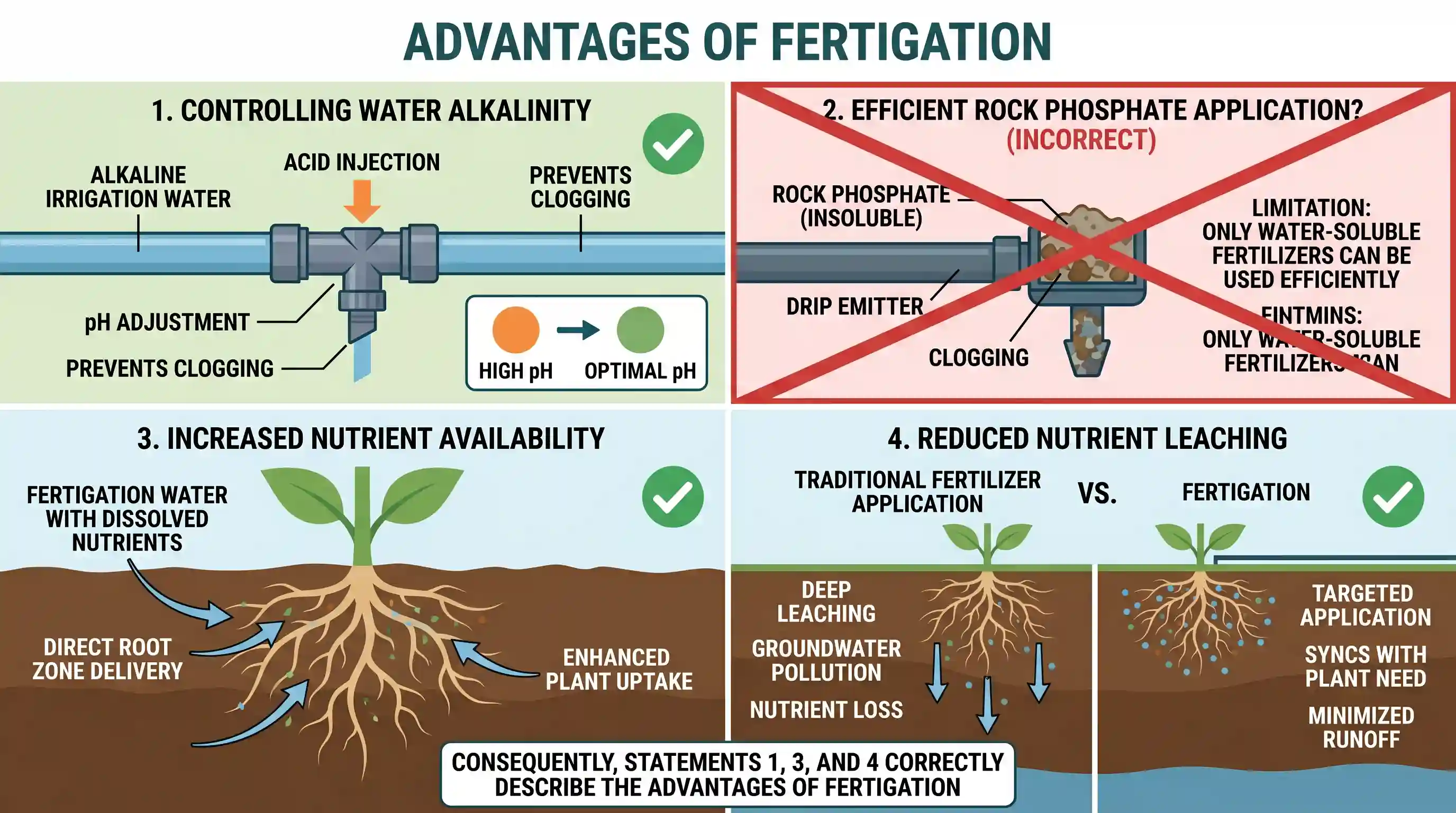
Controlling the alkalinity of irrigation water is possible: This statement is correct. Through fertigation, acidic solutions or acid-forming fertilizers can be injected into the irrigation system. This helps to neutralize alkaline irrigation water, maintain an optimal pH in the root zone, and prevent the clogging of drip emitters, which can be an issue with high pH water or certain fertilizers.
-
Efficient application of Rock Phosphate and all other phosphatic fertilizers is possible: This statement is incorrect. While some phosphatic fertilizers (like monoammonium phosphate or phosphoric acid) are water-soluble and can be efficiently applied through fertigation, Rock Phosphate is largely insoluble in water. Due to its low solubility, it cannot be effectively dissolved and uniformly distributed through a fertigation system, and its particles can cause clogging in drip lines. Therefore, it's not suitable for efficient application via fertigation.
-
Increased availability of nutrients to plants is possible: This statement is correct. Fertigation delivers dissolved nutrients directly and precisely to the plant root zone, where they are immediately available for uptake. This targeted application minimizes nutrient losses through leaching or volatilization and ensures that plants receive nutrients more readily and efficiently, leading to improved nutrient use efficiency and potentially higher yields.
-
Reduction in the leaching of chemical nutrients is possible: This statement is correct. By supplying nutrients in smaller, more frequent doses directly to the root zone, fertigation allows for better synchronization between nutrient supply and plant demand. This minimizes the accumulation of excess nutrients in the soil profile that could otherwise be leached below the root zone by heavy rainfall or excessive irrigation, thereby reducing nutrient runoff and groundwater contamination.
Therefore, statements 1, 3, and 4 correctly describe the advantages of fertigation.
Related questions
More UPSC Prelims practice from the same subject and topic.
- Prelims 2020GS1geography
Which of the following are the reasons/factors for exposure to benzene pollution? 1. Automobile exhaust 2. Tobacco smoke 3. Wood burning 4. Using varnished wooden furniture 5. Using products made of p…
- Prelims 2020GS1geography
With reference to Indian elephants, consider the following statements: 1. The leader of an elephant group is a female. 2. The maximum gestation period can be 22 months. 3. An elephant can normally go …
- Prelims 2020GS1geography
With reference to India's biodiversity, Ceylon frogmouth, Coppersmith barbet, Gray-chinned minivet and White-throated redstart are
- Prelims 2020GS1geography
Which one of the following protected areas is well-known for the conservation of a sub-species of the Indian swamp deer (Barasingha) that thrives well on hard ground and is exclusively graminivorous?
- Prelims 2020GS1geography
Which of the following are the most likely places to find the musk deer in its natural habitat? 1. Askot Wildlife Sanctuary 2. Gangotri National Park 3. Kishanpur Wildlife Sanctuary 4. Manas National …
- Prelims 2020GS1geography
In rural road construction, the use of which of the following is preferred for ensuring environmental sustainability or to reduce carbon footprint? 1. Copper slag 2. Cold mix asphalt technology 3. Geo…