In the context of India, which of the following is/are considered to be practice(s) of eco-friendly agriculture ? 1. Crop diversification 2. Legume intensification 3. Tensiometer use 4. Vertical farming Select the correct answer using the code given below:

- A1, 2 and 3 only
- B3 only
- C4 only
- D1, 2, 3 and 4Correct
Explanation
All four practices listed are considered components of eco-friendly agriculture, aiming to minimize environmental impact, enhance resource efficiency, and promote sustainability:
-
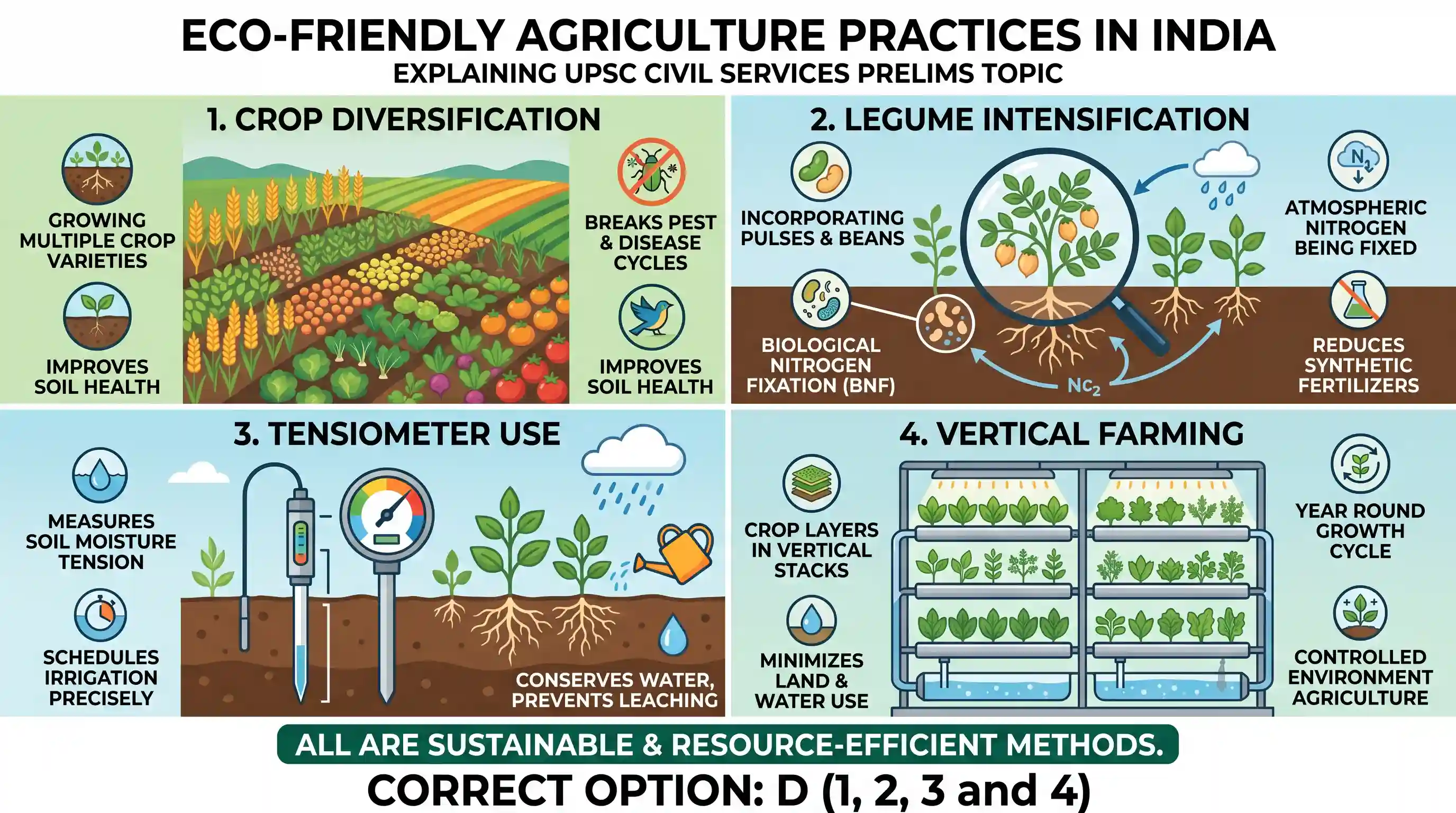
Crop diversification: This involves growing a variety of crops in the same area or over different seasons. It helps in breaking pest and disease cycles, improving soil health (through varied root systems and nutrient cycling), enhancing biodiversity on farms, reducing reliance on a single crop, and managing risks, thus promoting ecological balance and sustainability.
-
Legume intensification: Incorporating more legumes into cropping systems (through intercropping, crop rotation, or cover cropping) is highly eco-friendly. Legumes have a symbiotic relationship with nitrogen-fixing bacteria in their root nodules, which convert atmospheric nitrogen into a form usable by plants. This naturally enriches soil fertility, reduces the need for synthetic nitrogen fertilizers (which are energy-intensive to produce and can cause environmental pollution), and improves soil structure.
-
Tensiometer use: A tensiometer is an instrument that measures soil moisture tension, indicating how tightly water is held by soil particles and thus how much effort plants need to extract it. Using tensiometers allows farmers to schedule irrigation precisely when plants truly need water, preventing over-irrigation (which leads to water wastage and nutrient leaching) and under-irrigation. This optimizes water use, conserves water resources, and ensures efficient nutrient delivery, making it an eco-friendly irrigation management tool.
-
Vertical farming: This is a method of growing crops in vertically stacked layers, often in controlled indoor environments. It offers numerous eco-friendly advantages: significantly reduced land use, highly efficient water use (often through hydroponics/aeroponics with recirculation), minimal need for pesticides, year-round production, and reduced transportation costs due to urban placement. It represents a highly sustainable approach to food production.
Therefore, all the listed practices contribute to eco-friendly agriculture.
Related questions
More UPSC Prelims practice from the same subject and topic.
- Prelims 2020GS1geography
Which of the following are the reasons/factors for exposure to benzene pollution? 1. Automobile exhaust 2. Tobacco smoke 3. Wood burning 4. Using varnished wooden furniture 5. Using products made of p…
- Prelims 2020GS1geography
With reference to Indian elephants, consider the following statements: 1. The leader of an elephant group is a female. 2. The maximum gestation period can be 22 months. 3. An elephant can normally go …
- Prelims 2020GS1geography
With reference to India's biodiversity, Ceylon frogmouth, Coppersmith barbet, Gray-chinned minivet and White-throated redstart are
- Prelims 2020GS1geography
Which one of the following protected areas is well-known for the conservation of a sub-species of the Indian swamp deer (Barasingha) that thrives well on hard ground and is exclusively graminivorous?
- Prelims 2020GS1geography
Which of the following are the most likely places to find the musk deer in its natural habitat? 1. Askot Wildlife Sanctuary 2. Gangotri National Park 3. Kishanpur Wildlife Sanctuary 4. Manas National …
- Prelims 2020GS1geography
In rural road construction, the use of which of the following is preferred for ensuring environmental sustainability or to reduce carbon footprint? 1. Copper slag 2. Cold mix asphalt technology 3. Geo…