Consider the following statements: 1. 36% of India's districts are classified as "overexploited" or "critical" by the Central Ground Water Authority (CGWA). 2. CGWA was formed under the Environment (Protection) Act. 3. India has the largest area under groundwater irrigation in the world. Which of the statements given above is/are correct?

- A1 only
- B2 and 3 onlyCorrect
- C2 only
- D1 and 3 only
Explanation
Let's analyze the statements regarding groundwater management in India:
-
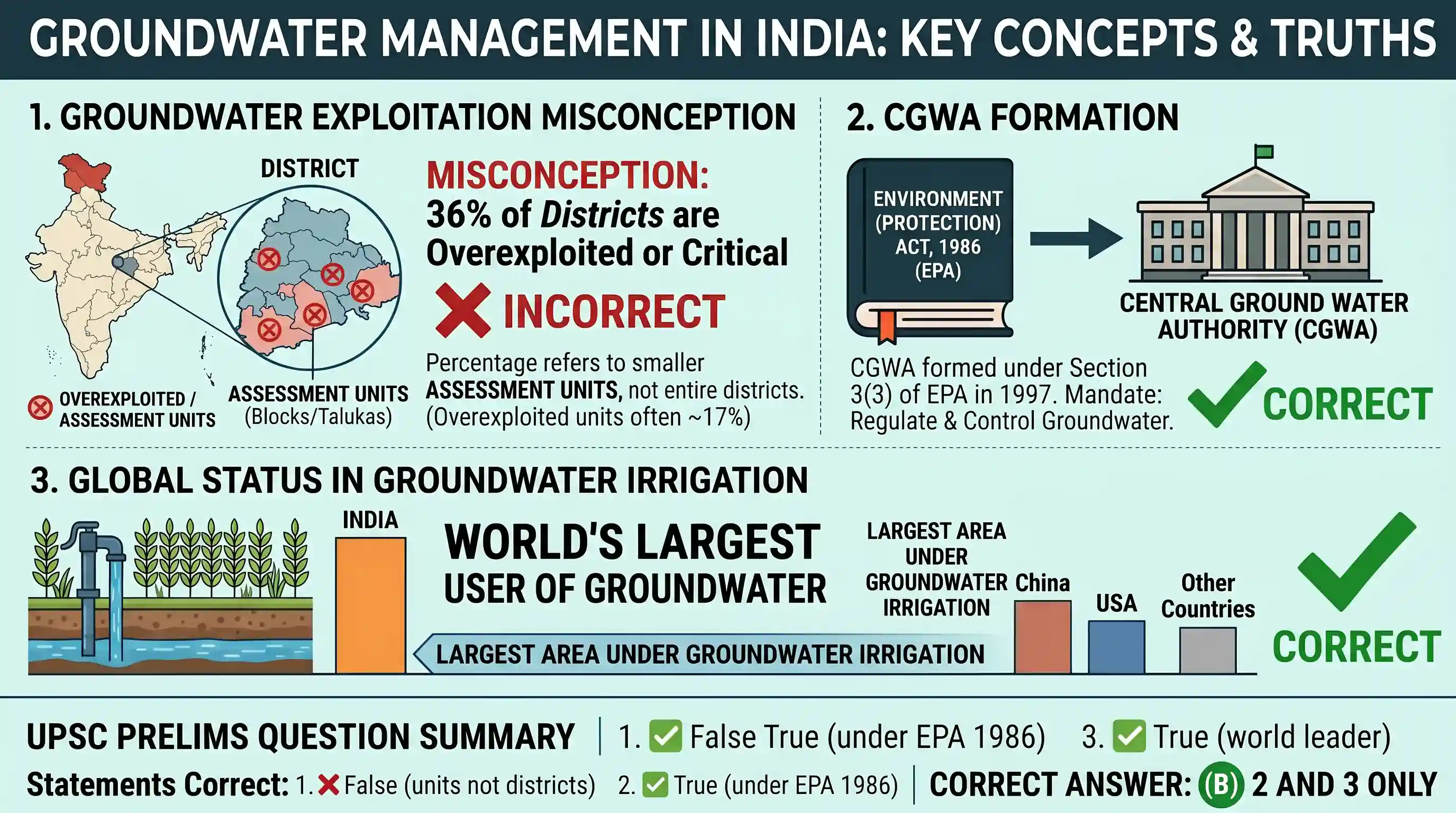
36% of India's districts are classified as "overexploited" or "critical" by the Central Ground Water Authority (CGWA): This statement is incorrect. While groundwater over-exploitation is a severe issue in India, the figure of 36% often refers to the percentage of 'assessment units' (such as blocks, talukas, or mandals), not entire districts, that are categorized as over-exploited, critical, or semi-critical. According to various reports by the CGWB (Central Ground Water Board, which works under CGWA), the percentage of over-exploited assessment units varies but is typically around 17% (as per 2022 assessment). The cumulative percentage of 'over-exploited,' 'critical,' and 'semi-critical' units is higher, but 36% specifically for 'districts' being overexploited or critical is not accurate in official assessments. Therefore, the statement is inaccurate in terms of the unit of measurement and possibly the precise percentage.
-
CGWA was formed under the Environment (Protection) Act: This statement is correct. The Central Ground Water Authority (CGWA) was constituted under Section 3(3) of the Environment (Protection) Act, 1986, in 1997. Its primary mandate is to regulate and control groundwater development and management throughout the country.
-
India has the largest area under groundwater irrigation in the world: This statement is correct. India is globally recognized as the largest user of groundwater, with groundwater being the primary source of irrigation for a vast agricultural area. This extensive reliance on groundwater for irrigation has significantly contributed to the rapid decline of water tables in many parts of the country.
Therefore, statements 2 and 3 are correct.
Related questions
More UPSC Prelims practice from the same subject and topic.
- Prelims 2020GS1geography
Which of the following are the reasons/factors for exposure to benzene pollution? 1. Automobile exhaust 2. Tobacco smoke 3. Wood burning 4. Using varnished wooden furniture 5. Using products made of p…
- Prelims 2020GS1geography
With reference to Indian elephants, consider the following statements: 1. The leader of an elephant group is a female. 2. The maximum gestation period can be 22 months. 3. An elephant can normally go …
- Prelims 2020GS1geography
With reference to India's biodiversity, Ceylon frogmouth, Coppersmith barbet, Gray-chinned minivet and White-throated redstart are
- Prelims 2020GS1geography
Which one of the following protected areas is well-known for the conservation of a sub-species of the Indian swamp deer (Barasingha) that thrives well on hard ground and is exclusively graminivorous?
- Prelims 2020GS1geography
Which of the following are the most likely places to find the musk deer in its natural habitat? 1. Askot Wildlife Sanctuary 2. Gangotri National Park 3. Kishanpur Wildlife Sanctuary 4. Manas National …
- Prelims 2020GS1geography
In rural road construction, the use of which of the following is preferred for ensuring environmental sustainability or to reduce carbon footprint? 1. Copper slag 2. Cold mix asphalt technology 3. Geo…