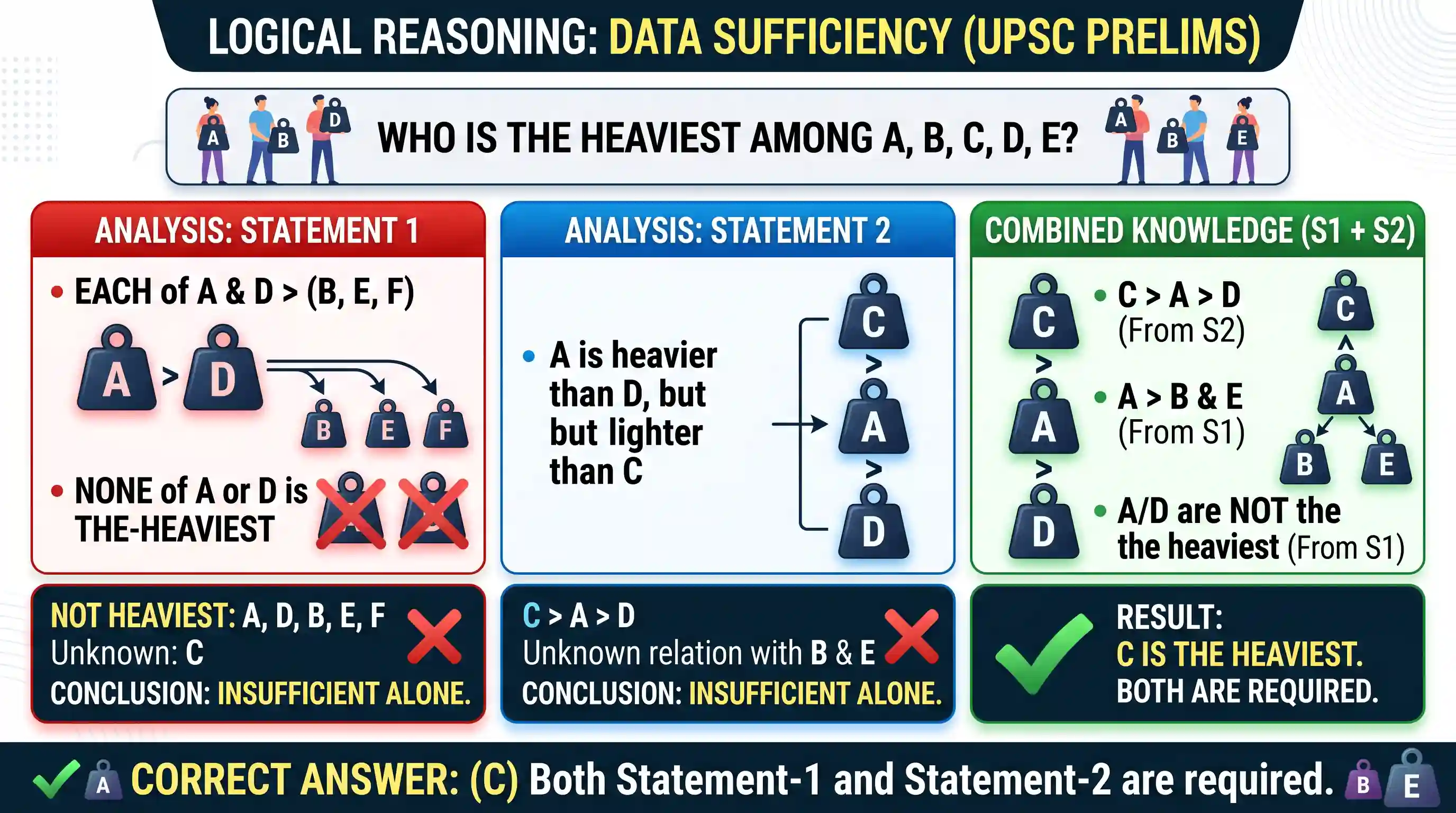
Consider two Statements and a Question: Statement 1: Each of A and D is heavier than each of B, E and F, but none of them is the- heaviest. Statement 2: A is heavier than D, but is lighter than C. Question: Who is the heaviest among A,B,C, D and E? Which one of the following is correct in respect of the Statements and the Question?

- AStatement-1 alone is sufficient to answer the Question
- BStatement-2 alone is sufficient to answer the Question
- CBoth Statement-1 and Statement-2 are required to answer the QuestionCorrect
- DNeither Statement-1 alone nor Statement-2 alone is sufficient to answer the Question
Explanation
The question asks to identify the heaviest person among A, B, C, D, and E.
Let's analyze each statement:
Statement 1: "Each of A and D is heavier than each of B, E and F, but none of them is the heaviest." From this:
- A > B, E, F
- D > B, E, F
- Neither A nor D is the heaviest among all the people mentioned or implied (A, B, C, D, E, F, and potentially others). This statement tells us that B and E cannot be the heaviest because A and D are heavier than them. It also tells us that A and D cannot be the heaviest. So, from the list (A, B, C, D, E), only C remains as a potential heaviest person. However, Statement 1 does not provide any information about C's weight relative to A or D. It's possible that C is lighter than A, and some unknown person 'X' (not in the list A, B, C, D, E) is the heaviest. For example, X > A > D > C > B > E. In this scenario, Statement 1 holds true, but C is not the heaviest. Therefore, Statement 1 alone is NOT sufficient.
Statement 2: "A is heavier than D, but is lighter than C." From this:
- A > D
- C > A Combining these, we get: C > A > D. This statement tells us that C is heavier than A and D. However, it provides no information about B and E. It's possible that B or E could be heavier than C. For example, B > C > A > D. In this scenario, B would be the heaviest. Therefore, Statement 2 alone is NOT sufficient.
Now, let's combine both Statement 1 and Statement 2: From Statement 2: C > A > D. From Statement 1: A > B and A > E (since A is heavier than B, E, F). Combining these facts: Since C > A, and A > B, it implies C > B. Since C > A, and A > E, it implies C > E. We already know C > A and C > D from Statement 2. Therefore, by combining both statements, we can conclude that C is heavier than A, B, D, and E. The phrase "none of them is the heaviest" in Statement 1 (referring to A and D) is consistent with C being the heaviest, as C is not A or D. Thus, C is the heaviest among A, B, C, D, and E.
Both Statement 1 and Statement 2 are required to answer the question.
The final answer is $\boxed{C}$
Related questions
More UPSC Prelims practice from the same subject and topic.
- Prelims 2021CSATLogical Reasoning
A Statement followed by Conclusion-I and Conclusion-II is given below. You have to take the Statement to be true even if it seems to be at variance from the commonly known facts. Read all conclusions …
- Prelims 2021CSATLogical Reasoning
A Statement followed by Conclusion-I and Conclusion-II is given below, You have to take the Statement to be true even if it seems to be at variance from the commonly known facts. Read all conclusions …
- Prelims 2021CSATLogical Reasoning
Consider two Statements and four Conclusions given below. You have to take the Statements to be true even if they seem to be at variance from the commonly known facts. Read all Conclusions and then de…
- Prelims 2021CSATLogical Reasoning
Seven books P, Q, R, S, T, U and V are placed side by side. R, Q and T have ( ) blue covers and other books have red covers. Only S and U are new books and the rest are old. P, R and S are law reports…
- Prelims 2021CSATLogical Reasoning
Replace the incorrect term by the correct term in the given sequence 3, 2, 7, 4, 13, 10, 21, 18, 31, 28, 43, 40 and where odd terms and even terms follow the same pattern
- Prelims 2021CSATLogical Reasoning
Following is a matrix of certain entries. The entries follow a certain trend row-wise. Choose the missing entry (?) accordingly. +-----+-----+-----+ | 7B | 10A | 3C | +-----+-----+-----+ | 3C | 9B | 6…