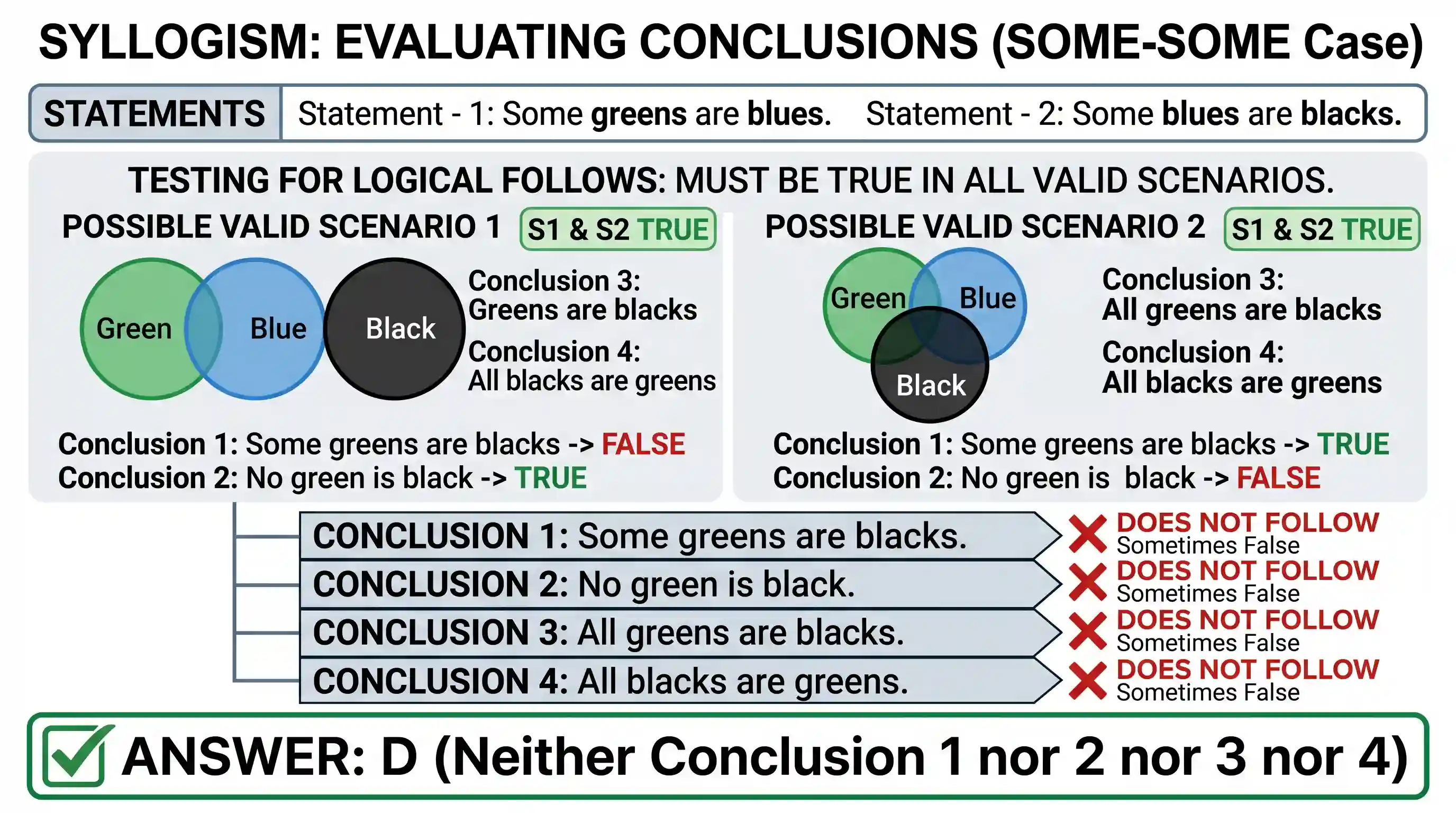
Consider two Statements and four Conclusions given below. You have to take the Statements to be true even if they seem to be at variance from the commonly known facts. Read all Conclusions and then decide which of the given Conclusion(s) logically follows/follow from the Statements, disregarding the commonly known facts. Statement - 1: Some greens are blues. Statement - 2 Some blues are blacks. Conclusion - 1: Some greens are blacks. Conclusion - 2: No green is black. Conclusion - 3: All greens are blacks. Conclusion - 4: All blacks are greens. Which one of the following is correct?

- AConclusion-1 and Conclusion-2 only
- BConclusion-2 and Conclusion-3 only
- CConclusion-3 and Conclusion-4 only
- DNeither Conclusion 1 nor 2 nor 3 nor 4Correct
Explanation
The problem is a classic example of syllogism. For a conclusion to logically follow, it must be true in ALL possible scenarios where the statements are true. If even one scenario exists where the statements are true but the conclusion is false, then the conclusion does not logically follow.
Let's analyze the statements and conclusions:
Statements:
- Some greens are blues. (This means there's an overlap between greens and blues, but not all greens are blues, and not all blues are greens.)
- Some blues are blacks. (This means there's an overlap between blues and blacks, but not all blues are blacks, and not all blacks are blues.)
Now let's test each conclusion:
Conclusion 1: Some greens are blacks.
- Can this be true? Yes, if the set of greens, blues, and blacks all overlap at some point. For example, if a specific item is green, blue, and black.
- Must this be true? No. Consider a scenario: Greens = {apple, pear}, Blues = {apple, banana}, Blacks = {banana, cherry}. Statement 1 (Some greens are blues): Apple is common. (TRUE) Statement 2 (Some blues are blacks): Banana is common. (TRUE) Conclusion 1 (Some greens are blacks): There is no common element between {apple, pear} and {banana, cherry}. (FALSE) Since Conclusion 1 can be false while the statements are true, it does not logically follow.
Conclusion 2: No green is black.
- Can this be true? Yes, as shown in the scenario above (Greens = {apple, pear}, Blacks = {banana, cherry}).
- Must this be true? No. Consider a scenario where Greens, Blues, and Blacks all share a common element. For example, if a specific item is green, blue, and black. In this case, "Some greens are blacks" would be true, making "No green is black" false. Since Conclusion 2 can be false while the statements are true, it does not logically follow.
Conclusion 3: All greens are blacks.
- This is a very strong statement. From "some" relationships, we cannot conclude an "all" relationship unless explicitly stated or implied. It's clearly not necessarily true. For instance, if there's a green item that is not black. Since Conclusion 3 can be false, it does not logically follow.
Conclusion 4: All blacks are greens.
- Similar to Conclusion 3, this is a strong "all" statement that cannot be derived from "some" statements. It's clearly not necessarily true. For instance, if there's a black item that is not green. Since Conclusion 4 can be false, it does not logically follow.
Since none of the conclusions necessarily follow from the given statements (i.e., for each conclusion, we can construct a scenario where the statements are true but the conclusion is false), the correct answer is that neither Conclusion 1 nor 2 nor 3 nor 4 follows.
The final answer is D.
Related questions
More UPSC Prelims practice from the same subject and topic.
- Prelims 2021CSATLogical Reasoning
A Statement followed by Conclusion-I and Conclusion-II is given below. You have to take the Statement to be true even if it seems to be at variance from the commonly known facts. Read all conclusions …
- Prelims 2021CSATLogical Reasoning
Consider two Statements and a Question: Statement 1: Each of A and D is heavier than each of B, E and F, but none of them is the- heaviest. Statement 2: A is heavier than D, but is lighter than C. Que…
- Prelims 2021CSATLogical Reasoning
A Statement followed by Conclusion-I and Conclusion-II is given below, You have to take the Statement to be true even if it seems to be at variance from the commonly known facts. Read all conclusions …
- Prelims 2021CSATLogical Reasoning
Seven books P, Q, R, S, T, U and V are placed side by side. R, Q and T have ( ) blue covers and other books have red covers. Only S and U are new books and the rest are old. P, R and S are law reports…
- Prelims 2021CSATLogical Reasoning
Replace the incorrect term by the correct term in the given sequence 3, 2, 7, 4, 13, 10, 21, 18, 31, 28, 43, 40 and where odd terms and even terms follow the same pattern
- Prelims 2021CSATLogical Reasoning
Following is a matrix of certain entries. The entries follow a certain trend row-wise. Choose the missing entry (?) accordingly. +-----+-----+-----+ | 7B | 10A | 3C | +-----+-----+-----+ | 3C | 9B | 6…