Consider the following addition problem: 3P + 4P + PP + PP = RQ2 ; where P, Q and R are different digits. What is the arithmetic mean of all such possible sums?

- A102
- B120
- C202Correct
- D220
Explanation
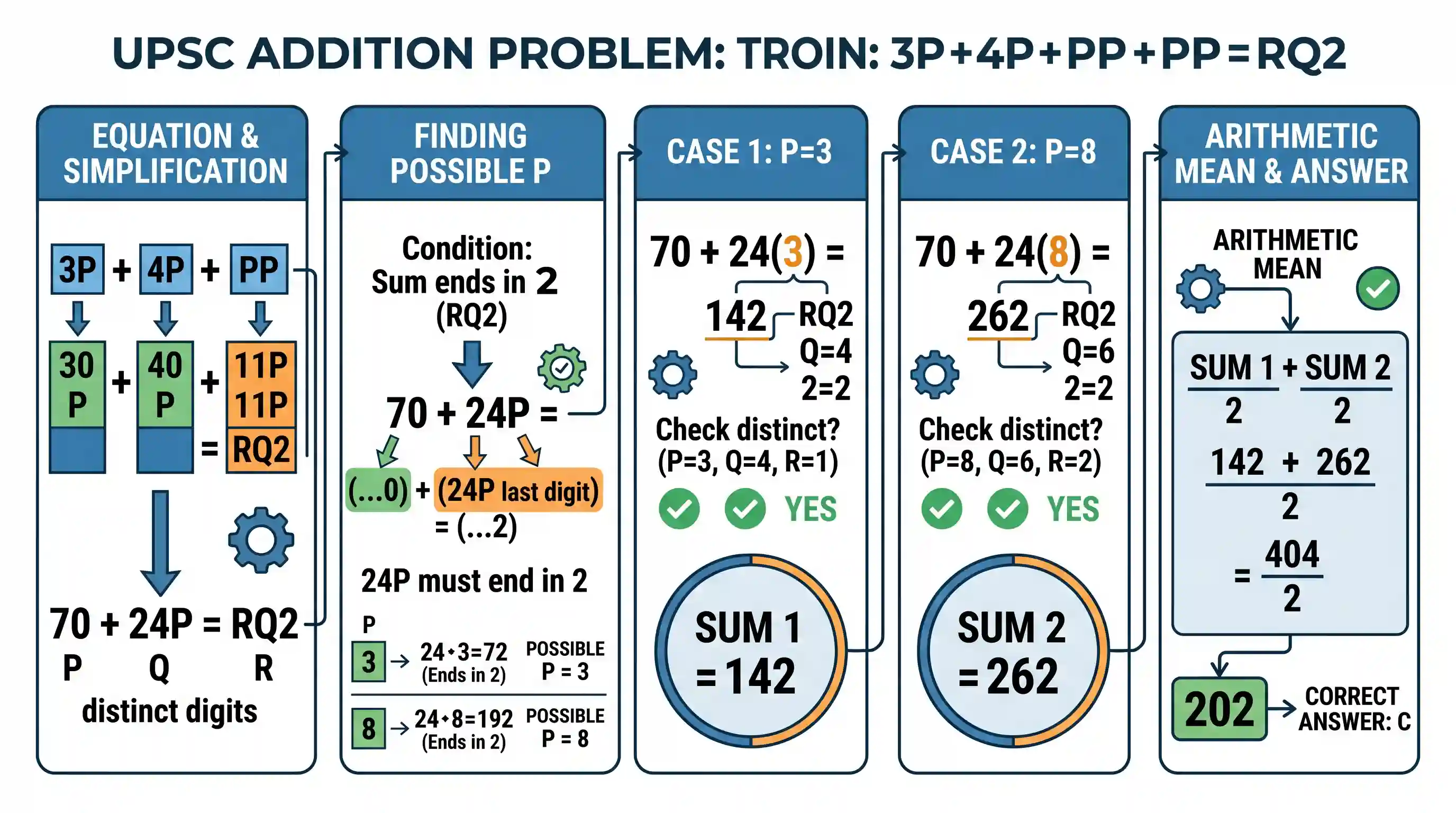
To solve the equation 3P + 4P + PP + PP = RQ2, we first express the terms in their expanded decimal forms.
3P is 30 + P 4P is 40 + P PP is 10P + P, which is 11P
The equation becomes: (30 + P) + (40 + P) + 11P + 11P = RQ2 70 + 24P = RQ2
Since the sum ends in 2, the unit digit of 24P must be 2. This happens when P is 3 or 8.
Case 1: P = 3 70 + 24 times 3 = 70 + 72 = 142 Here, R = 1 and Q = 4. All digits (P=3, Q=4, R=1) are different, so 142 is a valid sum.
Case 2: P = 8 70 + 24 times 8 = 70 + 192 = 262 Here, R = 2 and Q = 6. However, the unit digit of the sum is also 2. The problem states P, Q, and R are different digits. Since R = 2 and the unit digit is 2, this matches the requirement for the form RQ2, but we must check if P, Q, and R are distinct. Here P=8, Q=6, R=2. These are all different from each other. Thus, 262 is also a valid sum.
The possible sums are 142 and 262. The arithmetic mean is (142 + 262) divided by 2. 404 divided by 2 = 202.
Therefore, the correct answer is C.
Related questions
More UPSC Prelims practice from the same subject and topic.
- Prelims 2021CSATQuantitative Aptitude
If 3²⁰¹⁹ is divided by 10, then what is the remainder?
- Prelims 2021CSATQuantitative Aptitude
The number 3798125P369 is divisible by 7. What is the value of the digit P?
- Prelims 2021CSATQuantitative Aptitude
Consider all 3-digit numbers (without repetition of digits) obtained using three non-zero digits which are multiples of 3. Let S be their sum. Which of the following is/are correct? 1. S is always div…
- Prelims 2021CSATQuantitative Aptitude
Integers are listed from 700 to 1000. In how many integers is the sum of the digits 10 ?
- Prelims 2021CSATQuantitative Aptitude
Consider the following statements: 1 The sum of 5 consecutive integers can be 100. 2 The product of three consecutive natural numbers can be equal to their sum. Which of the above statements is/are co…
- Prelims 2021CSATQuantitative Aptitude
The difference between a 2-digit number and the number obtained by interchanging the positions of the digits is 54. Consider the following statements: 1. The sum of the two digits of the number can be…