Consider the following multiplication problem: (PQ) × 3 = RQQ , where P, Q and R are different digits and R ≠ 0 . What is the value of (P + R) ÷ Q ?

- A1
- B2Correct
- C45
- DCannot be determined due to insufficient data
Explanation
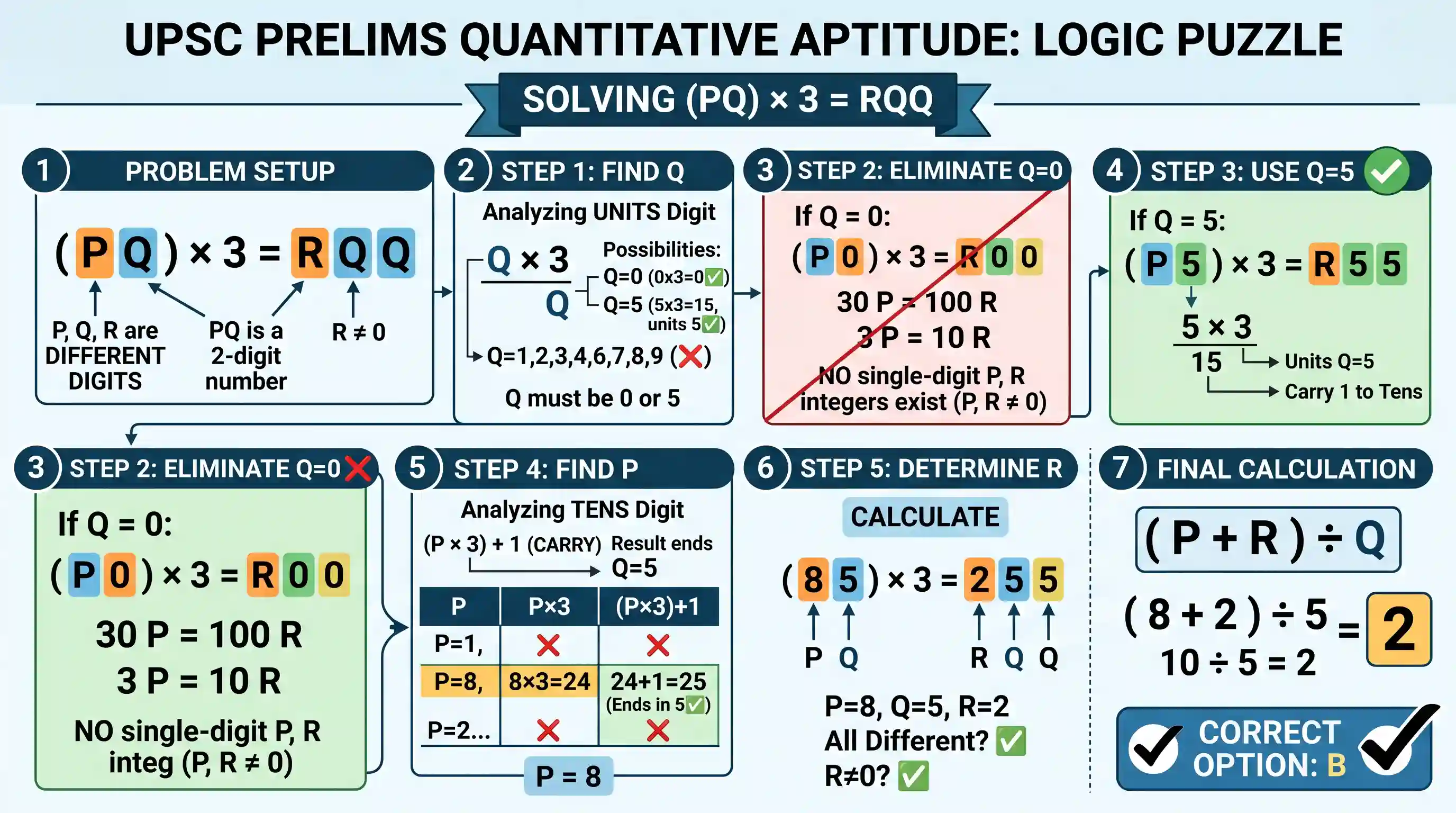
The problem is (PQ) x 3 = RQQ. This can be written as (10P + Q) x 3 = 100R + 10Q + Q.
-
Analyze the units digit: For the units digit of RQQ to be Q, the units digit of Q x 3 must be Q. This occurs only for Q = 0 (0 x 3 = 0) or Q = 5 (5 x 3 = 15, units digit is 5).
-
Eliminate Q = 0: If Q = 0, the equation becomes (P0) x 3 = R00, which simplifies to 30P = 100R, or 3P = 10R. Since P and R are single non-zero digits (P cannot be 0 as PQ is a two-digit number, and R is given as non-zero), there is no integer solution for P and R. Thus, Q cannot be 0.
-
Determine Q = 5: Therefore, Q must be 5. When Q = 5, 5 x 3 = 15. This means the units digit of RQQ is 5 (which is Q), and there is a carry-over of 1 to the tens place.
-
Analyze the tens digit: For the tens digit of RQQ to be Q (which is 5), the result of (P x 3) + 1 (carry-over) must have a units digit of 5. This implies that P x 3 must end in 4. The only single digit P (from 1 to 9) for which P x 3 ends in 4 is P = 8 (since 8 x 3 = 24).
-
Determine R: With P = 8 and Q = 5, the multiplication is (85) x 3. 85 x 3 = 255. Comparing this to RQQ, we get R = 2.
-
Verify conditions: P = 8, Q = 5, R = 2. These are different digits, and R is not 0. All conditions are met.
-
Calculate the final expression: We need to find the value of (P + R) / Q. (8 + 2) / 5 = 10 / 5 = 2.
The value is 2.
The final answer is B
Related questions
More UPSC Prelims practice from the same subject and topic.
- Prelims 2021CSATQuantitative Aptitude
If 3²⁰¹⁹ is divided by 10, then what is the remainder?
- Prelims 2021CSATQuantitative Aptitude
The number 3798125P369 is divisible by 7. What is the value of the digit P?
- Prelims 2021CSATQuantitative Aptitude
Consider all 3-digit numbers (without repetition of digits) obtained using three non-zero digits which are multiples of 3. Let S be their sum. Which of the following is/are correct? 1. S is always div…
- Prelims 2021CSATQuantitative Aptitude
Integers are listed from 700 to 1000. In how many integers is the sum of the digits 10 ?
- Prelims 2021CSATQuantitative Aptitude
Consider the following statements: 1 The sum of 5 consecutive integers can be 100. 2 The product of three consecutive natural numbers can be equal to their sum. Which of the above statements is/are co…
- Prelims 2021CSATQuantitative Aptitude
The difference between a 2-digit number and the number obtained by interchanging the positions of the digits is 54. Consider the following statements: 1. The sum of the two digits of the number can be…