The vegetation of savannah consists of grassland with scattered small trees, but extensive areas have no trees. The forest development in such areas is generally kept in check by one or more or a combination of some conditions. Which of the following are such conditions? 1. Burrowing animals and termites 2. Fire 3. Grazing herbivores 4. Seasonal rainfall 5. Soil properties Select the correct answer using the code given below.

- A1 and 2
- B4 and 5
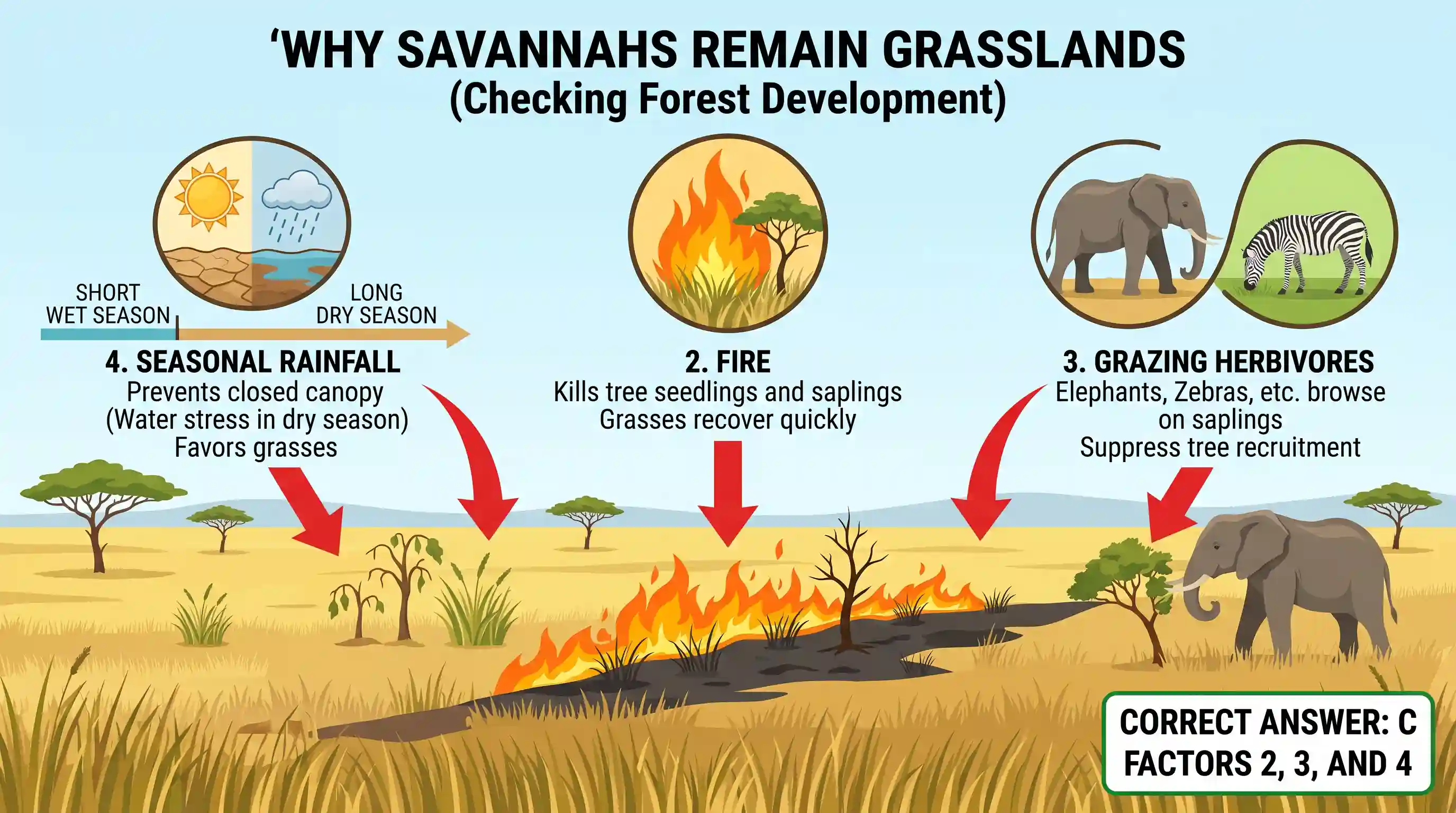
- C2, 3 and 4Correct
- D1, 3 and 5
Explanation
Savannahs are characterized by grasslands with scattered trees, and forest development is often kept in check by several factors:
- Fire: Frequent natural or human-induced fires are a major factor. Grasses are more resistant to fire and recover quickly, while tree seedlings and saplings are often killed, preventing the establishment of dense forests.
- Grazing herbivores: Large populations of grazing animals (like zebras, wildebeest, elephants) consume tree seedlings and saplings, suppressing tree growth and favoring the dominance of grasses.
- Seasonal rainfall: Savannahs experience distinct wet and dry seasons. The prolonged dry season creates conditions (e.g., water scarcity) that are unfavorable for the growth of a dense, closed-canopy forest, but sufficient for drought-adapted grasses and scattered trees. This rainfall pattern is a fundamental limiting factor for forest development.
- Burrowing animals and termites: While these animals affect soil structure and nutrient cycling, they are generally not considered primary factors that check extensive forest development on a landscape scale in savannas.
- Soil properties: While specific soil properties can influence vegetation, they are not a universal or primary checking factor across all savannas compared to the direct impact of fire, grazing, and rainfall patterns. Therefore, fire, grazing herbivores, and seasonal rainfall are the most significant conditions that prevent the extensive development of forests in savanna regions.
Related questions
More UPSC Prelims practice from the same subject and topic.
- Prelims 2021GS1geography
'R2 Code of Practices' constitutes a tool available for promoting the adoption of
- Prelims 2021GS1geography
Why is there a concern about copper smelting plants? 1. They may release lethal quantities of carbon monoxide into environment. 2. The copper slag can cause the leaching of some heavy metals into envi…
- Prelims 2021GS1geography
What is blue carbon?
- Prelims 2021GS1geography
In the nature, which of the following is/are most likely to be found surviving on a surface without soil? 1. Fern 2. Lichen 3. Moss 4. Mushroom Select the correct answer using the code given below.
- Prelims 2021GS1geography
Consider the following kinds of organisms : 1. Copepods 2. Cyanobacteria 3. Diatoms 4. Foraminifera Which of the above are primary producers in the food chains of oceans?
- Prelims 2021GS1geography
Consider the following animals : 1. Hedgehog 2. Marmot 3. Pangolin To reduce the chance of being captured by predators, which of the above organisms rolls up/roll up and protects/ protect its/their vu…