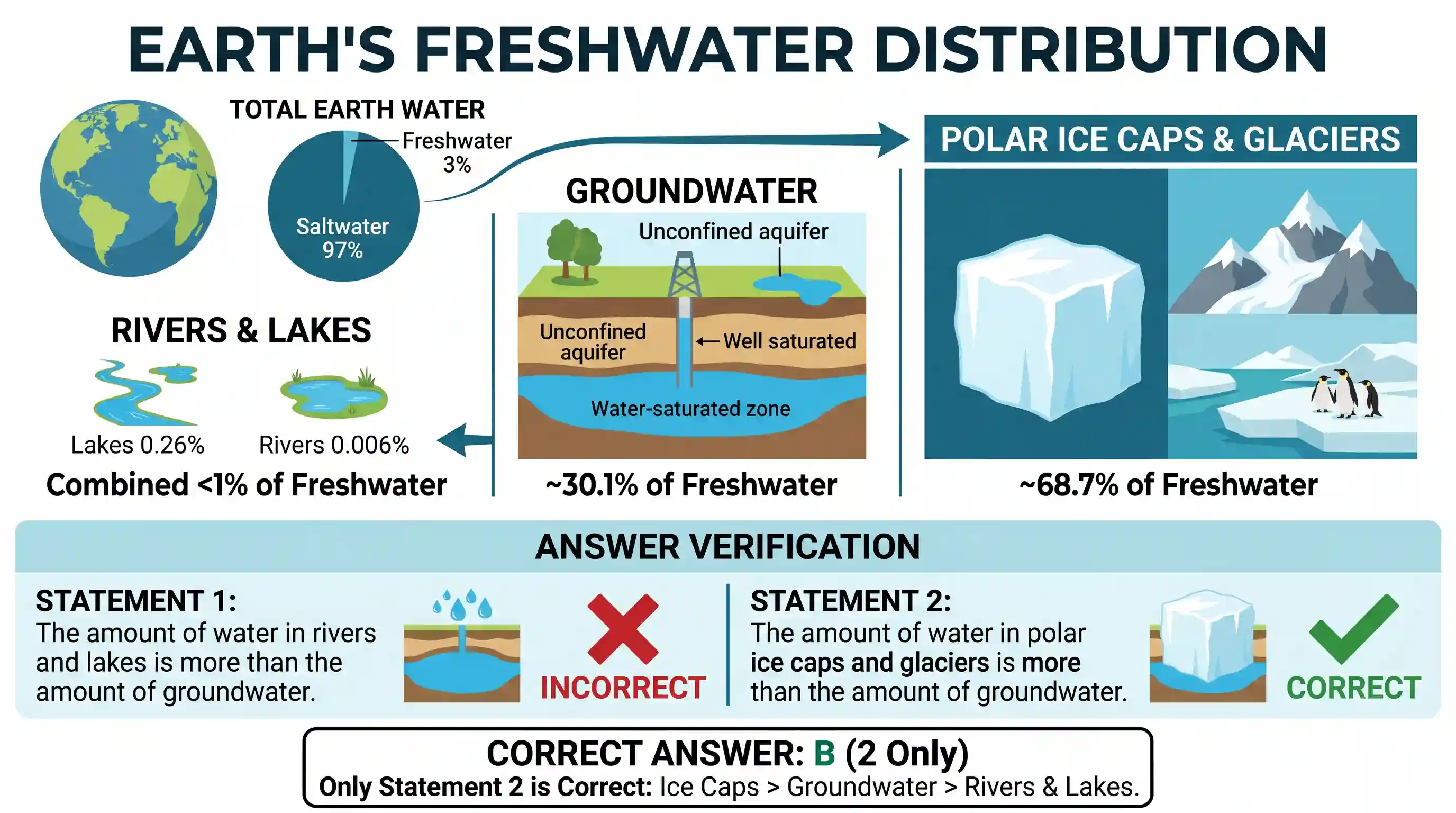
With reference to the water on the planet Earth, consider the following statements : 1. The amount of water in the rivers and lakes is more than the amount of groundwater. 2. The amount of water in polar ice caps and glaciers is more than the amount of groundwater. Which of the statements given above is/are correct?

- A1 only
- B2 onlyCorrect
- CBoth 1 and 2
- DNeither 1 nor 2
Explanation
Statement 1 is incorrect: The amount of groundwater on Earth is significantly larger than the combined amount of water in rivers and lakes. While rivers and lakes are visible freshwater sources, groundwater constitutes a much larger reservoir of accessible freshwater. Globally, groundwater accounts for approximately 30.1% of all freshwater, whereas rivers account for a mere 0.006% and lakes about 0.26% of total freshwater.
Statement 2 is correct: Polar ice caps and glaciers hold the vast majority of Earth's freshwater. Approximately 68.7% of all freshwater on Earth is locked up in glaciers and ice caps. This amount is indeed more than the amount of groundwater, which is about 30.1% of freshwater.
Related questions
More UPSC Prelims practice from the same subject and topic.
- Prelims 2021GS1geography
Consider the following statements : 1. In the tropical zone, the western sections of the oceans are warmer than the eastern sections owing to the influence of trade winds. 2. In the temperate zone, we…
- Prelims 2021GS1geography
'R2 Code of Practices' constitutes a tool available for promoting the adoption of
- Prelims 2021GS1geography
Why is there a concern about copper smelting plants? 1. They may release lethal quantities of carbon monoxide into environment. 2. The copper slag can cause the leaching of some heavy metals into envi…
- Prelims 2021GS1geography
What is blue carbon?
- Prelims 2021GS1geography
In the nature, which of the following is/are most likely to be found surviving on a surface without soil? 1. Fern 2. Lichen 3. Moss 4. Mushroom Select the correct answer using the code given below.
- Prelims 2021GS1geography
Consider the following kinds of organisms : 1. Copepods 2. Cyanobacteria 3. Diatoms 4. Foraminifera Which of the above are primary producers in the food chains of oceans?