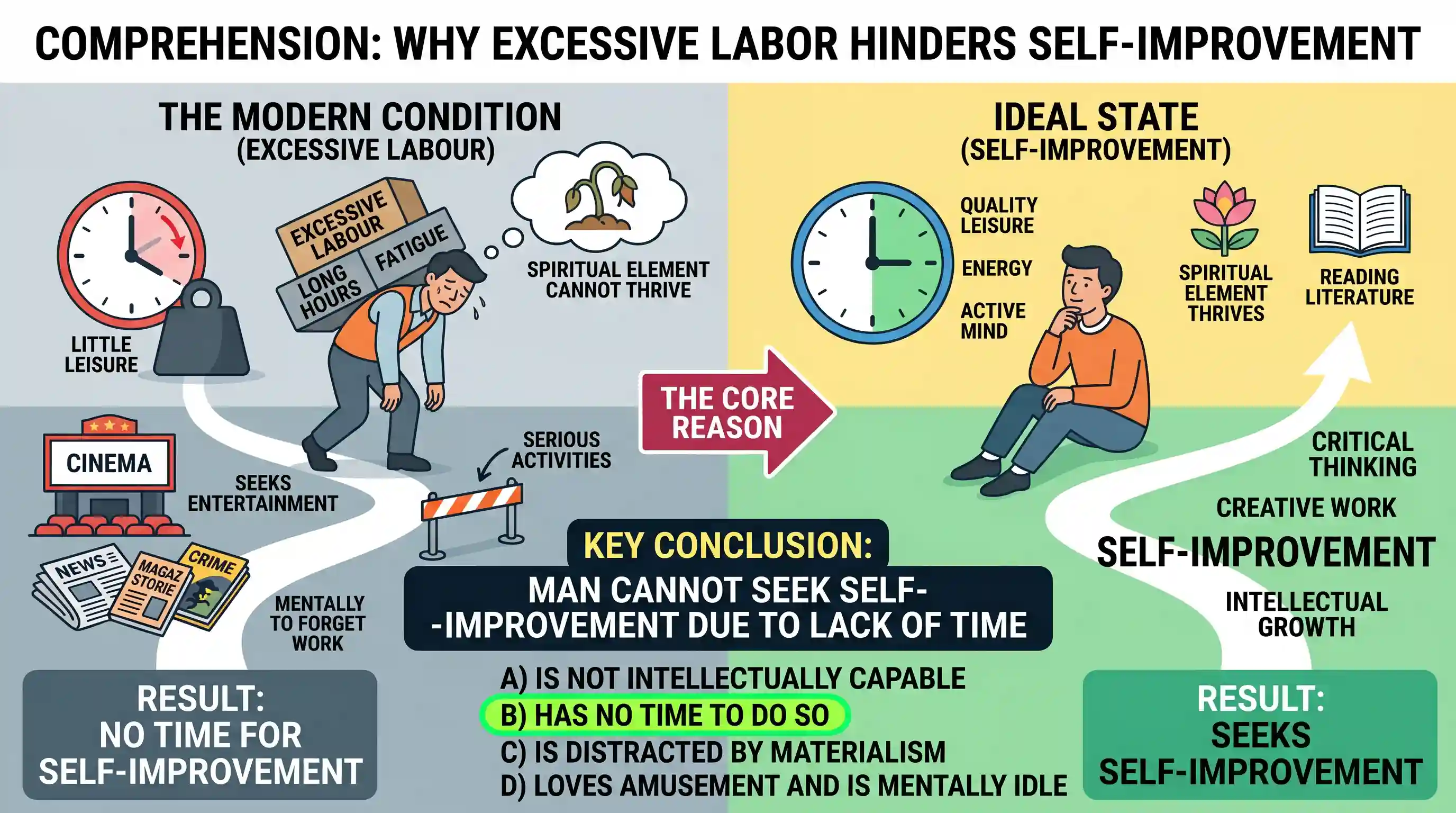
For two or three generations past, ever- increasing numbers of individuals have been living as workers merely, not as human beings. An excessive amount of labour is rule today in every circle of society, with the result that man's spiritual element cannot thrive. He finds it very difficult to spend his little leisure in serious activities. He does not want to think; or he cannot even if he wants to. He seeks not self- improvement, but entertainment which would enable him to be mentally idle and to forget his usual activities. Therefore, the so- called culture of our age is dependant more on cinema than on theatre, more on newspapers, magazines and crime stories than on serious literature. Man does not seek self- improvement because he

- Ais not intellectually capable
- Bhas no time to do soCorrect
- Cis distracted by materialism
- Dloves amusement and is mentally idle
Explanation
The passage states, "An excessive amount of labour is rule today in every circle of society, with the result that man's spiritual element cannot thrive. He finds it very difficult to spend his little leisure in serious activities." This directly implies that the individual's lack of time and energy, due to excessive work and "little leisure," is the primary reason he cannot engage in serious activities like self-improvement.
Analyzing the options: A) is not intellectually capable: The passage says "He does not want to think; or he cannot even if he wants to." This suggests an inability stemming from exhaustion or unwillingness, not a fundamental lack of intellectual capacity. B) has no time to do so: This aligns perfectly with the passage's emphasis on "excessive amount of labour" and finding it "very difficult to spend his little leisure in serious activities." The lack of sufficient and quality leisure time directly impedes self-improvement. C) is distracted by materialism: The passage mentions seeking entertainment for mental idleness, but it does not attribute this to materialism. The focus is on forgetting work and mental rest, not acquiring material possessions. D) loves amusement and is mentally idle: While the passage states that man seeks entertainment to be mentally idle, this is presented as a consequence or symptom of his condition (excessive labor, lack of time/energy), rather than the fundamental reason he does not seek self-improvement. He seeks amusement because he is exhausted and finds it difficult to engage in serious activities.
Therefore, the most direct reason, as stated in the passage, is the lack of time due to excessive labor.
Related questions
More UPSC Prelims practice from the same subject and topic.
- Prelims 2022CSATReading Comprehension
The main threat to maintaining progress in human development comes from the increasingly evident unsustainability of production and consumption patterns. Current production models rely heavily on foss…
- Prelims 2022CSATReading Comprehension
The main threat to maintaining progress in human development comes from the increasingly evident unsustainability of production and consumption patterns. Current production models rely heavily on foss…
- Prelims 2022CSATReading Comprehension
Unless the forces and tendencies which are responsible for destroying the country's environment are checked in the near future and afforestation of denuded areas is taken up on a massive scale, the ha…
- Prelims 2022CSATReading Comprehension
"In simple matters like shoe- making, we think only a specially trained person will serve our purpose, but in politics, we presume that everyone who knows how to get votes knows how to administer a St…
- Prelims 2022CSATReading Comprehension
The poverty line is quite unsatisfactory when it comes to grasping the extent of poverty in India. It is not only because of its extremely narrow definition of 'who is poor' and the debatable methodol…
- Prelims 2022CSATReading Comprehension
The poverty line is quite unsatisfactory when it comes to grasping the extent of poverty in India. It is not only because of its extremely narrow definition of 'who is poor' and the debatable methodol…