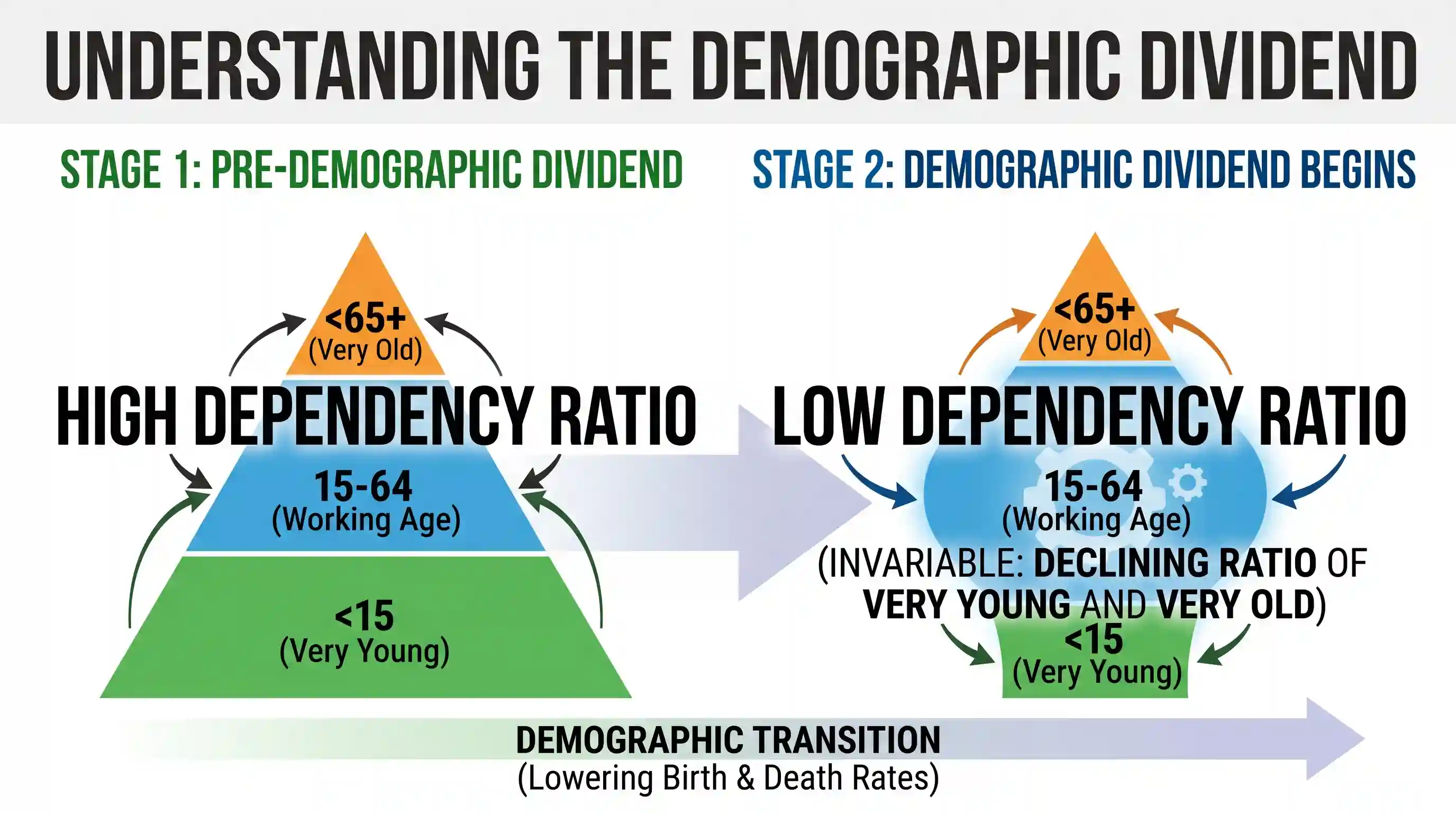
The demographic dividend, which has begun in India and is expected to last another few decades, is a great window of opportunity. The demographic dividend is basically a swelling in the working age population, which conversely means that the relative ratio of very young and very old will, for a while, be on the decline. From the experience of Ireland and China, we know that this can be a source of energy and an engine of economic growth. The demographic dividend tends to raise a nation's savings rate since in any nation, it is the working age population that is the main saver. And since the savings rate is an important driver of growth, this should help elevate our growth rate. However, the benefits of demographic dividend depend on the quality of the working age population. And this implies bringing back the importance of education, acquisition of skills and human capital. Which of the following would invariably happen in a country, when the demographic dividend has begun to operate? 1. The number of illiterate people will decrease. 2. The ratio of very old and very young will decrease for a while. 3. Population growth rate will quickly stabilize. Select the correct answer using the code given below

- A1 and 2 only
- B2 onlyCorrect
- C1 and 3 only
- D1, 2 and 3
Explanation
The demographic dividend refers to a period when the proportion of the working-age population is higher than the dependent population (very young and very old).
Let's analyze each statement:
-
The number of illiterate people will decrease. While the demographic dividend presents an opportunity for a country to invest in education and human capital, it does not invariably lead to a decrease in the number of illiterate people. The passage states that the benefits depend on the quality of the working-age population, implying that efforts are needed to improve education, not that it automatically happens. A country might fail to capitalize on this opportunity, or the overall population growth might still be high enough that the absolute number of illiterate people doesn't decrease.
-
The ratio of very old and very young will decrease for a while. The passage explicitly states: "The demographic dividend is basically a swelling in the working age population, which conversely means that the relative ratio of very young and very old will, for a while, be on the decline." This is a direct definition and an invariable characteristic of the demographic dividend.
-
Population growth rate will quickly stabilize. The demographic dividend is a phase characterized by changes in the age structure, primarily due to declining birth rates and low death rates. While declining birth rates contribute to this, it does not mean the overall population growth rate will quickly stabilize. The population might still be growing, albeit at a slower rate, and stabilization or decline typically occurs later in the demographic transition. The dividend is about the proportion of working-age people, not the immediate stabilization of total population growth.
Therefore, only statement 2 is an invariable consequence when the demographic dividend begins to operate.
The final answer is B
Related questions
More UPSC Prelims practice from the same subject and topic.
- Prelims 2022CSATReading Comprehension
The main threat to maintaining progress in human development comes from the increasingly evident unsustainability of production and consumption patterns. Current production models rely heavily on foss…
- Prelims 2022CSATReading Comprehension
The main threat to maintaining progress in human development comes from the increasingly evident unsustainability of production and consumption patterns. Current production models rely heavily on foss…
- Prelims 2022CSATReading Comprehension
Unless the forces and tendencies which are responsible for destroying the country's environment are checked in the near future and afforestation of denuded areas is taken up on a massive scale, the ha…
- Prelims 2022CSATReading Comprehension
"In simple matters like shoe- making, we think only a specially trained person will serve our purpose, but in politics, we presume that everyone who knows how to get votes knows how to administer a St…
- Prelims 2022CSATReading Comprehension
The poverty line is quite unsatisfactory when it comes to grasping the extent of poverty in India. It is not only because of its extremely narrow definition of 'who is poor' and the debatable methodol…
- Prelims 2022CSATReading Comprehension
The poverty line is quite unsatisfactory when it comes to grasping the extent of poverty in India. It is not only because of its extremely narrow definition of 'who is poor' and the debatable methodol…