With reference to the Earth's atmosphere, which one of the following statements is correct?

- AThe total amount of insolation received at the equator is roughly about 10 times of that received at the poles.
- BInfrared rays constitute roughly two-thirds of insolation.
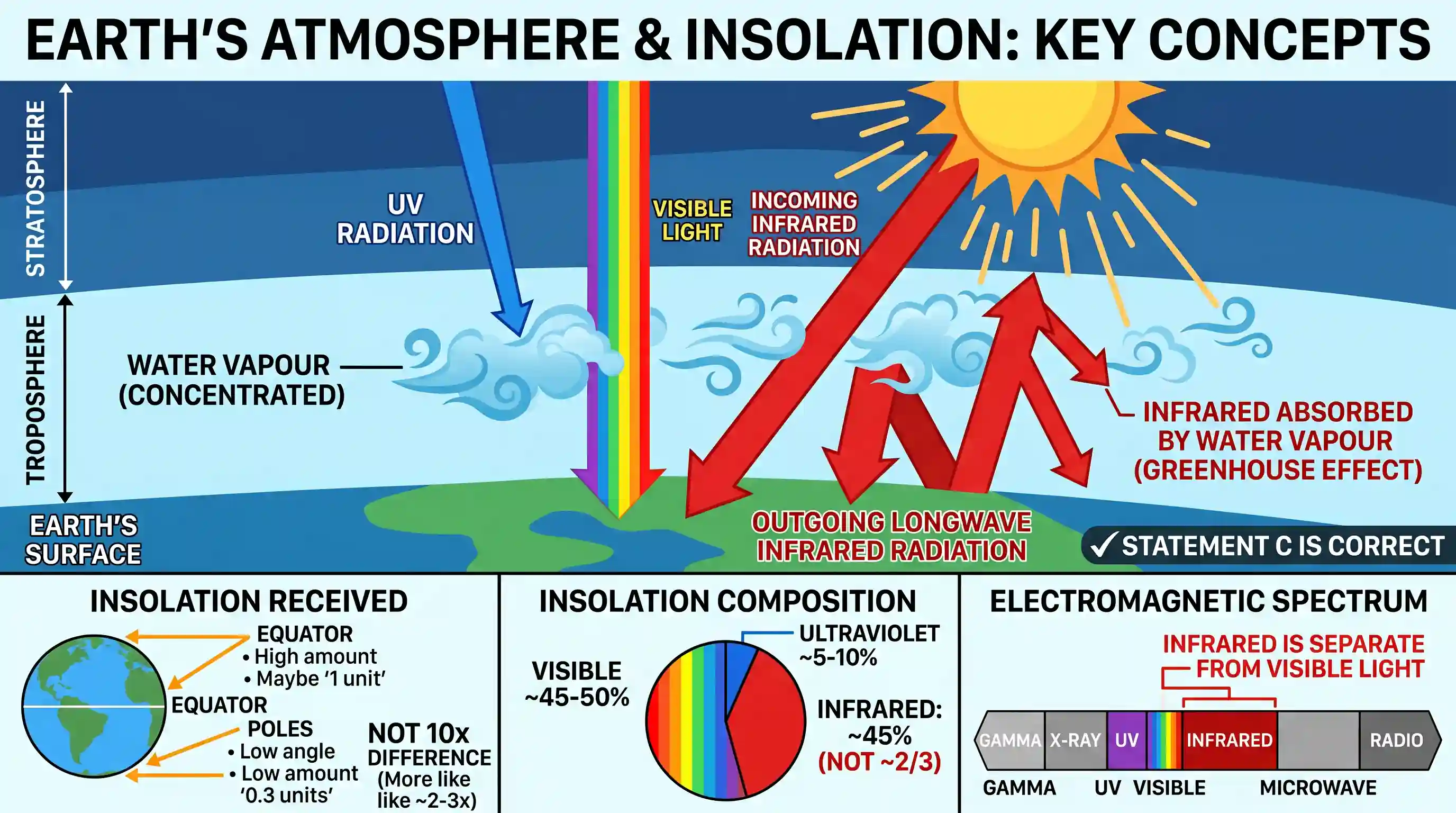
- CInfrared waves are largely absorbed by water vapour that is concentrated in the lower atmosphere.Correct
- DInfrared waves are a part of visible spectrum of electromagnetic waves of solar radiation.
Explanation
Let's evaluate each statement concerning the Earth's atmosphere:
A) The total amount of insolation received at the equator is roughly about 10 times of that received at the poles. This statement is incorrect. While the equator receives significantly more insolation than the poles due to the angle of incidence, the difference is not as extreme as 10 times. Poles still receive insolation, particularly during their respective summers, and factors like albedo and atmospheric absorption play a role.
B) Infrared rays constitute roughly two-thirds of insolation. This statement is incorrect. The solar radiation (insolation) reaching Earth is composed of different wavelengths. Visible light accounts for about 45-50%, infrared (IR) radiation accounts for roughly 45%, and ultraviolet (UV) radiation for about 5-10%. Two-thirds (approx. 66%) is an overestimation for infrared.
C) Infrared waves are largely absorbed by water vapour that is concentrated in the lower atmosphere. This statement is correct. Water vapor is a potent greenhouse gas. It efficiently absorbs outgoing longwave infrared radiation emitted by the Earth's surface and atmosphere, trapping heat and contributing significantly to the greenhouse effect in the lower atmosphere (troposphere).
D) Infrared waves are a part of visible spectrum of electromagnetic waves of solar radiation. This statement is incorrect. The visible spectrum is a narrow band of electromagnetic radiation that the human eye can perceive. Infrared waves have longer wavelengths than visible light and are therefore outside the visible spectrum. They are part of the broader electromagnetic spectrum but not the visible portion.
Based on the analysis, statement C is the correct one.
Related questions
More UPSC Prelims practice from the same subject and topic.
- Prelims 2023GS1geography
Consider the following statements: Statement-I: The temperature contrast between continents and oceans is greater during summer than in winter. Statement-II: The specific heat of water is more than th…
- Prelims 2023GS1geography
Consider the following statements: 1. Jhelum River passes through Wular Lake. 2. Krishna River directly feeds Kolleru Lake. 3. Meandering of Gandak River formed Kanwar Lake. How many of the statements…
- Prelims 2023GS1geography
Consider the following pairs: Port Well known as 1. Kamarajar Port: First major port in India registered as a company 2. Mundra Port: Largest privately owned port in India 3. Visakhapatnam Port: Large…
- Prelims 2023GS1geography
Consider the following trees: 1. Jackfruit (Artocarpus heterophyllus) 2. Mahua (Madhuca indica) 3. Teak (Tectona grandis) How many of the above are deciduous trees?
- Prelims 2023GS1geography
Consider the following statements: 1. India has more arable area than China. 2. The proportion of irrigated area is more in India as compared to China. 3. The average productivity per hectare in India…
- Prelims 2023GS1geography
Which one of the following is the best example of repeated falls in sea level, giving rise to present-day extensive marshland?