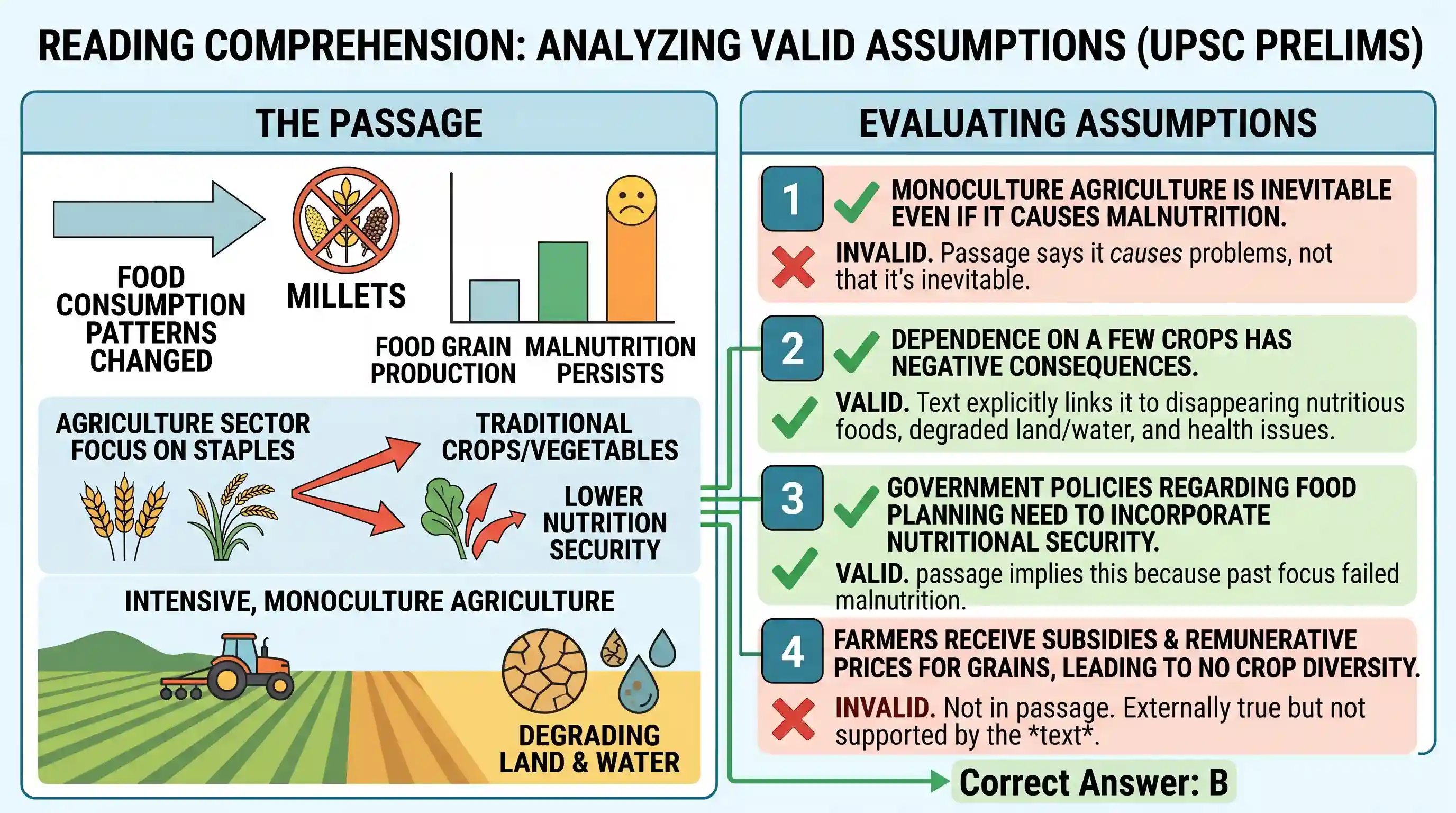
Food consumption patterns have changed substantially in India over the past few decades. This has resulted in the disappearance of many nutritious foods such as millets. While food grain production has increased over five times since independence, it has not sufficiently addressed the issue of malnutrition. For long, the agriculture sector focused on increasing food production particularly staples, which led to lower production and consumption of indigenous traditional corps/grains, fruits and other vegetables, impacting food and nutrition security in the process. Further, intensive, monoculture agriculture practices can perpetuate the food and nutrition security problem by degrading the quality of land, water and food derived through them. Based on the above passage, the following assumptions have been made: 1. To implement the Sustainable Development Goals and to achieve zero-hunger goal, monoculture agriculture practices are inevitable even if they do not address malnutrition. 2. Dependence on a few crops has negative consequences for human health and the ecosystem. 3. Government policies regarding food planning need to incorporate nutritional security. 4. For the present monoculture agriculture practices, farmers receive subsidies in various ways and government offers remunerative prices for grains and therefore they do not tend to consider crop diversity. Which of the above assumptions are valid?

- A1, 2 and 4 only
- B2 and 3 onlyCorrect
- C3 and 4 only
- D1, 2, 3 and 4
Explanation
The correct answer is B because only assumptions 2 and 3 can be logically derived from the passage.
Assumption 1 is incorrect because the passage suggests that monoculture agriculture practices contribute to food and nutrition security problems by degrading land and water. The passage implies a need for change, not that such practices are inevitable for achieving Sustainable Development Goals.
Assumption 2 is valid because the passage explicitly mentions that focusing on staples and monoculture has led to the disappearance of nutritious foods like millets and has degraded the quality of land and water, affecting both human health and the ecosystem.
Assumption 3 is valid because the passage highlights that increasing food production alone has not addressed malnutrition. It suggests that the past focus on staples impacted nutrition security, implying that future food planning must incorporate nutritional aspects.
Assumption 4 is incorrect because, while it may be true in a real-world context, the passage provides no information regarding government subsidies or remunerative prices. An assumption must be rooted in the provided text.
Therefore, only 2 and 3 are valid assumptions based on the text.
Related questions
More UPSC Prelims practice from the same subject and topic.
- Prelims 2024CSATReading Comprehension
According to the Food and Agriculture Organization, one-third of food produced for human consumption is lost or wasted globally. Food is lost or wasted throughout the supply chain, from initial agricu…
- Prelims 2024CSATReading Comprehension
As inflation rises, even governments previously committed to budget discipline are spending freely to help households. Higher interest rates announced by central banks are supposed to help produce mod…
- Prelims 2024CSATReading Comprehension
As inflation rises, even governments previously committed to budget discipline are spending freely to help households. Higher interest rates announced by central banks are supposed to help produce mod…
- Prelims 2024CSATReading Comprehension
How best can the problems of floods and droughts be addressed so that the losses are minimal and the system becomes resilient? In this context, one important point that needs to be noted is that India…
- Prelims 2024CSATReading Comprehension
"The social order is a sacred right which is the basis of all other rights. Nevertheless, this right does not come from nature, and must therefore be founded on conventions." With reference to the abo…
- Prelims 2024CSATReading Comprehension
In an economic organization, allowing mankind to benefit by the productivity of machines should lead to a very good life of leisure, and much leisure is apt to be tedious except to those who have inte…