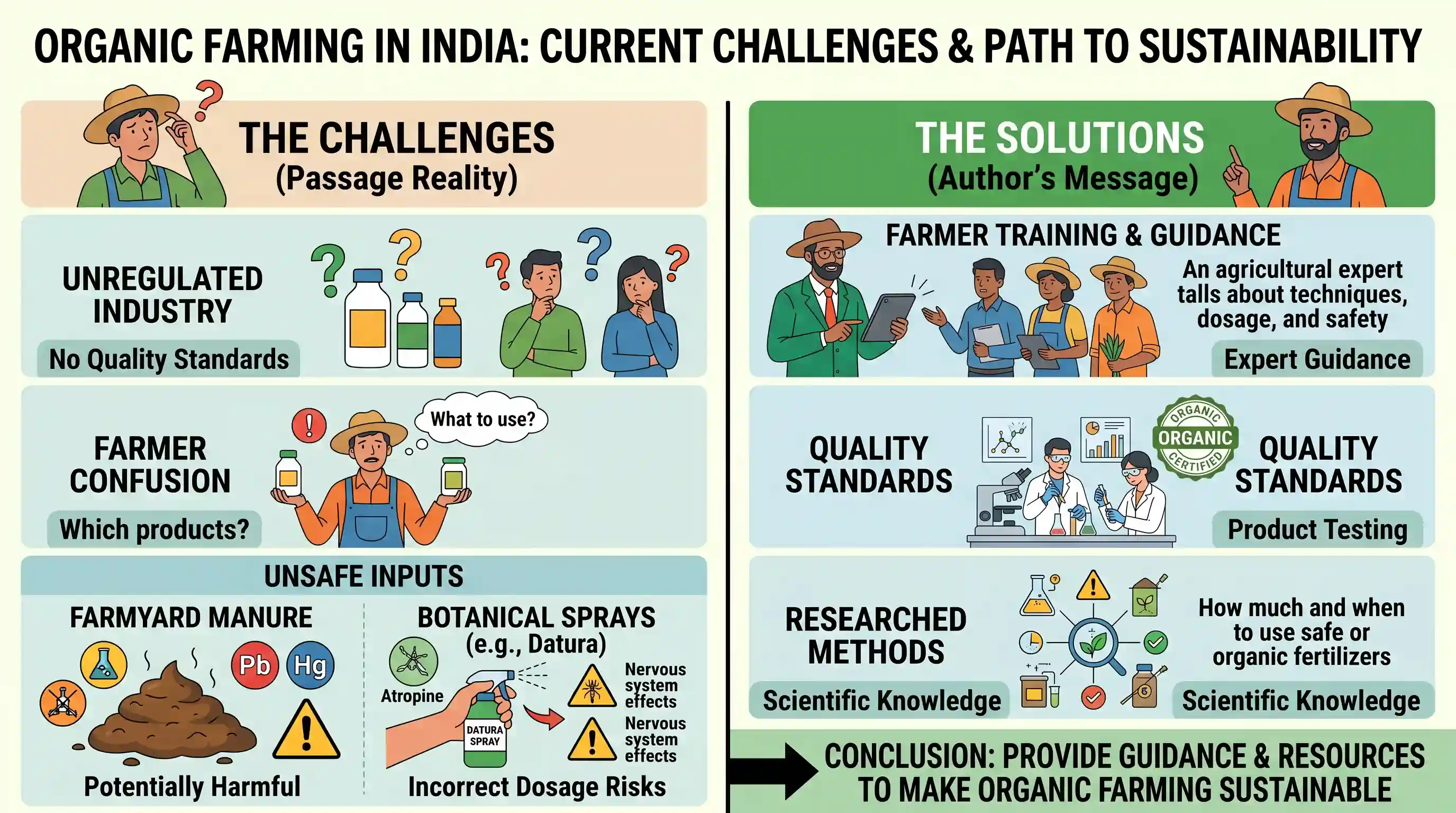
There is a claim that organic farming is inherently safer and healthier. The reality is that because the organic farming industry is still young and not well-regulated in India, farmers and consumers, alike, are not only confused about what products are best for them, but sometimes use products in ways that could harm them as well. For example, since organic fertilizers are difficult to obtain on a large scale in India, farmers often use farmyard manure, which may contain toxic chemicals and heavy metals. Certain plant sprays, such as Datura flower and leaf spray, have an element called atropine. If it is not applied in the right dose, it can act on the nervous system of the consumer. Unfortunately, how much and when to use it are not well- researched or regulated issues. Which one of the following statements best reflects the most logical, rational and practical message conveyed by the author of the passage?

- AIn India, organic farming should not be promoted as a substitute for conventional farming
- BThere are no safe organic alternatives to chemical fertilizers
- CIn India, farmers need to be guided and helped to make their organic farming sustainableCorrect
- DThe aim of organic farming should not be to generate huge profits as there is still no global market for its products.
Explanation
The passage highlights several issues with organic farming in India: lack of regulation, farmer confusion, difficulty obtaining proper organic fertilizers (leading to use of potentially toxic farmyard manure), and unsafe use of plant sprays due to lack of research and guidance on dosage.
Let's analyze the options:
A) In India, organic farming should not be promoted as a substitute for conventional farming. The passage does not argue against promoting organic farming itself. Instead, it points out the challenges and dangers in its current unregulated and unguided state, implying a need for improvement, not abandonment.
B) There are no safe organic alternatives to chemical fertilizers. The passage states that "organic fertilizers are difficult to obtain on a large scale in India," implying that safe alternatives do exist but are not readily accessible, leading farmers to use less safe options like farmyard manure. It doesn't claim a complete absence of safe alternatives.
C) In India, farmers need to be guided and helped to make their organic farming sustainable. This option directly addresses the core issues raised. The passage details how farmers are "confused," use products "in ways that could harm them," and lack knowledge on "how much and when to use" certain sprays. This clearly indicates a need for guidance, research, and regulation to ensure organic farming practices are truly safe, healthy, and viable in the long term (i.e., sustainable). This is the most logical, rational, and practical message.
D) The aim of organic farming should not be to generate huge profits as there is still no global market for its products. The passage makes no mention of profits, market size, or global markets. This option introduces an idea completely outside the scope of the given text.
Therefore, C best reflects the message conveyed by the author, who points out the need for better support, knowledge, and regulation for organic farmers in India.
Related questions
More UPSC Prelims practice from the same subject and topic.
- Prelims 2024CSATReading Comprehension
According to the Food and Agriculture Organization, one-third of food produced for human consumption is lost or wasted globally. Food is lost or wasted throughout the supply chain, from initial agricu…
- Prelims 2024CSATReading Comprehension
As inflation rises, even governments previously committed to budget discipline are spending freely to help households. Higher interest rates announced by central banks are supposed to help produce mod…
- Prelims 2024CSATReading Comprehension
As inflation rises, even governments previously committed to budget discipline are spending freely to help households. Higher interest rates announced by central banks are supposed to help produce mod…
- Prelims 2024CSATReading Comprehension
How best can the problems of floods and droughts be addressed so that the losses are minimal and the system becomes resilient? In this context, one important point that needs to be noted is that India…
- Prelims 2024CSATReading Comprehension
"The social order is a sacred right which is the basis of all other rights. Nevertheless, this right does not come from nature, and must therefore be founded on conventions." With reference to the abo…
- Prelims 2024CSATReading Comprehension
In an economic organization, allowing mankind to benefit by the productivity of machines should lead to a very good life of leisure, and much leisure is apt to be tedious except to those who have inte…