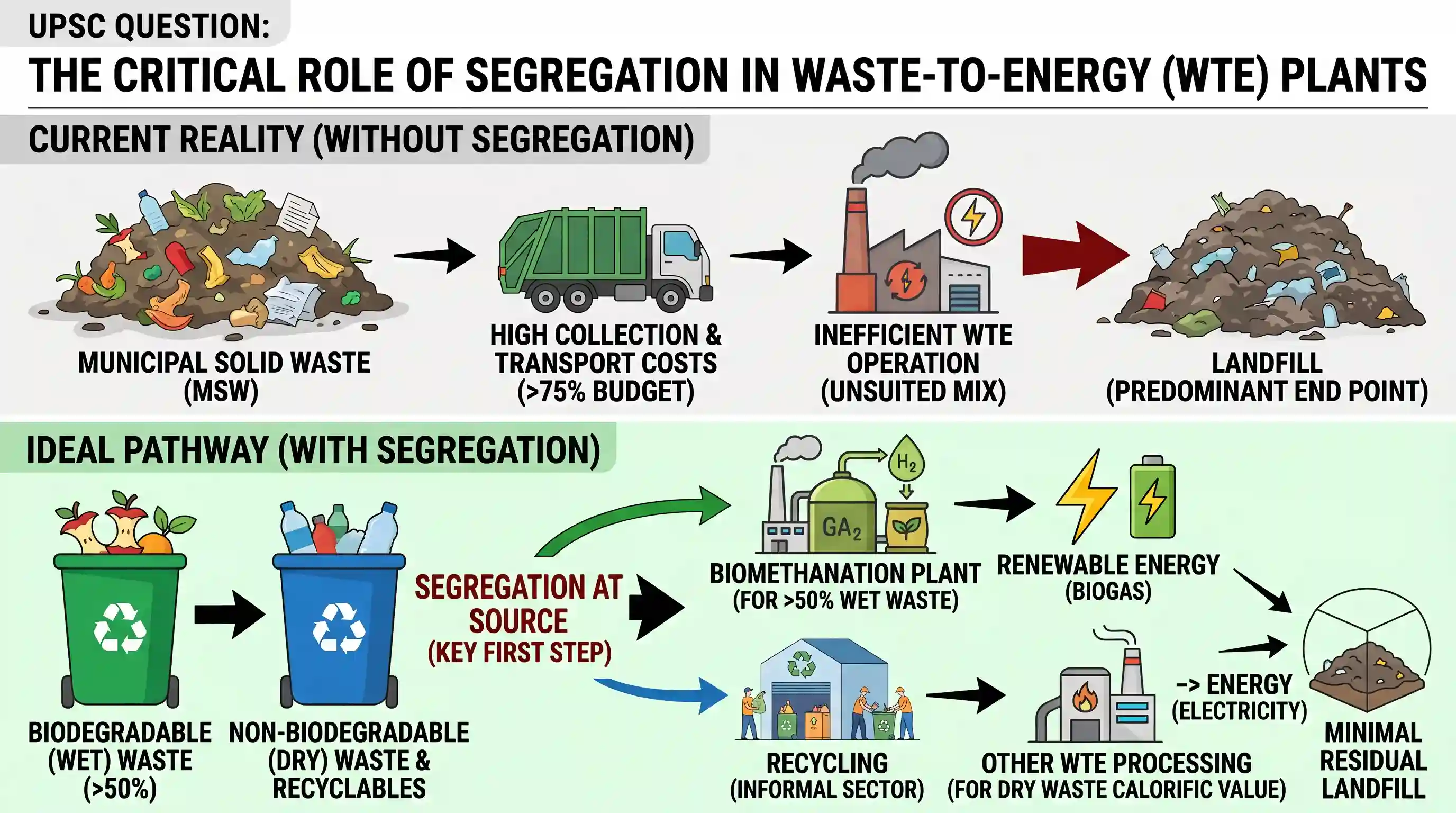
In India, the segregation of municipal waste at source is rare. Recycling is mostly with the informal sector. More than three- fourths of the municipal budget goes into collection and transportation, which leaves very little for processing/resource recovery and disposal. Where does waste- to- energy fit into all this? Ideally it fits in the chain after segregation (between wet waste and rest), collection, recycling, and before getting to the landfill. Which technology is most appropriate in converting waste to energy depends on what is in the waste (that is biodegradable versus non- biodegradable component) and its calorific value. The biodegradable component of India's municipal solid waste is a little over 50 per cent, and biomethanation offers a major solution for processing this. Which one of the following statements best reflects the crux of the passage?

- AGeneration of energy from municipal solid waste is inexpensive
- BBiomethanation is the most ideal way of generating energy from municipal solid waste
- CSegregation of municipal solid waste is the first step in ensuring the success of waste-to-energy plantsCorrect
- DThe biodegradable component of India's municipal solid waste is not adequate to provide energy from waste efficiently/effectively.
Explanation
The passage highlights that "segregation of municipal waste at source is rare" in India. It then states that waste-to-energy "ideally fits in the chain after segregation (between wet waste and rest), collection, recycling, and before getting to the landfill." This clearly establishes segregation as a fundamental prerequisite for the successful and ideal integration of waste-to-energy into the waste management system. The passage implicitly argues that the current lack of segregation is a major hurdle.
Let's analyze the options:
A) Generation of energy from municipal solid waste is inexpensive. The passage mentions that "More than three-fourths of the municipal budget goes into collection and transportation, which leaves very little for processing/resource recovery and disposal." This suggests that processing (including WTE) is either expensive or underfunded, not inexpensive. This statement is not supported.
B) Biomethanation is the most ideal way of generating energy from municipal solid waste. The passage says biomethanation "offers a major solution for processing this [biodegradable component]," which is a little over 50%. It also states that the "most appropriate" technology depends on the waste's composition and calorific value. It does not claim biomethanation is the "most ideal way" for all waste.
C) Segregation of municipal solid waste is the first step in ensuring the success of waste-to-energy plants. The passage explicitly places waste-to-energy after segregation in the ideal chain. Given that segregation is currently rare, the passage implies that implementing segregation is crucial for WTE to fit effectively. This statement accurately reflects a key point.
D) The biodegradable component of India's municipal solid waste is not adequate to provide energy from waste efficiently/effectively. The passage states that "The biodegradable component... is a little over 50 per cent, and biomethanation offers a major solution for processing this." This indicates that the biodegradable component is significant and can be used for energy, contradicting the statement.
Therefore, option C best reflects the crux by emphasizing the critical role of segregation, which is currently lacking in India, as a prerequisite for effective waste-to-energy implementation.
Related questions
More UPSC Prelims practice from the same subject and topic.
- Prelims 2024CSATReading Comprehension
According to the Food and Agriculture Organization, one-third of food produced for human consumption is lost or wasted globally. Food is lost or wasted throughout the supply chain, from initial agricu…
- Prelims 2024CSATReading Comprehension
As inflation rises, even governments previously committed to budget discipline are spending freely to help households. Higher interest rates announced by central banks are supposed to help produce mod…
- Prelims 2024CSATReading Comprehension
As inflation rises, even governments previously committed to budget discipline are spending freely to help households. Higher interest rates announced by central banks are supposed to help produce mod…
- Prelims 2024CSATReading Comprehension
How best can the problems of floods and droughts be addressed so that the losses are minimal and the system becomes resilient? In this context, one important point that needs to be noted is that India…
- Prelims 2024CSATReading Comprehension
"The social order is a sacred right which is the basis of all other rights. Nevertheless, this right does not come from nature, and must therefore be founded on conventions." With reference to the abo…
- Prelims 2024CSATReading Comprehension
In an economic organization, allowing mankind to benefit by the productivity of machines should lead to a very good life of leisure, and much leisure is apt to be tedious except to those who have inte…