Read the following passage and answer the items that follow the passages. Your answers to these items should be based on the passages only. In India, the segregation of municipal waste at source is rare. Recycling is mostly with the informal sector. More than three-fourths of the municipal budget goes into collection and transportation, which leaves very little for processing/resource recovery and disposal. Where does waste-to-energy fit into all this? Ideally it fits in the chain after segregation (between wet waste and rest), collection, recycling, and before getting to the landfill. Which technology is most appropriate in converting waste to energy depends on what is in the waste (that is biodegradable versus non-biodegradable component) and its calorific value. The biodegradable component of India's municipal solid waste is a little over 50 per cent, and biomethanation offers a major solution for processing this. Based on the above passage, the following assumptions have been made: 1. Collection, processing and segregation of municipal waste should be with government agencies. 2. Resource recovery and recycling require technological inputs that can be best handled by private sector enterprises. Which of the assumptions given above is/are correct?

- A1 only
- B2 only
- CBoth 1 and 2
- DNeither 1 nor 2Correct
Explanation
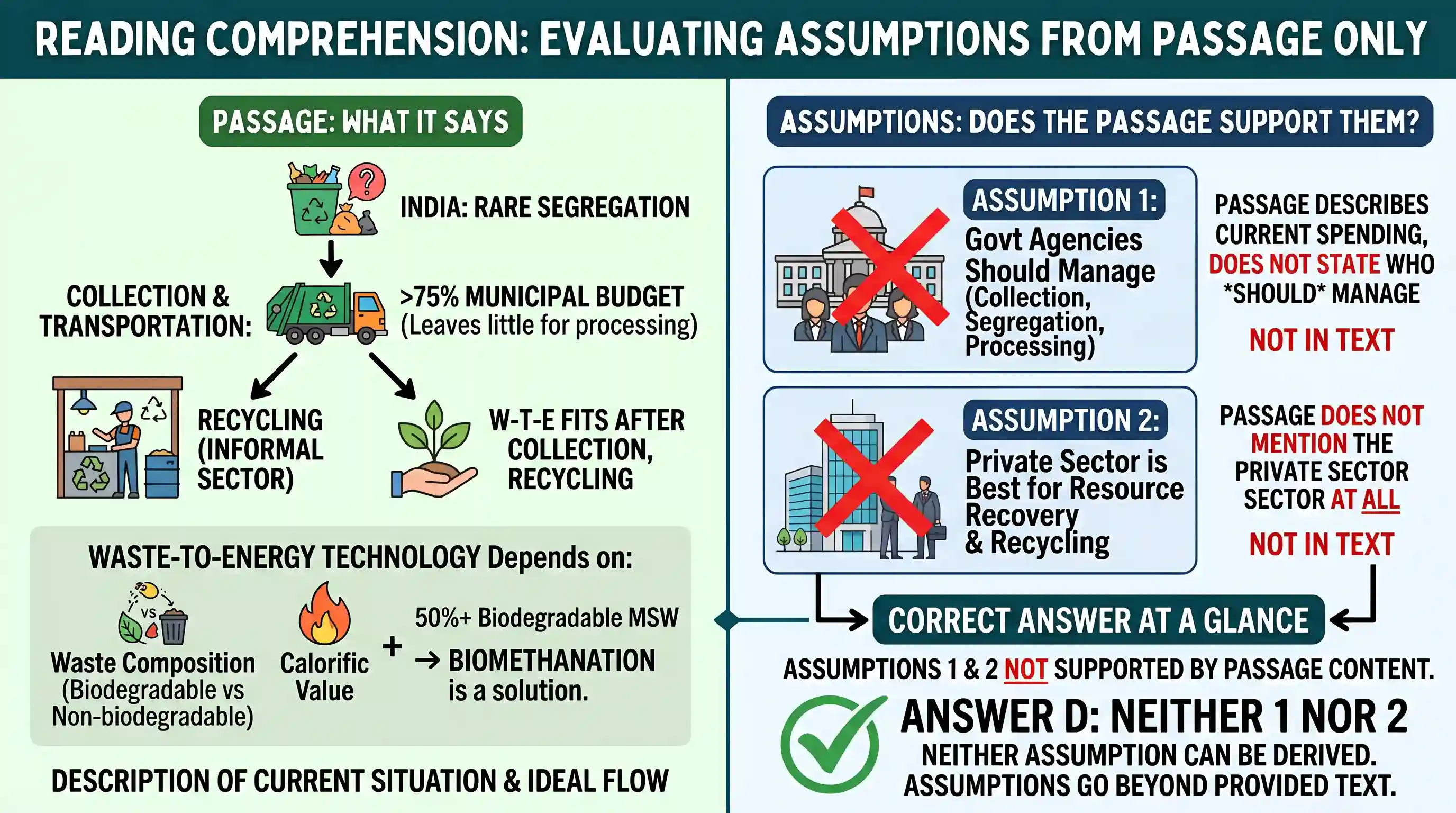
The correct answer is D because neither of the two assumptions can be logically derived from the passage.
Regarding Assumption 1, the passage mentions that the informal sector currently handles most recycling and that municipal budgets are heavily spent on collection. However, it nowhere states or implies that these tasks should be handled exclusively by government agencies. The text describes the current financial and operational situation without recommending a specific organizational mandate.
Regarding Assumption 2, while the passage discusses the importance of technology in waste-to-energy processes like biomethanation, it does not mention the private sector at all. There is no suggestion in the text that resource recovery and recycling are best handled by private enterprises versus public or informal ones.
Since the passage focuses on the composition of waste and the sequence of processing rather than who should manage these systems, both assumptions go beyond the scope of the provided text.
Related questions
More UPSC Prelims practice from the same subject and topic.
- Prelims 2024CSATReading Comprehension
According to the Food and Agriculture Organization, one-third of food produced for human consumption is lost or wasted globally. Food is lost or wasted throughout the supply chain, from initial agricu…
- Prelims 2024CSATReading Comprehension
As inflation rises, even governments previously committed to budget discipline are spending freely to help households. Higher interest rates announced by central banks are supposed to help produce mod…
- Prelims 2024CSATReading Comprehension
As inflation rises, even governments previously committed to budget discipline are spending freely to help households. Higher interest rates announced by central banks are supposed to help produce mod…
- Prelims 2024CSATReading Comprehension
How best can the problems of floods and droughts be addressed so that the losses are minimal and the system becomes resilient? In this context, one important point that needs to be noted is that India…
- Prelims 2024CSATReading Comprehension
"The social order is a sacred right which is the basis of all other rights. Nevertheless, this right does not come from nature, and must therefore be founded on conventions." With reference to the abo…
- Prelims 2024CSATReading Comprehension
In an economic organization, allowing mankind to benefit by the productivity of machines should lead to a very good life of leisure, and much leisure is apt to be tedious except to those who have inte…