With reference to revenue collection by Cornwallis, consider the following statements: 1. Under the Ryotwari Settlement of revenue collection, the peasants were exempted from revenue payment in case of bad harvests or natural calamities. 2. Under the Permanent Settlement in Bengal, if the Zamindar failed to pay his revenues to the state, on or before the fixed date, he would be removed from his Zamindari. Which of the statements given above is/are correct?

- A1 only
- B2 onlyCorrect
- CBoth 1 and 2
- DNeither 1 nor 2
Explanation
Let's analyze each statement:
-
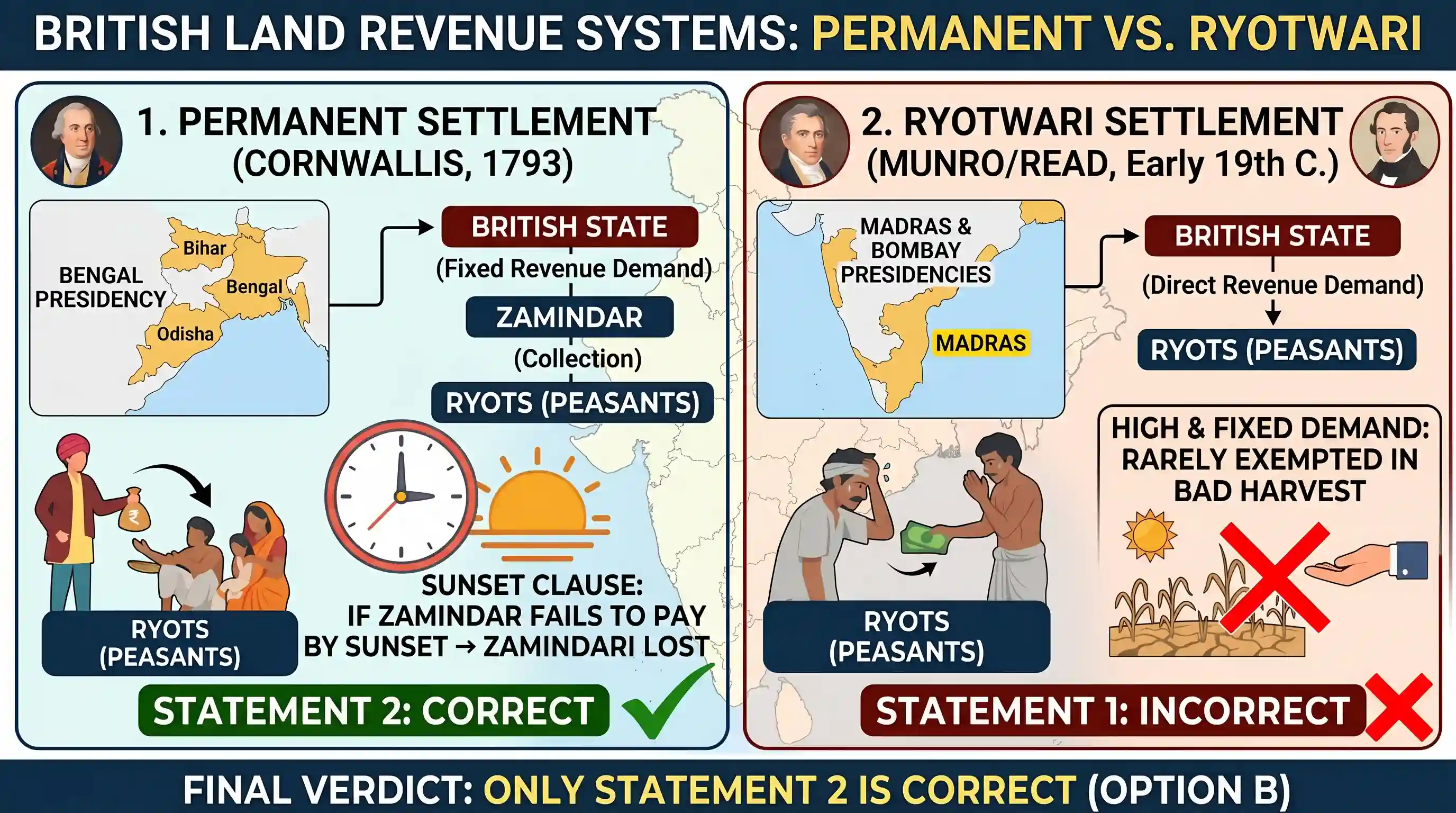
Statement 1 is incorrect. The Ryotwari Settlement was introduced primarily by Thomas Munro and Alexander Read, not Cornwallis. Cornwallis is famously associated with the Permanent Settlement. More importantly, even under Ryotwari, the revenue demand was often very high and fixed, and peasants were generally not exempted from payment during bad harvests or natural calamities. Remissions were rare and discretionary, and failure to pay often led to eviction. The system aimed at direct revenue collection from the cultivators (ryots), but it often resulted in severe pressure on them.
-
Statement 2 is correct. The Permanent Settlement (1793), introduced by Lord Cornwallis in Bengal, Bihar, and Odisha, fixed the land revenue demand permanently with the Zamindars. The system included a strict 'Sunset Clause,' meaning that if a Zamindar failed to pay the fixed amount by the stipulated date (sunset), their Zamindari rights would be immediately forfeited and sold off to the highest bidder. This was a deliberate policy to ensure punctual revenue collection and create a loyal class of landlords. This provision indeed led to the removal of many old Zamindars and the rise of new ones.
Therefore, only statement 2 is correct.
Related questions
More UPSC Prelims practice from the same subject and topic.
- Prelims 2024GS1history
Consider the following pairs (Party — Its Leader): 1. Bharatiya Jana Sangh — Dr. Shyama Prasad Mukherjee 2. Socialist Party — C. Rajagopalachari 3. Congress for Democracy — Jagjivan Ram 4. Swatantra P…
- Prelims 2024GS1history
With reference to ancient India, Gautama Buddha was generally known by which of the following epithets? 1. Nayaputta 2. Shakyamuni 3. Tathagata Select the correct answer using the code given below:
- Prelims 2024GS1history
Consider the following information (Archaeological Site — State — Description): 1. Chandraketugarh — Odisha — Trading port town 2. Inamgaon — Maharashtra — Chalcolithic site 3. Mangadu — Kerala — Mega…
- Prelims 2024GS1history
Who of the following rulers of medieval India gave permission to the Portuguese to build a fort at Bhatkal?
- Prelims 2024GS1history
Sanghabhuti, an Indian Buddhist monk, who travelled to China at the end of the fourth century AD, was the author of a commentary on:
- Prelims 2026GS1history
Which of the following factors contributed to the formation of the Forward Bloc by Subhas Chandra Bose in 1939 ? 1. Bose failed to win the confidence of Mahatma Gandhi. 2. The Congress Left was disuni…