Sanghabhuti, an Indian Buddhist monk, who travelled to China at the end of the fourth century AD, was the author of a commentary on:

- APrajnaparamita Sutra
- BVisuddhimagga
- CSarvastivada VinayaCorrect
- DLalitavistara
Explanation
The correct answer is C) Sarvastivada Vinaya.
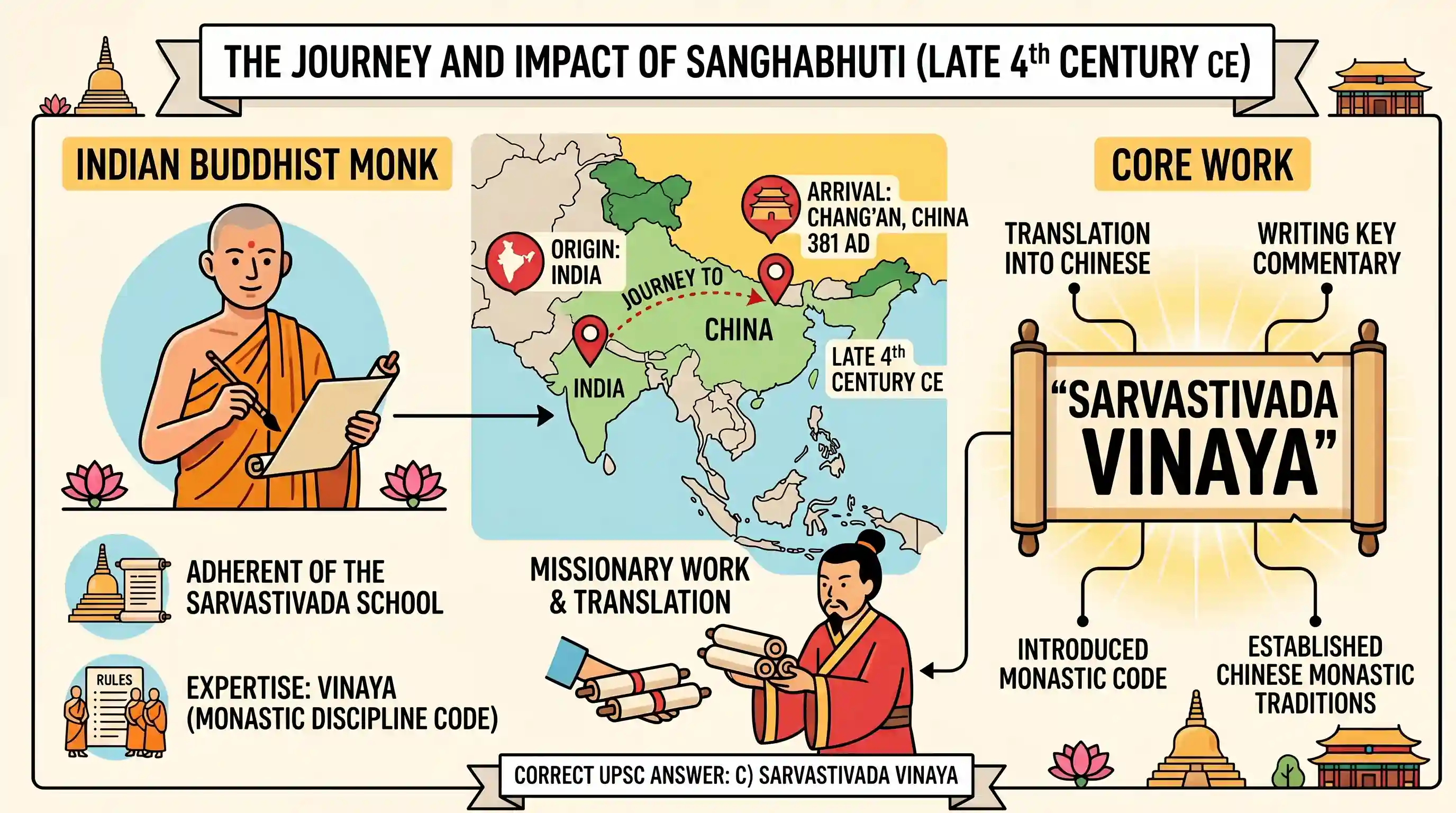
Sanghabhuti (or Saṃghabhūti) was an Indian Sarvastivada monk who traveled to China in the late 4th century CE. He was particularly known for his knowledge of the Sarvastivada Vinaya (the monastic discipline code of the Sarvastivada school of Buddhism). He translated and authored commentaries on parts of the Vinaya texts into Chinese, which was significant for the development of monastic traditions in China. He arrived in Chang'an in 381 AD and helped in the translation of the 'Abhidharmavibhasa Sastra' and composed a commentary on the Sarvastivada Vinaya.
- Prajnaparamita Sutra: A genre of Mahayana Buddhist sutras concerning the perfection of wisdom. Many commentaries exist, but not primarily by Sanghabhuti in this specific context.
- Visuddhimagga: A Theravada Buddhist text, a comprehensive summary of Theravada doctrine and meditation, written by Buddhaghosa in the 5th century CE, much later than Sanghabhuti.
- Lalitavistara: A Mahayana Buddhist text that narrates the life of Gautama Buddha. While important, it's not the primary text Sanghabhuti commented on.
Therefore, Sarvastivada Vinaya is the correct answer.
Related questions
More UPSC Prelims practice from the same subject and topic.
- Prelims 2024GS1history
With reference to ancient India, Gautama Buddha was generally known by which of the following epithets? 1. Nayaputta 2. Shakyamuni 3. Tathagata Select the correct answer using the code given below:
- Prelims 2024GS1history
Consider the following information (Archaeological Site — State — Description): 1. Chandraketugarh — Odisha — Trading port town 2. Inamgaon — Maharashtra — Chalcolithic site 3. Mangadu — Kerala — Mega…
- Prelims 2024GS1history
Who of the following rulers of medieval India gave permission to the Portuguese to build a fort at Bhatkal?
- Prelims 2024GS1history
With reference to revenue collection by Cornwallis, consider the following statements: 1. Under the Ryotwari Settlement of revenue collection, the peasants were exempted from revenue payment in case o…
- Prelims 2024GS1history
Consider the following pairs (Party — Its Leader): 1. Bharatiya Jana Sangh — Dr. Shyama Prasad Mukherjee 2. Socialist Party — C. Rajagopalachari 3. Congress for Democracy — Jagjivan Ram 4. Swatantra P…
- Prelims 2026GS1history
Which of the following pairs of ancient and modern names of rivers is/are correctly matched ? 1. Vitasta : Chenab 2. Asikni : Jhelum 3. Parushni : Ravi 4. Yavyavati : Beas Select the answer using the …